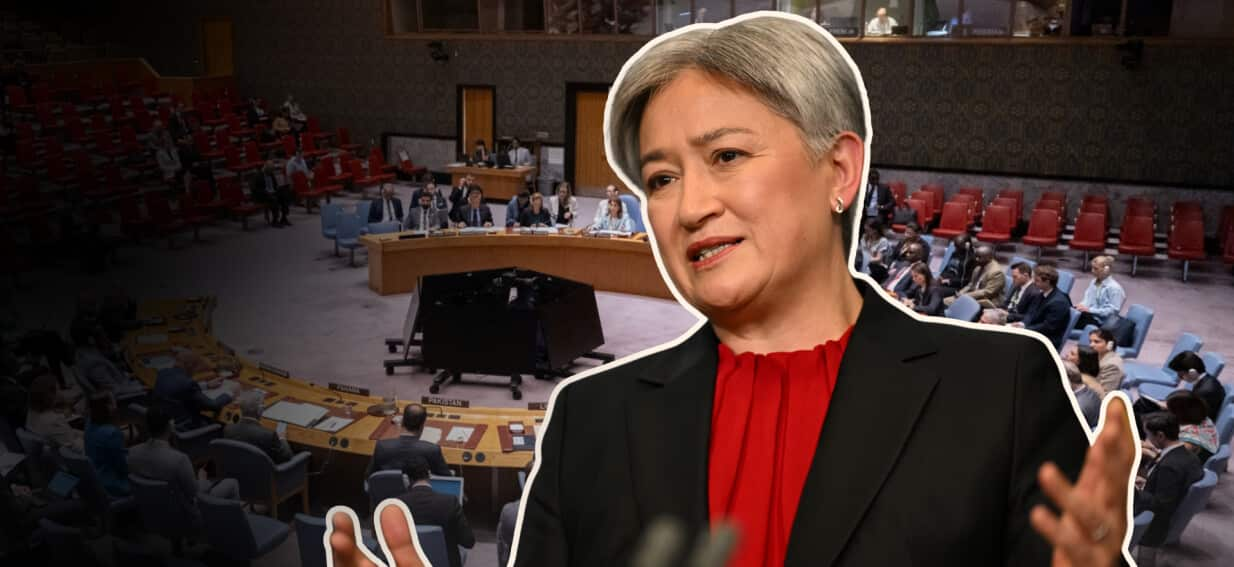
The marble halls of Turtle Bay echo with a peculiar kind of silence. It is not the quiet of a sanctuary, but the tense, heavy stillness of a courtroom waiting for a verdict that has already been written behind closed doors. Here, in the heart of Manhattan, the architecture is grand, the carpets are thick, and the stakes are measured in human breath. Yet, beneath the polished veneer of diplomacy lies a structural fracture nearly eight decades old—a fracture built into the very foundation of the post-World War II order.
Picture a table set in 1945. The smoke of a global conflagration is still clearing. Five victors sit down, carving the map of the future with ink and ambition. They grant themselves a singular, extraordinary instrument: the veto. A single stroke of a pen from Washington, London, Paris, Moscow, or Beijing, and the collective will of the international community freezes in its tracks. No matter how loud the suffering, no matter how clear the evidence of atrocity, one raised hand can silence the entire world.
For decades, this mechanism was defended as a grim necessity. It was the blunt instrument designed to keep the giants from tearing each other apart, the safety valve that supposedly prevented a third world war by ensuring the superpowers always had an exit ramp. But safety valves are meant to release pressure, not trap it indefinitely. Today, that single mechanism has become a monument to paralysis.
Walk into a makeshift clinic in a conflict zone where the medicine has run out because a convoy stalled at a bureaucratic checkpoint three time zones away. Look into the eyes of a mother who no longer asks when the war will end, but only which sky the next shell will fall from. That is where the abstraction of international law meets the concrete reality of human suffering. And somewhere in a carpeted chamber thousands of miles away, a diplomat raises a paddle, and a resolution dies. Not because it lacked merit, but because it bruised an interest.
Australia, a middle power sitting far to the south of these geopolitical epicenters, has spent years staring at this dysfunction with a growing sense of urgency. Canberra’s diplomatic corps has taken up a mantle that many larger nations find inconvenient: the stubborn insistence that rules are not mere suggestions written for the compliant, but the very scaffolding of civilization. When rules bend only for the powerful, they cease to be rules at all. They become privileges.
The push to reform the United Nations Security Council is often framed in the bloodless jargon of institutional restructuring. Pundits talk about regional representation, equitable seating, and bureaucratic efficiency. But beneath the dry memoranda and committee reports beats a raw, moral question: Who speaks for the millions who have no vote?
Consider the arithmetic of the veto. Since the founding of the United Nations, thousands of resolutions have faced the dreaded red card. Each instance represents a moment where collective conscience collided with narrow national self-interest. When mass atrocities unfold—when hospitals are bombed, civilian corridors are shelled, and starvation is weaponized as a tactical strategy—the world often watches through a screen, paralyzed not by a lack of solutions, but by a constitutional veto.
Australia’s argument is deceptively simple, yet radically disruptive to the status quo: power must carry responsibility, and impunity cannot be baked into the charter. Canberra has consistently thrown its weight behind initiatives aimed at restraining the use of the veto in situations involving mass atrocities. The logic is unassailable. If the United Nations was founded to save succeeding generations from the scourge of war, a mechanism that shields perpetrators of mass violence from accountability is an existential betrayal of its founding promise.
Yet, challenging the architecture of the Security Council is akin to trying to remodel a house while standing on its roof. The permanent five members hold the ultimate irony of international politics: any reform of the system requires their consent. Asking a superpower to surrender its veto is like asking an absolute monarch to sign away their crown. They look at you with polite indifference, sip their coffee, and remind you of the delicate balance of global stability.
Stability for whom? That is the question that lingers in the corridors long after the delegates have left for the evening.
History is filled with institutions that mistook longevity for immortality. The League of Nations withered because it lost its moral authority, paralyzed by its own procedural handcuffs while the world marched toward catastrophe. The architects of the United Nations knew this history intimately. They attempted to build a sturdier vessel, one equipped with teeth. But they gave the most ferocious teeth to the very nations most likely to bite.
When Australia steps up to the podium in New York to speak on this issue, it does so not as an empire seeking dominion, but as a nation deeply invested in a rules-based international order. Australia relies on maritime trade routes, regional stability, and predictable legal frameworks to thrive. When those frameworks erode, the shockwaves reach every coastline. A world where might makes right is a terrifying neighborhood for any nation that cannot project military power across oceans.
This is why the campaign for veto restraint matters. It is not just about procedural clean-up or diplomatic score-settling. It is about whether international institutions retain any moral resonance whatsoever. If the United Nations can only act when the interests of five capitals happen to align, then it is not a parliament of nations. It is a gentlemen's club with a global audience.
The resistance to change is fierce, wrapped in the protective armor of sovereignty and realpolitik. Critics argue that tampering with the veto will cause the major powers to walk away, shattering the organization entirely. Better an imperfect forum than no forum at all, the argument goes.
But there is a tipping point where an institution that refuses to change to meet reality becomes an accomplice to the crisis it was designed to prevent. When a child in a war-torn city looks up at the sky, they do not care about the delicate diplomatic equilibrium of the Security Council. They care about protection. They care about justice. They care about whether the world outside sees them as human beings or merely as collateral damage in a diplomatic chess match.
The debate over Australia's push and the broader international movement for veto reform forces a reckoning that cannot be indefinitely postponed. Every time a resolution is blocked to protect an ally or shield a strategic interest, a piece of the architecture cracks. The foundation does not give way all at once. It erodes slowly, silently, through thousands of small compromises with conscience.
What happens when the rules lose their binding force entirely? We do not have to guess. We can read the headlines from any decade of the twentieth or twenty-first century. We can trace the arc from unchecked aggression to widespread devastation. The lesson is as old as human governance: power without accountability is tyranny, whether exercised by a dictator in a bunker or a permanent member in a wood-paneled chamber.
The diplomatic heavyweights will continue their rituals. They will draft compromises that water down the ambitions of reformers. They will issue communiqués that praise cooperation while quietly defending their prerogatives. But the conversation has shifted. The taboo against questioning the sacred geometry of the Security Council has been broken.
And that is where hope begins. Not in the sudden conversion of empires, but in the stubborn, unyielding insistence of middle powers and civil society that the world can be ordered differently. It begins when someone stands up in the middle of a polite, sterile room and points out that the emperor has no clothes—and worse, that the emperor's cloak is woven from the indifference of bystanders.
The path ahead is steep, strewn with bureaucratic resistance and cynical calculations. Yet, the alternative is unthinkable. To accept permanent paralysis is to surrender to a world where might is the only language understood.
As the sun sets over the East River, casting long shadows across the glass facade of the United Nations headquarters, the flags of nearly two hundred nations flutter in the breeze. Most of them belong to countries that have no veto, no permanent seat, and no direct say in whether war visits their homes. They are the silent majority of the globe. Their presence is a reminder that the future of international law does not belong solely to the giants who built the system. It belongs to everyone who has to live in it.
The rules must be upheld, yes. But they must also be rewritten when they protect the powerful at the expense of the vulnerable. Until that day comes, the quiet struggle in the halls of Turtle Bay remains the most important story in the world—a story of whether human conscience can finally outgrow the instruments of power.