The air in Northern Ontario doesn't just smell like smoke in late July. It tastes like wet ash and copper.
Ask any wildland firefighter standing on the edge of a trench at three in the morning. Their lungs burn long before the flames reach the treeline. For them, the disaster isn't a talking point broadcast from a podium in Ottawa or Washington. It is an immediate, suffocating reality.
Yet while crews fight to keep embers from jumping highway barriers, a different kind of fire burns through political newsrooms.
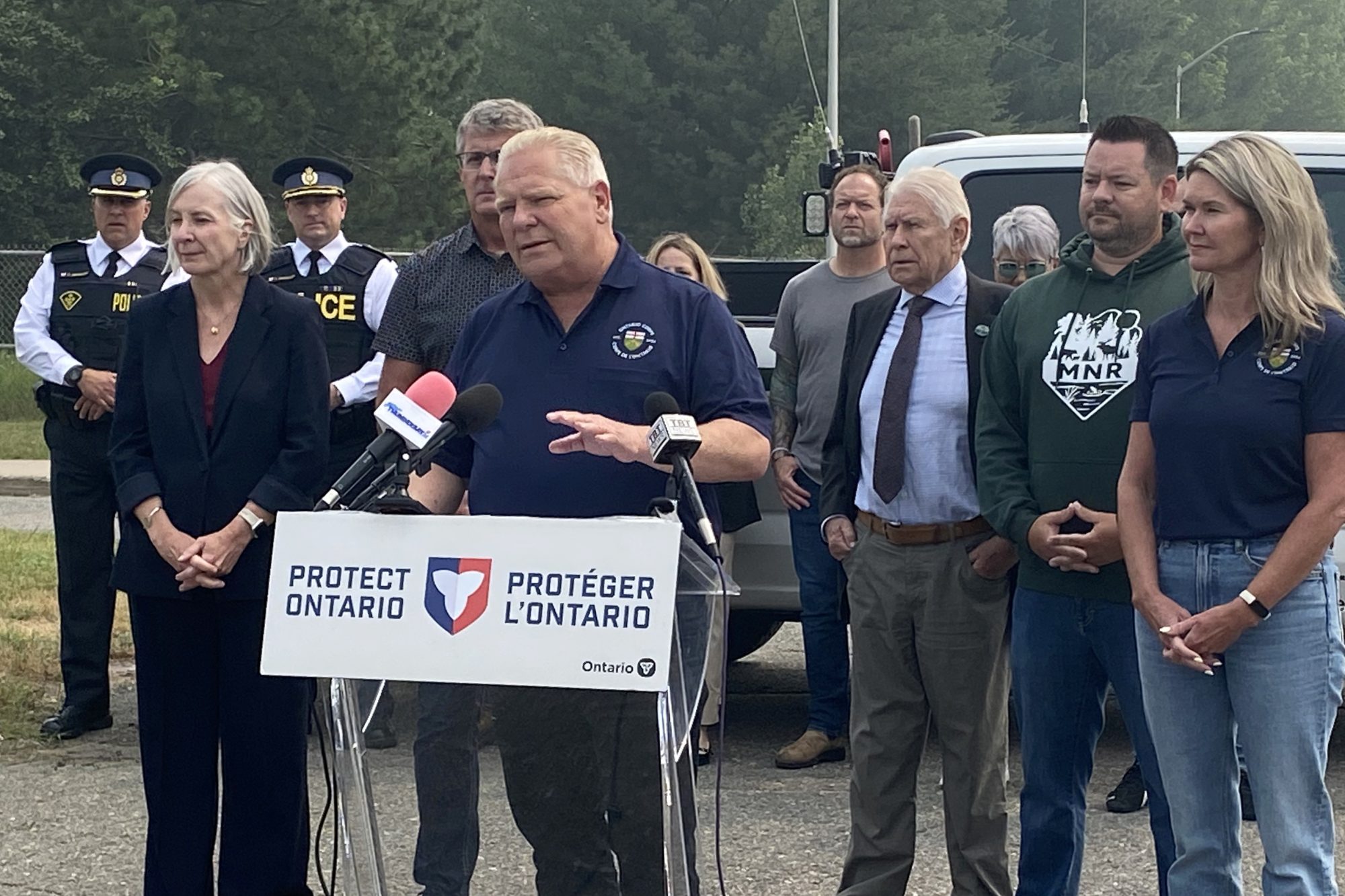
When former Canadian premier Doug Ford publicly rebuked statements made by Donald Trump regarding wildfire management, the headlines framed it as a standard political spat. Conservative leader meets populist icon; harsh words are exchanged; commentators analyze the poll numbers. But viewing this conflict through the lens of partisan posturing misses the real story entirely.
The disagreement wasn't about rhetoric. It was about a fundamental breakdown in how modern nations prepare for natural disasters.
The Myth of the Easy Fix
Disaster response often suffers from the illusion of simplicity.
From a distance, a forest fire looks like a problem with an obvious solution: drop more water, cut down more trees, or simply open a valve somewhere upstream. During his tenure, Donald Trump frequently suggested that devastating fires in the Western United States and Canada were largely the result of poor "forest raking" or a refusal to divert water from Pacific rivers.
To anyone who has ever stood in a dry pine forest during a drought, those suggestions sound like a dispatch from another planet.
Consider a hypothetical scenario to understand the scale. Imagine a single square mile of dense, dry boreal forest. Millions of trees stand packed together, surrounded by decades of fallen needles, dead branches, and dry peat moss stretching four feet underground. When an ignition event occurs—whether from a lightning strike or a discarded cigarette—the fire doesn't just burn on top of the soil. It burns beneath it.
Water dropped from an aircraft evaporates before it even touches the root system. Sweeping the forest floor across millions of acres of unmapped wilderness isn't just impractical; it's physically impossible.
When Doug Ford pushed back against these simplified narratives, he wasn't just defending his administration's record. He was articulating a frustration felt by emergency managers across North America. Fire management cannot be reduced to a soundbite because nature does not negotiate with political slogans.
A Patchwork Strategy in an Era of Megafires
Wildfires do not stop at provincial lines or international borders. Smoke drifted down from Canadian forests to choke major American cities, turning the skies above Manhattan a surreal, apocalyptic orange.
That single event exposed a glaring vulnerability: North America relies on an ad-hoc network of mutual aid agreements rather than a unified, centralized strategy.
Right now, when a massive fire breaks out, response teams rely on local resources first. If those prove insufficient, provincial or state authorities request assistance from neighboring jurisdictions. Equipment gets moved around like pieces on a overcrowded chessboard. Water bombers fly in from neighboring provinces; specialized crews cross the border from the United States, Australia, or South Africa.
It works—until everything burns at once.
When multiple regions face severe fire conditions simultaneously, the mutual aid system hits a wall. There aren't enough specialized air tankers to go around. Smoke jumpers find themselves grounded waiting for logistics clearances. Local fire chiefs are left making impossible choices about which neighborhood to protect and which to abandon to the flames.
Ford’s call for a comprehensive national firefighting strategy was an admission of this structural flaw. The current framework was built for a world where fires were regional and sporadic. We now live in an era of megafires that require military-grade coordination, standardized equipment, and year-round preparation.
The Human Cost of Political Inaction
Behind every policy debate sits a human being paying the price for delay.
Take the story of a volunteer firefighter in a remote town. Let's call him Mark. Mark isn't a career politician or an environmental lobbyist. He runs a local mechanic shop eleven months out of the year. In the twelfth month, he puts on eighty pounds of yellow Nomex gear and steps into a wall of heat to protect his neighbors' homes.
When national leaders bicker over who is to blame for a bad fire season, Mark is watching his department’s budget get stretched thin. He is relying on radio equipment that can't communicate directly with federal aircraft flying overhead. He is watching his crew members suffer from chronic smoke inhalation while waiting for national standards on long-term health tracking for wildland firefighters.
Political delay isn't abstract for Mark. It means working a thirty-hour shift with inadequate gear while public figures debate whether the problem is climate policy or forest maintenance.
The truth is that effective wildfire management requires both. It requires aggressive forest management near populated zones, controlled burns to reduce fuel loads, and significant investment in early-detection technology. But it also requires recognizing that shifting weather patterns are creating longer, hotter, and more volatile fire seasons that no amount of raking can prevent.
The Path Forward Requires Cold Realism
If North America is going to survive the coming decades without losing entire towns to seasonal blazes, the approach to wildland management must change.
First, federal governments must treat wildland firefighting as a core element of national security rather than a seasonal emergency. That means building dedicated, permanent fleets of fire-suppression aircraft rather than relying heavily on aging, leased equipment. It means standardizing training and communication protocols across all jurisdictions so that an engine company from Texas can operate seamlessly alongside a crew from Ontario.
Second, leaders must abandon the temptation to use natural disasters as weapons in culture wars. Pointing fingers across borders or down party lines might generate short-term headlines, but it leaves communities exposed when the wind shifts.
The flames moving through the timber do not check party affiliations before consuming a home. They do not care about borders, headlines, or political posturing.
Late at night, when the wind dies down and the fire drops to a smolder, the forest goes completely quiet. In that silence, the political noise fades away, leaving only the stark reality of what was lost and the terrifying certainty of what will burn next year.