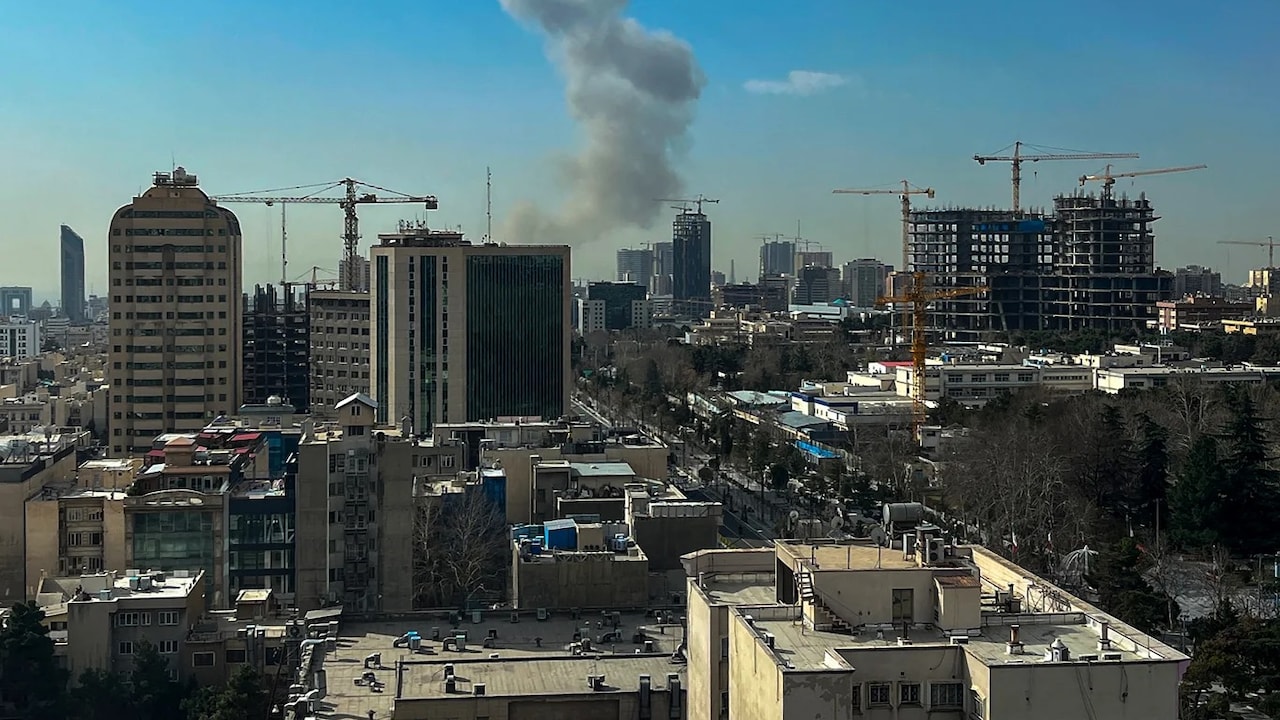
The strategic calculus of American power in the Middle East hinges on a single, sprawling expanse of concrete in the Qatari desert. For decades, Al Udeid Air Base functioned as the nerve center for US Central Command, an ostensibly impregnable fortress capable of projecting overwhelming force from the Levant to the Hindu Kush. That projection of absolute security is over. The reality of regional conflict has exposed a critical vulnerability. Western military infrastructure in the Persian Gulf is no longer an untouchable sanctuary; it is a localized hostage to asymmetric escalation.
When regional tensions boil over into direct kinetic action against forward-deployed US assets, the immediate reaction from conventional analysts is to view the event through a narrow lens of retaliation. This misses the broader structural breakdown. The true crisis is not merely the immediate physical damage of a missile strike, but the functional expiration of Western deterrence in a theater dominated by precision-guided saturation capabilities.
The Myth of the Untouchable Hub
Al Udeid was constructed on an assumption of total air superiority. In the early years of the post-Cold War era, the primary threats to American staging grounds were unconventional sabotage or rudimentary unguided rockets. The base grew to accommodate more than ten thousand personnel and a vast armada of strategic bombers, refueling tankers, and reconnaissance aircraft. It became a centralized hub, a single point of failure masked as a monument of strength.
The proliferation of sophisticated missile technology changed the geography of risk. Iran has systematically built the largest and most diverse missile arsenal in the region, focusing explicitly on overcoming Western air defense systems through volume and velocity. The deployment of solid-fuel ballistic missiles like the Kheibar Shekan, alongside low-flying cruise missiles and loitering munitions, means that a facility as vast as Al Udeid presents an enormous, static target.
Air defense is a game of probability. Even the most advanced surface-to-air systems face a mathematical breaking point when subjected to a coordinated, multi-axis assault. A saturation attack utilizes cheap, slow-moving drones to force defensive batteries to deplete their interceptors, clearing a path for high-velocity ballistic missiles to strike high-value assets. When a strike occurs, it proves that the cost-exchange ratio has permanently shifted against the defender. An interceptor missile costs millions of dollars. The drone it destroys costs a fraction of that amount.
Qatar Tightrope Act Between Washington and Tehran
The political geography of Al Udeid introduces complications that military planners rarely discuss openly. Qatar occupies a precarious diplomatic position, balancing its status as a Major Non-NATO Ally to the United States with its shared economic interests alongside Iran. The two nations share ownership of the North Dome-South Pars field, the largest natural gas reservoir in the world. This economic reality dictates Doha's foreign policy.
Doha has consistently sought to position itself as a neutral intermediary, hosting political offices for various regional factions while simultaneously providing the United States with its most critical operational footprint in the region. This dualism works during peacetime. During an active conflict, the strategy unravels completely.
Tehran has long warned Gulf states that allowing their territory to be used as a launchpad for offensive actions against Iranian interests would render those host nations legitimate targets. If the United States utilizes assets stationed within Qatar to conduct operations against Iranian assets, Qatar becomes an involuntary participant in the conflict. This puts Doha in an impossible position, caught between its security guarantor and its powerful neighbor. The vulnerability of the base is therefore as much political as it is physical.
The Integrated Air Defense Illusion
For years, Washington has pushed for the creation of an integrated air and missile defense network among the Gulf Cooperation Council states. The objective was to link radar systems, early warning sensors, and defensive batteries from Kuwait to Oman into a unified grid capable of tracking and neutralizing incoming threats collectively.
This network exists largely on paper. Political distrust, sovereign sensitivities, and competing procurement strategies have prevented true integration. Individual states remain reluctant to share real-time radar data with their neighbors. Consequently, defenses remain balkanized, consisting of isolated pockets of capability rather than a continuous shield.
Tactical Realities of Saturation
A closer inspection of defensive architecture reveals systemic limitations.
- Radar Horizon Limitations: Low-flying cruise missiles exploit terrain masking and follow trajectories that remain below conventional radar horizons until the final moments of flight.
- Interceptor Depletion: Defensive batteries carry a finite number of ready-to-fire missiles, and reloading these systems during an active engagement is a protracted, dangerous process.
- Geographic Proximity: The narrow waters of the Persian Gulf offer exceptionally short flight times, leaving command systems with mere minutes to identify, track, and authorize an interception.
These technical realities mean that no amount of defensive deployment can guarantee absolute protection for a target as large as Al Udeid. When an adversarial force decides to penetrate these defenses, they do so by exploiting the inherent math of saturation warfare.
Shifting the Balance of Regional Leverage
The wider implication of this vulnerability extends far beyond the borders of Qatar. If Al Udeid can be targeted or held at bay through the threat of kinetic destruction, the entire American security architecture in the region requires a fundamental recalculation.
Power projection relies on the certainty of logistical lines. If transport aircraft, refueling wings, and command nodes are forced to operate under the constant threat of missile inundation, the operational tempo of the entire theater slows down dramatically. The United States is faced with a difficult choice: either accept the heightened risk of keeping its primary assets within range of regional strike systems, or incur the massive logistical burden of dispersing its forces to more distant, less optimal facilities outside the immediate Gulf zone.
Dispersal sounds like a simple solution, but the infrastructure required to support heavy bombers and complex aerial operations cannot be built overnight elsewhere. The alternatives, such as facilities in Jordan or Oman, present their own distinct geopolitical and logistical hurdles. The era of relying on centralized, mega-bases in the Gulf is drawing to a close, forced out by the harsh reality of modern precision weaponry. Washington must now adapt to a reality where its presence is actively contested, and its primary hubs are treated as liabilities rather than assets.