We have spent decades trying to make light go faster, forgetting that its greatest trick might be learning how to stop.
Light is the Usain Bolt of the universe. It sprints through standard silica glass at roughly two hundred thousand kilometers per second, carrying vast oceans of data across continents in the blink of an eye. But speed has a bitter cost. When you want to process information—when you want a computer system to actually think, pause, store, and weigh options rather than just pipe data blindly from point A to point B—light is entirely too fast and too slippery. It refuses to wait. It refuses to hold still.
For years, physicists working at the intersection of optics and acoustics have stared at this problem with a quiet frustration. They knew about a strange physical quirk called Brillouin-Mandelstam scattering. In ordinary terms, it is the invisible friction that happens when light bumps into sound waves vibrating through a material. Light presses on the medium through a phenomenon called electrostriction, creating microscopic density fluctuations that scatter the beam. But in a standard, solid glass fiber, light and sound are like two strangers passing on a crowded subway platform. They barely acknowledge each other. The interaction is so weak, so stubbornly faint, that you need miles of fiber and heavy machinery just to catch a whisper of a coupling.
Then a collaborative team spanning the Max Planck Institute for the Science of Light in Erlangen, Leibniz University Hannover, and the Leibniz Institute for Photonic Technologies in Jena decided to change the state of matter itself.
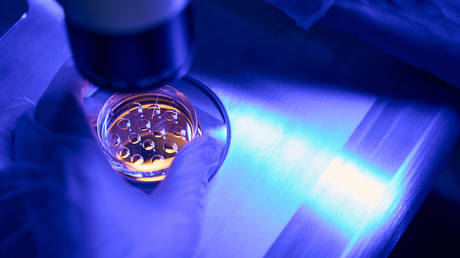
Imagine standing in a laboratory chilled by liquid nitrogen, watching a hair-thin glass capillary tube drop to minus one hundred and ninety-six degrees Celsius. Inside that microscopic glass vein is not solid silica, but a liquid core—specifically, carbon disulfide. As the temperature plummets, the liquid transforms, solidifying into a dense crystal structure.
Common intuition suggests that freezing the core of an optical fiber should ruin it. Glass shatters, light scatters, and the delicate waveguiding properties ought to collapse into a useless blur.
That intuition is entirely wrong.
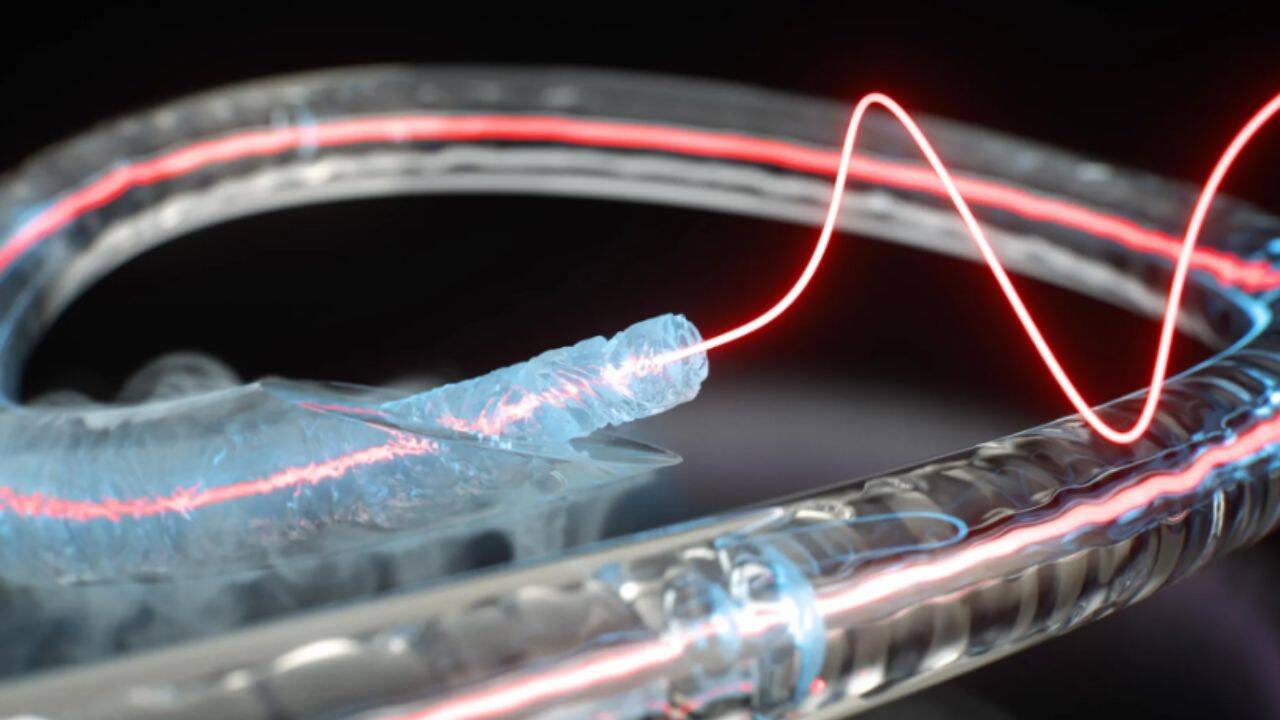
The frozen core continues to guide light with startling clarity. More importantly, it successfully guides hypersonic sound waves. But the true magic happens at the molecular boundary where the two phenomena meet. By locking the liquid into a frozen state, the researchers created an exceptionally dense, tightly confined environment. Under these extreme cryogenic conditions, the interaction between light and sound explodes. It does not merely improve by a marginal fraction. It becomes more than one thousand times stronger than it is in standard, room-temperature optical fibers.
Suddenly, the strangers on the subway are locked in a deep conversation.
To understand why this matters, you have to look at the tyranny of modern computing architecture. Electronics generate immense heat because electrons constantly slam into atomic lattice structures, bleeding energy as thermal waste. Photonic computing—routing data using light instead of electricity—promises a cooler, faster future, but it has always lacked a practical memory element. Light cannot be easily stored in a small space without looping it endlessly through giant reels of fiber optic cable.
The frozen liquid-core fiber solves this by doing something radical. It translates light into sound.
Because sound waves travel at a glacial pace compared to photons—slowing down by a factor of hundreds of thousands—they act as a natural parking brake. When a rapid pulse of light enters the frozen fiber, it transfers its information payload directly into a much slower acoustic phonon. The data is temporarily caught, held frozen in a mechanical vibration within the solid core, and then converted back into light on command.
The team successfully demonstrated this as a functional optoacoustic memory. They achieved a massive Brillouin gain using sub-nanojoule energy levels, requiring a fraction of the power needed by previous experimental setups.
Consider what this unlocks for the architecture of tomorrow. We are moving toward an era where neuromorphic computing systems—computer chips designed to mimic the neural networks of the human brain—will require ultra-low-energy components to handle the staggering cognitive loads of artificial intelligence. By creating a high-efficiency memory buffer that operates entirely via light and sound coupling, physicists have built a vital bridge between optical communication and physical computation.
We are no longer just piping light from one dark box to another. We are teaching it how to listen, how to pause, and how to remember.
The cold glass holds its breath, waiting for the next pulse to arrive.