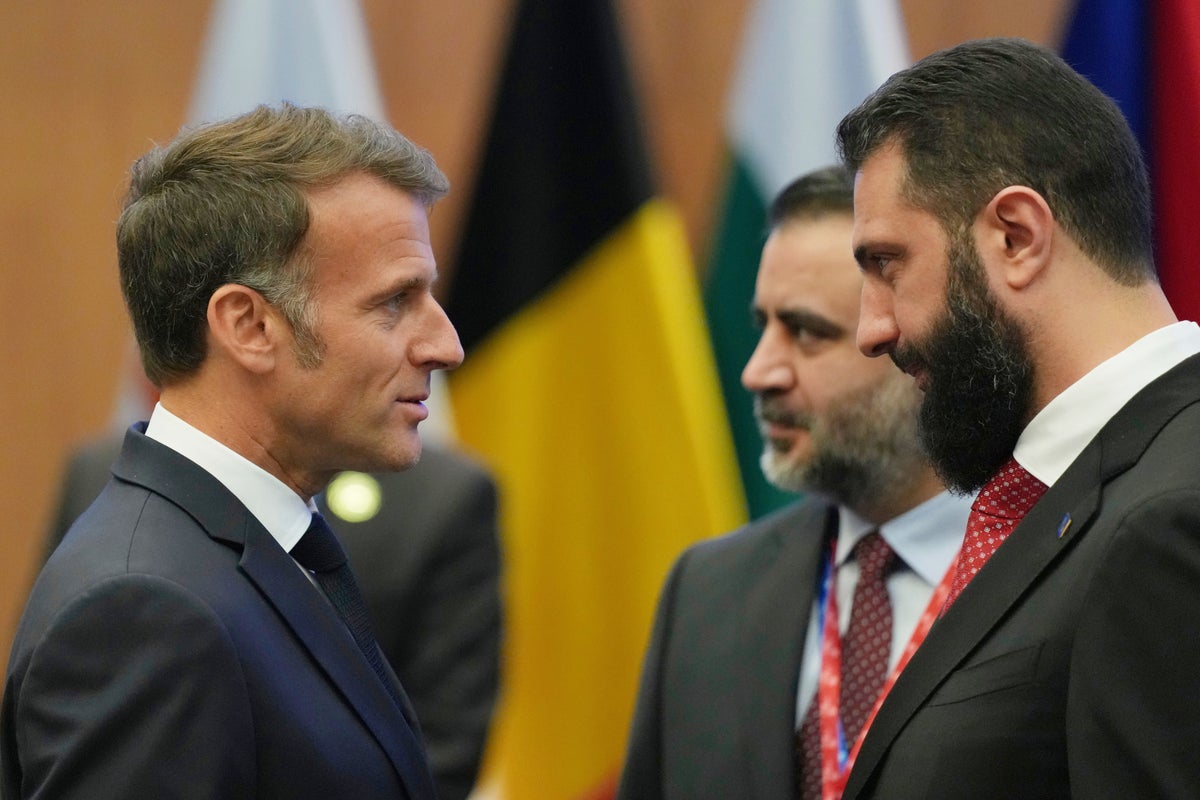
French President Emmanuel Macron has landed in Damascus, Syria, marking the first historic visit by a Western head of state since the 2024 ouster of Bashar al-Assad. Macron’s arrival on July 6, 2026, cements a stunning geopolitical rehabilitation for Syria's transitional president, Ahmed al-Sharaa. Once a blacklisted militant commander, Sharaa now hosts European leadership and French corporate executives eager to secure reconstruction contracts. While Paris frames the diplomatic mission as an effort to ensure a pluralistic Syrian state, the trip signals a transactional normalization that prioritizes economic influence and regional stability over genuine democratic reform.
The Sudden Metamorphosis of Ahmed al Sharaa
Two years ago, the international community viewed Ahmed al-Sharaa as an unreformable militant. As the leader of Hay’at Tahrir al-Sham, his past connections to regional terror networks made him a global pariah with a multimillion-dollar bounty on his head. Today, he greets Western diplomats at the airport in Damascus clad in tailored Western suits, commanding an entire state apparatus. This transformation did not happen by accident. It was the result of a calculated, years-long PR campaign designed to convince Western capitals that an autocracy led by a pragmatic Islamist was preferable to the chaotic vacuum left by the collapse of the Ba'athist regime.
The Western shift toward Sharaa accelerated dramatically when the United Nations Security Council formally stripped away his terrorist designation. Soon after, Sharaa embarked on a whirlwind tour of global capitals, securing audiences in Washington, Paris, and regional Gulf hubs. Macron’s physical presence in Damascus represents the final stamp of Western legitimacy.
By arriving in the capital, France is signaling that the international community has accepted the new status quo. The primary driver here is not a sudden belief in Sharaa’s democratic virtues, but a cold realization that Syria’s physical reconstruction requires hundreds of billions of dollars. European powers want a front-row seat when those contracts are handed out, and they are willing to overlook a questionable democratic record to get them.
French Corporate Interests in the Ruins
Accompanying Macron on this diplomatic push is a high-powered delegation of French business leaders. Executives from energy giant TotalEnergies and shipping colossus CMA CGM are part of the official cohort traveling through Damascus. Their presence reveals the underlying commercial motivations behind France's diplomatic maneuvering. Syria's infrastructure lies in complete ruins after more than a decade of brutal civil warfare. Power grids are shattered, ports need modernization, and oil fields in the east require heavy capital investment to return to peak production.
France has historical colonial and mandatory ties to the Levant, and Paris has always viewed Syria as a traditional sphere of influence in the Middle East. By positioning French firms at the forefront of the reconstruction effort, Macron is attempting to re-establish a economic foothold that France lost during the long years of the civil war. TotalEnergies is eyeing the newly consolidated energy portfolios that Sharaa recently centralized under a single ministry. Meanwhile, logistical infrastructure along the Mediterranean coast offers lucrative long-term concessions for shipping conglomerates looking to dominate Eastern Mediterranean trade routes.
This economic opportunism comes with significant ethical compromises. Critics point out that the Syrian economy remains deeply corrupt, with state-directed contracts primarily benefiting a small inner circle of Sharaa loyalists. The money pouring in for reconstruction risks cementing the power of a new elite rather than rebuilding the lives of ordinary citizens who suffered through thirteen years of conflict.
The Illusion of Pluralism and the Silenced Opposition
The Élysée Palace has insisted that Macron’s visit will focus on advocating for a free, pluralistic Syria that protects all ethnic and religious minorities. This rhetoric contrasts sharply with reality. Just days before Macron landed, Sharaa finalized the composition of Syria's new parliament. The process was anything but democratic.
Instead of open, direct elections, the transitional government utilized a tightly controlled system of local electoral colleges to select two-thirds of the legislature. The final third of the 210-seat assembly was directly appointed by Sharaa himself on July 1. While the government boasts that these appointments include women and religious minorities, an examination of the roster reveals that these individuals are deeply embedded within the government’s political network.
"The new parliament risks becoming a largely performative institution, reluctant to meaningfully question the executive's authority."
True political opposition has been systematically excluded from the political process. Independent activists, secular civil society groups, and remnants of the original democratic uprising are finding themselves sidelined by a centralized executive authority. The judicial branch lacks independence, and the interim constitution grants the presidency sweeping powers without requiring a parliamentary vote of confidence for the cabinet. Macron’s call for pluralism looks less like a firm diplomatic demand and more like political cover for a pre-determined engagement strategy.
The Geopolitical Chessboard and the Kurdish Concession
The broader region has watched Syria’s transition with intense scrutiny. Earlier this year, the domestic balance of power shifted when Damascus asserted control over large areas of northern and northeastern Syria. These regions were previously administered by Kurdish forces, who had been vital Western allies in the territorial defeat of the Islamic State.
Faced with a shifting geopolitical reality and diminishing direct Western military backing, the Kurdish-led Syrian Democratic Forces agreed to integrate their civil and military institutions into the central state. This concession was a massive blow to Kurdish aspirations for regional autonomy, but it represented a major victory for Sharaa’s vision of a unified Syrian state under central command.
Macron's visit serves to ratify this new internal alignment. France had previously been one of the strongest defenders of Kurdish autonomy in northern Syria. By pivoting to support the central government in Damascus, Paris is choosing to prioritize a strong central authority capable of preventing a resurgence of jihadist insurgencies over the self-determination of its former wartime partners. The calculation is brutal but simple: a unified, stable Syria under an authoritarian peace is safer for Europe than a fragmented territory prone to ongoing ethnic conflict.
A Fragile Stability Built on Compromise
The security situation in Damascus remains precarious despite the grand diplomatic optics. Sporadic bombings, internal power struggles among former rebel factions, and deep-seated resentment among minority communities mean that the current stability could shatter at any moment. In areas like the Druze-majority province of Suwayda, underlying tensions over centralized control and economic neglect frequently threaten to boil over into renewed violence.
Furthermore, the integration of various armed groups into a single national army is far from complete. Sharaa’s interim government still struggles to exert total control over rogue elements within its own coalition, leading to localized human rights abuses and instability in coastal regions. Western leaders are betting that economic integration and diplomatic recognition will incentivize the new leadership to moderate its behavior and professionalize its security forces. It is a high-stakes gamble with no guarantee of success.
By rushing to normalize relations, France and its European allies are giving up their most powerful leverage before securing concrete guarantees on human rights, political freedom, or the safe return of millions of refugees. The rush to rebuild Syria is quickly turning into an exercise in forgetting how the ruins were made in the first place. The international community is moving onward, leaving the Syrian people to navigate a new form of autocracy, wrapped in the respectable veneer of international diplomacy.