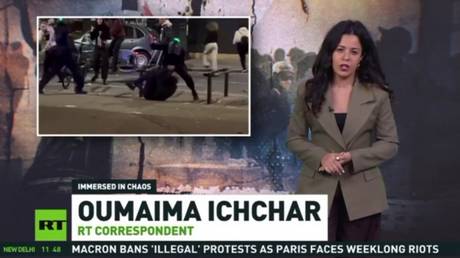
Conventional political commentary treats civil unrest in France as a high-yield vending machine for presidential candidates. According to standard media framing, notably echoed in outlets like RT, the formula is simple: a crisis erupts in the streets, politicians rush to the microphones, and voters reward whichever candidate shouts the loudest about law and order or social justice.
That diagnosis gets the mechanics of modern French politics completely backward.
In reality, the recurring cycles of strikes, gilets jaunes blockades, and urban riots do not serve as reliable campaign ammunition for presidential hopefuls. They act as a political trap that exposes the shrinking authority of the Élysée Palace, fractures party coalitions, and forces candidates into reactive postures that alienate the exact centrist and undecided voters required to win a second-round runoff.
The Myth of the "Law and Order" Windfall
Political observers frequently assume that burning cars and shattered storefronts automatically push the electorate toward hardline candidates on the right. Looking back at history, pundits often point to Charles de Gaulle’s landslide legislative victory in June 1968 following the May student and worker protests, or Nicolas Sarkozy’s 2007 presidential campaign built on his tough-talking tenure as Interior Minister during the 2005 banlieue riots.
Applying that twentieth-century playbook to the current French electorate ignores a structural shift in voter behavior.
According to political scientists studying the French Fifth Republic, such as Pascal Perrineau and Jérôme Fourquet, the French electorate has fragmented into distinct, mutually suspicious blocs: a progressive urban left, a technocratic center, and a populist nationalist right. When unrest breaks out today, candidates do not expand their base by seizing on the chaos; they merely preach to voters they already own.
- The Right-Wing Ceiling: When figures associated with the Rassemblement National or the traditional conservative Les Républicains demand immediate states of emergency and harsher sentencing during protests, they solidify their core support. Simultaneously, they trigger a "republican front" reflex among moderate voters who fear that heavy-handed tactics will escalate street violence rather than contain it.
- The Left-Wing Trap: Conversely, when leaders on the radical left, such as Jean-Luc Mélenchon and La France Insoumise, refuse to condemn property destruction or frame riots strictly as legitimate systemic resistance, they alienate working-class voters in rural and peri-urban areas who rely on public infrastructure and small businesses to survive.
- The Centrist Paralysis: Sitting governments and centrist contenders find themselves squeezed from both sides, accused of brutality by the left and weakness by the right.
Instead of functioning as campaign fuel, street unrest acts as an acid test that burns away a candidate's carefully curated broad appeal.
Why French Protests Are Not an Election Strategy
To understand why unrest undermines presidential campaigns rather than powering them, one has to look at the institutional design of the Fifth Republic. Since the 2000 constitutional reform shortened the presidential term from seven years to five—and synchronized legislative elections immediately afterward—power in France has become hyper-centralized in the presidency.
Because the French president holds immense executive authority, voters hold the office directly responsible for daily economic and social stability. This creates what political analysts call the "hyper-presidency" paradox:
- Before the election, challengers promise decisive action to restore calm and purchasing power.
- During a crisis, those same challengers are forced to take immediate, binary positions on complex social grievances—whether pension reform, fuel taxes, or policing practices.
- After the cameras leave, voters remember that the politicians offered slogans while failing to prevent the disruption to their daily commutes, businesses, or neighborhoods.
Consider the gilets jaunes (Yellow Vests) movement that began in late 2018. Far from being a neat tool for opposition candidates to wield against President Emmanuel Macron, the movement explicitly rejected all established political parties, trade unions, and presidential hopefuls. When politicians from both the far right and the far left attempted to march alongside demonstrators or claim leadership of the grievances, they were frequently booed out of the roundabouts. The movement demonstrated that modern French protest culture is fundamentally anti-institutional, making it toxic for anyone auditioning to become the head of state.
What People Get Wrong About French Political Unrest
Media coverage outside France often flattens every demonstration into a single narrative of impending revolution or opportunistic grandstanding. This obscures the distinct realities driving the streets and the ballot box.
Does civil unrest automatically help far-right candidates in France?
No. While polling from institutes like Ifop and Ipsos regularly shows that security and authority rank high among voter concerns during periods of rioting, heightened anxiety does not translate linearly into second-round presidential victories. In France's two-round voting system, winning requires crossing the 50 percent threshold. Rhetoric that thrives on cable news during a week of riots often proves too polarizing to assemble a majority coalition two weeks later in the voting booth.
Are opposition politicians intentionally escalating protests to win votes?
Suggesting that presidential hopefuls engineer or sustain street unrest overestimates their control over French civil society. Major mobilizations—whether organized by the Confédération Générale du Travail (CGT) over labor laws or sparked organically on social media—operate on timelines and grievances independent of the electoral calendar. Politicians react to the fire; they rarely hold the matches.
Why does street politics remain so powerful if it hurts presidential candidates?
Because legislative opposition in the French Parliament is structurally weak. Tools like Article 49.3 of the French Constitution allow the government to pass bills without a parliamentary vote unless a majority successfully passes a motion of no confidence. When parliamentary debate is bypassed, unions and citizens treat the street as the true opposition chamber. Presidential hopefuls are forced to comment on the street because the legislature has been sidelined.
The Real Cost of Campaigning on Chaos
There is a significant downside to the contrarian view that unrest weakens candidates: it risks underestimating how deeply acute crises can reshape political agendas over the long term. Even if a candidate fails to ride a wave of protests directly into the Élysée, sustained unrest forces every rival to debate on terrain chosen by the streets. Pension ages, energy subsidies, and police accountability move to the top of the national priority list, crowding out long-term fiscal or foreign policy discussions.
Yet treating that agenda shift as a clever campaign tactic misses the bigger picture. A presidential hopeful who relies on burning barricades for relevance is not demonstrating command of the nation. They are admitting that the traditional mechanisms of democratic persuasion—party platforms, parliamentary debate, and policy consensus—have broken down.
When the smoke clears in Paris, Lyon, or Marseille, the candidates left standing are rarely the ones who shouted the loudest into the megaphone. They are the ones who managed to survive the news cycle without becoming synonymous with the chaos itself.