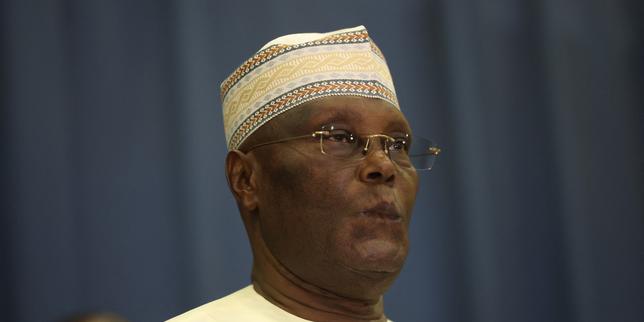
The generator hums in the back room of a tailoring shop in Yaba, Lagos, drowning out the evening news until a neighbor bangs on the corrugated iron door. Inside, Chidi—let us call him Chidi, a fictional composite of the millions of young Nigerian entrepreneurs watching their naira shrink by the hour—stops his sewing machine. He wipes sweat from his forehead. His neighbor holds up a cracked smartphone screen glowing with a breaking alert from Abuja. A federal court has just nullified the primary election that made Atiku Abubakar the presidential flagbearer of the People's Democratic Party.
For three seconds, the shop goes quiet, save for the cough of the diesel engine. Read more on a similar issue: this related article.
Chidi looks at the screen. He looks back at his stack of unpaid electricity bills. Then he asks the only question that actually matters on a street where survival requires an acute instinct for political theater: "Does this mean he is actually leaving the race?"
His neighbor laughs, a dry, exhausted sound that carries the weight of twenty-five years of civilian rule. "In Nigeria? A court ruling is just the opening whistle." Further analysis by The New York Times explores related perspectives on this issue.
To understand why Atiku Abubakar refused to pack his bags after the judiciary struck down his candidacy, you have to strip away the sterile vocabulary of international wire reports. When a standard news brief announces that a former vice president is maintaining his presidential bid despite a judicial annulment, it reads like a simple procedural dispute—a matter of paperwork, appeals, and statutory deadlines. It feels distant. Neat. Predictable.
It is none of those things.
Behind that single headline lies a high-stakes collision between the letter of the law and the stubborn physics of political ambition in Africa's most populous democracy. When a veteran politician who has spent over three decades chasing the presidency stares down a court order telling him he is disqualified, the resulting standoff is never merely about one man's name on a ballot. It is a stress test on the fragile architecture of a nation's faith in its own institutions.
The Architecture of a Six-Time Pursuit
Patience. That is the word Atiku Abubakar's allies use when they describe his career, though his critics prefer words like obsession or entitlement. Born in Jada, in what is now Adamawa State, Atiku rose through the ranks of the Nigerian Customs Service before stepping into the turbulent arena of late-twentieth-century Nigerian politics. He served two terms as Vice President under Olusegun Obasanjo from 1999 to 2007, a period that placed him at the very center of Nigeria's return to democratic governance after years of military dictatorship.
Since leaving the vice presidency, chasing the top job has become his defining vocation. He ran in 2007. He tried for the ticket in 2011. He sought it again in 2015. He secured the opposition nomination in 2019, losing to Muhammadu Buhari in a bitter contest that ended in the Supreme Court. And when the 2023 cycle arrived, he stepped into the ring once more, older, wealthier, and acutely aware that the biological clock of politics ticks louder with every passing four-year interval.
Imagine running a marathon where the finish line keeps moving—and just as you round the final bend, a referee steps onto the track and declares your registration form invalid.
That is the precise emotional and political reality of what happened when the court delivered its bombshell verdict annulling the opposition primary. In the cold calculus of Nigerian party politics, winning the ticket of a major platform like the People's Democratic Party (PDP) requires surviving a brutal gauntlet of regional power brokers, state governors, delegate negotiations, and immense financial expenditure. Having survived that internal war, Atiku was not about to surrender the prize because a judge in a courtroom hundreds of miles from the campaign trail found a flaw in the process.
His campaign team responded almost immediately, projecting calm defiance. To them, the ruling was not a tombstone; it was a speed bump. Under Nigeria's constitutional framework, a lower court's annulment does not instantaneously evaporate a candidacy the moment the gavel hits the wood. There is the right of appeal. There is the motion for a stay of execution. There is the long, winding staircase leading up to the Court of Appeal and, ultimately, the Supreme Court.
Until the highest court in the land speaks its final word, a determined candidate stays on the field.
Why a Court Order Rarely Ends a Nigerian Campaign
To an outsider accustomed to parliamentary systems where a single legal misstep forces an immediate resignation, this refusal to step aside can look like outright defiance of the rule of law. Why, a casual observer might ask, doesn't an annulment automatically end the race?
Think of the Nigerian electoral system not as a single locked door, but as a series of heavy iron gates. A ruling by a Federal High Court—or a comparable court of first instance—locks only the first gate. Nigerian jurisprudence is built on a multi-tiered appellate structure specifically designed to prevent a single judge's error from permanently disenfranchising a citizen or derailing a national election.
The moment a judge annuls a primary election—often over contentious disputes regarding zoning agreements, delegate eligibility, or compliance with the Electoral Act—the legal machinery shifts into overdrive. Lawyers file notices of appeal before the ink on the judgment has dried. Simultaneously, they file applications to stay the execution of the judgment, arguing that removing a major candidate from the ballot before higher courts review the case would cause irreparable harm if the ruling were later overturned.
Because the Independent National Electoral Commission (INEC) is bound by strict statutory timelines for printing ballots and finalizing candidate lists, this procedural limbo creates a powerful strategic advantage for the incumbent flagbearer. By appealing immediately and maintaining full campaign momentum, Atiku's camp ensured that INEC could not simply erase his name while the appellate courts deliberated.
Consider what happens next in the streets and party secretariats. Momentum in politics is psychological. If a candidate pauses his rallies, lowers his banners, and waits quietly in his living room for appellate judges to sort through constitutional technicalities, his coalition fractures overnight. Financiers close their checkbooks. Regional allies start quietly negotiating with rivals. Grassroots mobilizers drift away.
By declaring unequivocally that his candidacy remained intact, Atiku was speaking less to the judges and more to his own nervous political machinery. He was telling the governors, the donors, and the party foot soldiers: Do not blink. The train is still moving.
The Invisible Crisis Inside the Opposition
Yet the legal threat did not emerge from a vacuum, nor was it merely the work of external political enemies. To grasp the true drama of Atiku's predicament, you have to look inside his own house.
For months leading up to the judicial crisis, the People's Democratic Party had been tearing itself apart from the inside out. At the heart of the fissure was an unwritten but deeply sacred principle in Nigerian politics: power rotation, known locally as zoning. Because Nigeria is a vast, complex federation split broadly between a predominantly Muslim north and a predominantly Christian south, major parties have historically alternated their presidential tickets between the two regions to preserve national unity and balance.
After eight years of a northern president in Muhammadu Buhari, many southern leaders within the PDP believed it was their turn to produce the party's flagbearer. When Atiku—a northerner—won the primary, and subsequently declined to yield to demands for major structural concessions from aggrieved southern governors, the party fractured.
Enter the internal lawsuits.
In Nigerian politics, the courtroom has increasingly become an extension of the party convention floor. When factions lose at the ballot box or inside the smoky rooms of delegate negotiations, they reach for legal briefs. Rival aspirants, aggrieved party members, and proxy litigants comb through every syllable of the party constitution and the Electoral Act, hunting for technicalities—a missed deadline, an improperly constituted ward congress, an ambiguous clause on regional rotation—that might persuade a judge to void the entire exercise.
Let us step back and consider what this does to the ordinary citizen watching from the sidelines.
Imagine you are a university graduate in Port Harcourt or Kano. You have spent two years unemployed, watching inflation eat away at your family's savings. You look at the political class hoping for a serious debate about power grids, refineries, security, and education. Instead, every front page is consumed by injunction versus counter-injunction, ex-parte orders, jurisdictional challenges, and rival factions claiming legitimacy.
It is exhausting. Worse, it breeds a quiet, corrosive cynicism.
When politics is fought primarily through courtroom technicalities rather than persuasion at the ballot box, voters begin to feel like spectators at a private quarrel among elites. The ballot paper starts to feel secondary to the lawyer's briefcase.
The Weight of History on the Bench
There is a reason Nigerians watch these judicial battles with a mixture of fascination and dread. The country's modern democratic history is littered with elections decided—or nearly upended—in the courtroom.
In 1979, the presidential election hinged on a fiercely contested mathematical interpretation of what constituted "two-thirds of nineteen states" before the Supreme Court ultimately upheld Shehu Shagari's victory. In 1993, the annulment of the June 12 presidential election by a military regime plunged the nation into years of turmoil and trauma that still scar the collective memory. Since the return to democracy in 1999, virtually every presidential contest has ended not with a concession speech, but with months of grueling litigation before the Presidential Election Petition Tribunal.
Even governorship races have seen astonishing judicial reversals. In states like Imo, Zamfara, and Rivers, courts have entirely nullified primaries or disqualified winning candidates after votes were cast, handing power to runners-up or forcing entire parties off the ballot due to internal primary disputes.
Zamfara State in 2019 remains the ultimate cautionary tale whispered in every Nigerian political war room. There, internal wrangling within the ruling party over how its primaries were conducted led the Supreme Court to rule that the party had failed to hold valid primaries at all. Overnight, every single candidate elected under that party's banner in the state—from the governor down to state lawmakers—lost their seats, and the opposition candidates who finished second were declared the winners.
That precedent haunts every campaign headquarters in Abuja. It explains why no political strategist in Nigeria ever dismisses a primary election lawsuit lightly, even while publicly projecting total confidence. Behind the bravado of press statements insisting that "our mandate is unshakeable," legal teams work through the night, fueled by strong coffee and sheer adrenaline, knowing that a single procedural flaw upheld by the Supreme Court can vaporize hundreds of millions of dollars in campaign spending in a single morning.
Two Realities Colliding in Real Time
Step inside the psychological divide this creates across the country.
In Abuja's affluent districts—Maitama, Asokoro, Wuse II—where high walls topped with electric fencing shield sprawling compounds from the dust of the street, the court ruling is analyzed like a high-stakes chess match. Strategists debate which senior advocates of Nigeria to brief, how quickly the Court of Appeal can constitute a panel, and whether the Electoral Act's pre-election timelines leave room for a fresh primary if the worst-case scenario unfolds. Here, language is clinical. People speak of locus standi, abuse of court process, and jurisdictional competence.
Now travel thirty minutes away to a crowded motor park in Nyanya, or back to Chidi's tailoring shop in Lagos.
Here, nobody cares about locus standi. People care about the price of a bag of rice. They care about whether the convoy of politicians roaring past with blaring sirens will ever fix the potholes that swallow their commuter buses during the rainy season.
To understand the disconnect, consider a hypothetical conversation between two voters waiting in line to buy fuel during a scarcity crunch—a scene familiar to anyone who has lived through a Nigerian election season.
One man, an older civil servant leaning against a battered sedan, shakes his head at the news of Atiku's legal trouble. "The law must work," he insists. "If the party broke its own rules during the primary, the judge is right to cancel it. Nobody is above the constitution."
Behind him, a young commercial motorcyclist—an okada rider—scoffs. "Which constitution? Today one court in Abuja says yes, tomorrow another court in Port Harcourt says no. By the time they finish arguing in English, the election is over and the same people are still in power."
Both men are right. That is the tragedy of the moment.
The civil servant is right that without strict adherence to internal party democracy and judicial oversight, powerful politicians would trample every rule in their path to secure nominations. If courts cannot annul flawed primaries, party bosses become absolute monarchs.
Yet the motorcyclist is also right to sense that the weaponization of the courts has turned democratic choice into a labyrinth that ordinary people can neither navigate nor trust. When every political dispute triggers an avalanche of conflicting court orders, the judiciary itself gets dragged into the mud of partisan suspicion. Win a ruling, and the judges are hailed as courageous defenders of democracy; lose a ruling, and whispers of compromise and political interference immediately fill the airwaves.
The Strategy of Forward Motion
Against this volatile backdrop, Atiku Abubakar's decision to press forward without hesitation reveals a cold, hard truth about political survival.
In Nigerian politics, hesitation is fatal.
If Atiku had signaled even a flicker of doubt after the court's annulment—if he had suspended campaign tours, canceled media appearances, or convened emergency meetings to discuss potential replacements—the psychological damage would have been irreversible. His opponents in the ruling party and rival opposition movements would have seized upon the ruling as proof that his candidacy was dead on arrival. Donors would have frozen funding, reluctant to pour money into a campaign that might be struck off the ballot by judicial decree.
Instead, his campaign chose the strategy of relentless forward motion.
Rallies continued. Campaign councils met. Press statements framed the court's decision not as a defeat, but as a temporary judicial detour that higher courts would swiftly correct. By occupying the physical and media space aggressively, Atiku forced the political establishment to treat his candidacy as an active, undeniable reality rather than a legal question mark.
This tactic relies on a subtle psychological lever: the weight of inevitability. Judges, like everyone else, operate within a social and political ecosystem. While appellate courts are bound strictly by law and evidence, maintaining massive public visibility ensures that the case is treated with urgent priority on the appellate docket rather than languishing in procedural limbo while the election calendar runs out.
At the same time, keeping the campaign engine roaring protects his negotiating leverage inside his own fractured party. Even rebellious party governors who clashed with him over regional zoning have to calculate the cost of burning their bridges completely if the Supreme Court ultimately vindicates him and he marches into the general election as the sole opposition contender with a realistic nationwide structure.
What Really Hangs in the Balance
Strip away the names, the party logos, and the dense legal jargon, and what remains is a fundamental question facing every young democracy on earth: Who ultimately decides who gets to lead?
Is it the delegates in a convention hall? The judges in an appellate chamber? Or the millions of ordinary citizens standing under the scorching sun on election day, waiting to press an inked thumb onto a piece of paper?
In an ideal system, those three forces work in harmony. Parties follow their own rules; courts enforce those rules impartially and swiftly; voters make the final choice at the ballot box.
When those gears grind against each other, however, the friction threatens the entire machine. Every time a major candidacy hangs by a judicial thread weeks or months before a national vote, anxiety ripples through the economy, the security apparatus, and the public psyche. Businesses delay investments, waiting to see who will hold power and whether legal disputes will trigger post-election chaos. Foreign observers issue cautious statements urging respect for the rule of law. Families stock up on basic foodstuffs, just in case political tension spills onto the streets.
In Yaba, the evening drags toward midnight. The diesel in Chidi's generator finally runs dry, and the shop plunges into sudden, heavy darkness. Outside, the distant hum of Lagos traffic never quite stops—headlights sweeping across the broken asphalt, horns blaring impatiently at intersections where the traffic lights died years ago.
Chidi locks the heavy iron padlock on his shop door and pockets the key. Tomorrow morning, the radios will crackle with lawyers debating appeals, stays of execution, and constitutional clauses. Campaign posters bearing Atiku Abubakar's smiling portrait will still stare down from concrete flyovers across the city, untouched by the gavel that fell in Abuja. And millions of Nigerians will wake up, step out into the morning heat, and wonder whether the person they eventually vote for will actually be allowed to win.