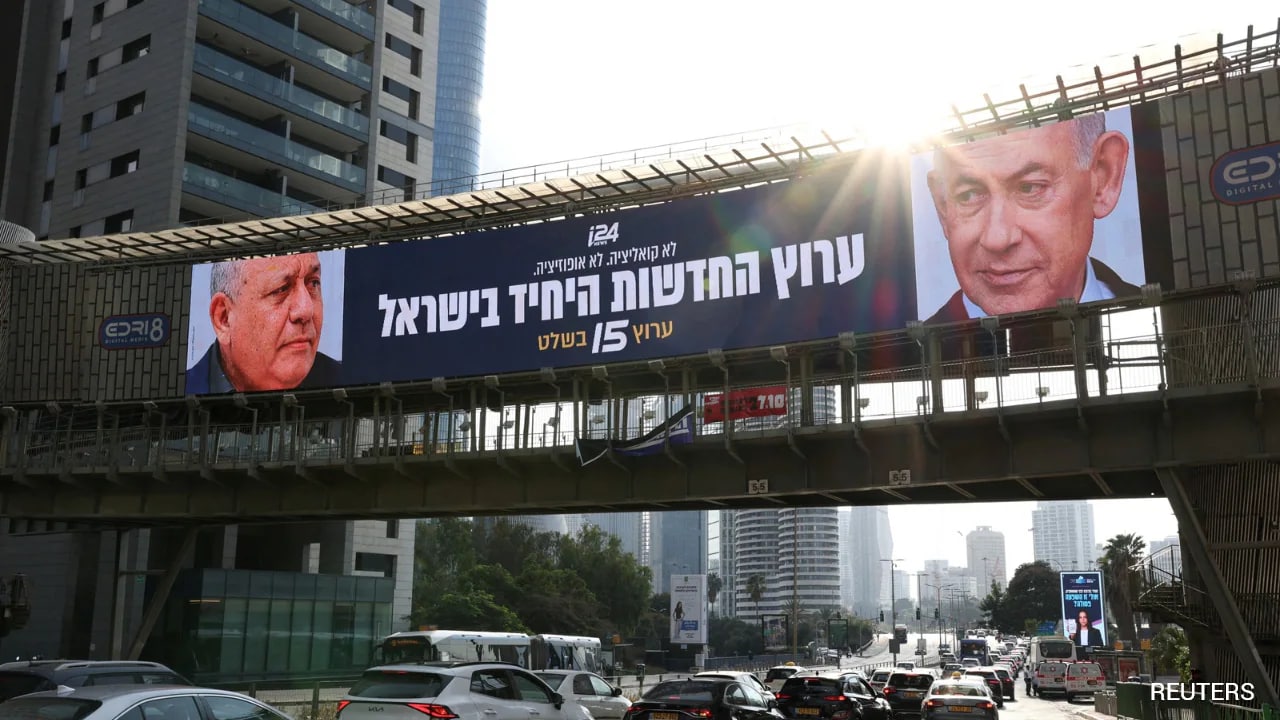
Silence.
In a room built for shouting, where political survival is measured in decibels and television soundbites, silence is the heaviest weapon in the arsenal. When Gadi Eisenkot speaks, he does not roar like a career politician fighting for airtime; he speaks with the flat, unhurried cadence of a man who has spent forty years reading maps by flashlight and calculating the exact weight of human lives.
So when the former Chief of Staff of the Israel Defense Forces—a man who buried his own son, Master Sergeant Gal Meir Eisenkot, in the soil of Gaza—looked straight into the cameras and declared that Benjamin Netanyahu is an existential threat who cannot remain Prime Minister for one more minute, the air in Tel Aviv changed.
You could feel it in the coffee shops along Rothschild Boulevard, where the usual background hum of clinking espresso cups and heated debate suddenly dropped an octave. People leaned over their tables, phones glowing in their palms, reading the transcript twice. This was not an opposition firebrand throwing red meat to a rally. This was not a rival party leader angling for a poll bump. This was the ultimate insider, a man whose entire adult life was dedicated to the preservation of the state's security architecture, stating plainly that the architect in charge was burning the house down while the family was still inside.
To understand why those words landed like artillery, you have to strip away the cable news chyrons and step into the boots of the people living underneath the decisions.
The Weight of the Map
Picture a kitchen table in central Israel at two in the morning. This is a hypothetical scene, yes, yet it is playing out in thousands of actual homes tonight. A mother sits across from her twenty-one-year-old son, whose olive-drab duffel bag rests against the front door. He has just been called back for another reserve rotation. Neither of them is talking about coalition math, judicial overhauls, or the latest parliamentary maneuver in Jerusalem. They are talking about whether the boots he was issued actually fit, whether his unit has enough night-vision gear, and why, after months of grueling urban combat, nobody in the Prime Minister's office can articulate what victory actually looks like on a map.
That kitchen table is the invisible battleground Eisenkot was addressing.
For decades, Israel operated under an unspoken, sacred covenant between its citizens and its leadership. The state asked young men and women to step into the fire, and in exchange, the state promised that every ounce of blood spilled would serve a clear, coherent, and achievable strategic purpose. War was a brutal necessity, never an indefinite state of suspension designed to delay a reckoning at the ballot box.
Eisenkot’s indictment cuts straight to the heart of that broken covenant. Having sat inside the war cabinet, having watched the classified briefings unfold hour after agonizing hour, he saw the gears grinding without catching. In military doctrine, tactics without strategy is merely the noise before defeat. You can clear a neighborhood, destroy a tunnel network, and eliminate a battalion commander, yet if you refuse to decide who governs the rubble the morning after, the vacuum fills back up with the very threat you just bled to erase.
Why would a seasoned leader refuse to make that decision? Because making a decision alienates coalition partners. Choosing a post-war diplomatic framework risks collapsing a fragile right-wing government. Holding onto power requires keeping every faction suspended in a permanent state of emergency, where asking "Where are we going?" is treated as treasonous, and demanding accountability is dismissed as a distraction from the war effort.
Anatomy of an Institutional Rupture
When a career soldier breaks ranks, he does not do it lightly. Military culture drills loyalty into your bones—loyalty to the chain of command, loyalty to the mission, loyalty to the quiet dignity of keeping internal disputes behind closed doors.
I have watched political systems fracture from the inside before, and the pattern is always the same. At first, the veterans whisper in hallways. They write polite, strongly worded memos that get buried in drawers. They join emergency unity governments, as Eisenkot did after October 7, believing that their presence at the table might steady the wheel and inject cold, hard operational reality into a room intoxicated by ideological slogans. They tell themselves that walking away is abandonment, that staying inside the tent is the only patriotic choice.
Then comes the tipping point. It arrives the moment you realize your presence is no longer a counterweight; it is a human shield for someone else's paralysis.
Consider what happens next when a leader treats national security as an extension of personal survival. Every hostage negotiation becomes a political calculation weighed against the threats of ultranationalist ministers who promise to topple the government if a deal is signed. Every diplomatic overture from Washington—the primary supplier of the munitions keeping the air force flying—is met with public defiance tailored for domestic applause rather than strategic leverage. Alliances built over half a century fray in real time while the prime minister plays to the balcony.
Eisenkot watched this unfold from the closest seat in the house. His argument is not built on ideological hatred; it is built on a cold, clinical audit of performance. Look at the metrics any commander uses to judge a campaign: Are the borders secure? Are the displaced citizens back in their homes in the north and south? Are the captives home? Is the country stronger regionally and internationally than it was a year ago?
By every measurable standard, the answer is no. Yet the leadership demands unconditional trust while refusing to accept a shred of responsibility for the catastrophic intelligence and security failures that allowed the crisis to ignite in the first place.
The Illusion of the Indispensable Man
There is a specific psychological trap that catches nations during prolonged trauma. Fear makes people cling to familiarity. Even when the captain has steered the ship onto the rocks, terrified passengers will hesitate to replace him mid-storm because the unknown feels even more dangerous than the wreckage beneath their feet.
Netanyahu has mastered this psychology for over a generation. He has carefully cultivated the persona of "Mr. Security," the lone adult in the room capable of navigating treacherous global waters, the indispensable shield standing between a vulnerable nation and its enemies. For years, that narrative held water. Economic growth was steady, normalization agreements with Arab neighbors seemed to rewrite the regional order, and the illusion of quiet deterrence lulled millions into believing that conflict could be managed indefinitely without ever being resolved.
October 7 shattered that illusion into dust. The emperor had no armor.
Still, old habits die hard, especially when fueled by a relentless media machine that paints every critic as weak, naive, or disloyal. That is precisely why Eisenkot’s voice disrupts the frequency so violently. You cannot easily smear a decorated general who commanded the entire military, who served under Netanyahu himself, and who paid the ultimate personal price in the current war as a "leftist traitor" disconnected from security realities. When Eisenkot speaks, the caricature dissolves.
What remains is a stark, uncomfortable question that every citizen, from Jerusalem to Haifa, is forced to confront: What happens when the person tasked with protecting the nation decides that his own political survival is synonymous with the survival of the state?
The Cost of Delay
Time is not a neutral bystander in the Middle East. Every week spent drifting without a strategic compass carries a compounding interest rate paid in lives, economic erosion, and diplomatic isolation.
Think of a bridge showing hairline fractures in its primary support pillars. An honest engineer closes the lanes, brings in heavy equipment, and reinforces the concrete immediately, accepting the short-term chaos of traffic jams to prevent a catastrophic collapse. A cowardly bureaucrat paints over the cracks, declares the bridge stronger than ever, and prays it holds together until his term ends.
Israel is standing on that bridge right now.
The reservists are exhausted, cycling through their third and fourth deployments while their businesses go bankrupt and their marriages strain under the weight of endless absence. The families of the hostages wake up every morning to a silence that grows heavier with each passing day, tortured by the suspicion that their loved ones are being sacrificed on the altar of coalition stability. International standing—not a luxury for a small nation dependent on global trade and defense partnerships, but an absolute necessity—is eroding at a pace that will take decades to repair.
Eisenkot’s call for immediate elections and Netanyahu’s removal is not an invitation to chaos during wartime; it is an emergency brake pulled before the train goes off the cliff. Democracies have survived wars while changing leaders. Britain replaced Neville Chamberlain with Winston Churchill in May 1940 while German panzers were literally rolling across Western Europe. Leadership changes during existential crises do not weaken a democracy—they prove that the system is still alive, still capable of self-correction when the man at the helm has lost his bearings.
A Reckoning in Broad Daylight
We tend to think of history turning on grand, cinematic moments—treaties signed under chandeliers, walls torn down by cheering crowds, speeches delivered from marble balconies. More often, history turns in quiet rooms when an ordinary human being decides they can no longer pretend that up is down.
Gadi Eisenkot is not a charismatic orator who will sweep crowds off their feet with soaring poetry. He is a gray-haired soldier who knows the exact cost of a bad order. By refusing to stay silent, by stripping away the polite fiction that things are under control, he has forced the conversation out of the shadows and into the harsh light of day.
Late at night, in that hypothetical kitchen in central Israel, the mother finally reaches across the table and places her hand over her son's. Outside, the streetlights hum against the dark. The duffel bag is still leaning against the door, heavy and waiting, while an entire country holds its breath to see whether the people in charge care more about saving the nation, or simply saving their seats.


