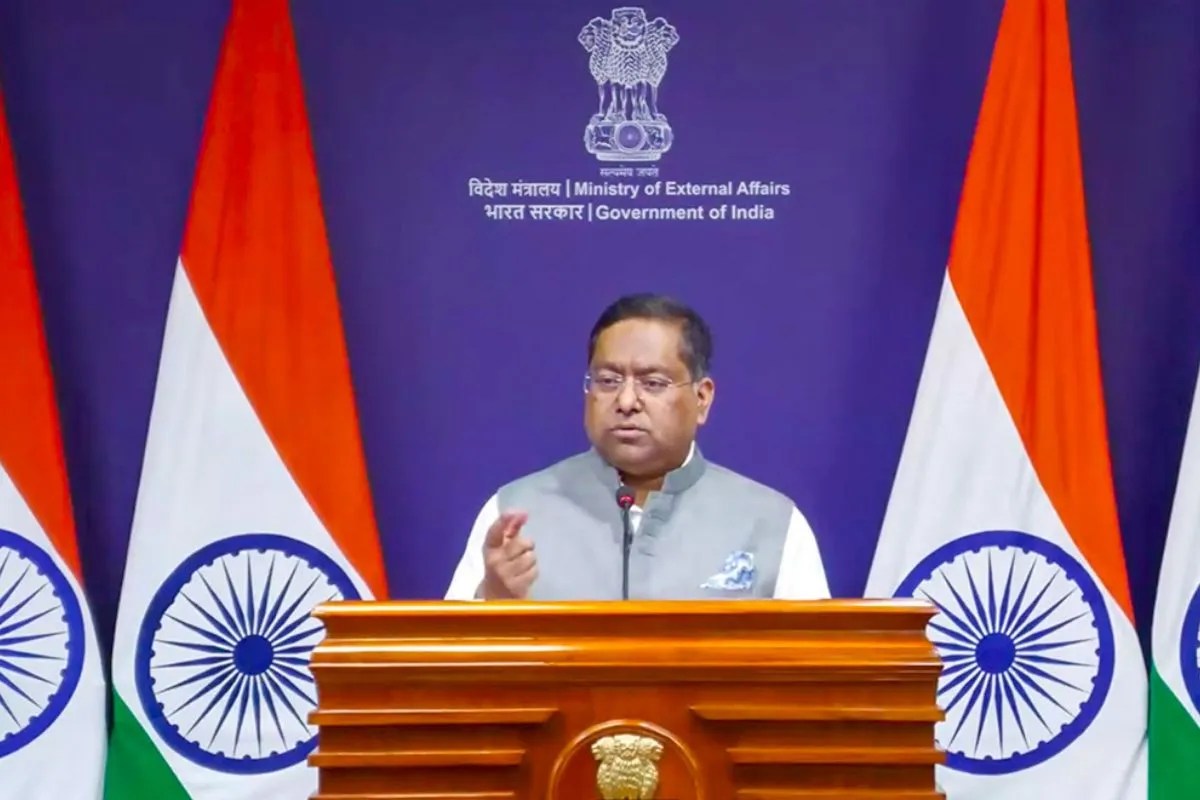
India has explicitly accused China of maintaining an illegal occupation over extensive areas of Jammu, Kashmir, and Ladakh. The Ministry of External Affairs reaffirmed that these territories remain integral parts of India, pointing directly to Beijing's decades-long military footprint and infrastructure expansion along the Line of Actual Control as a fundamental breach of international norms. This escalation highlights the structural tensions that continue to derail bilateral diplomacy between the two Asian giants, keeping thousands of heavily armed troops deployed along high-altitude border passes.
The Roots of the Himalayan Standoff
The core of the conflict stretches back to the 1962 Sino-Indian War. During this campaign, Chinese forces consolidated control over Aksai Chin, a strategic high-altitude plateau connecting Xinjiang with western Tibet. New Delhi has maintained continuously that Aksai Chin, along with significant tracts of eastern Ladakh, was annexed unlawfully.
Geopolitics rarely rests on emotion alone. Control over these desolate mountain passes dictates military mobility, trade artery defense, and river basin security across South and Central Asia. When Beijing construct roads, airstrips, and reinforced military encampments across disputed zones, it alters the operational balance on the ground.
Infrastructure as Tactical Strategy
Modern territorial disputes are fought as much with concrete mixers as with artillery. Over the past decade, China’s strategy along the western sector of the Line of Actual Control shifted toward rapid infrastructure modernization. Dual-use villages, known as Xiaokang, have appeared near sensitive boundary points. These settlements serve a dual function: establishing civilian demographic roots in disputed zones while providing instant logistics hubs for frontline border troops.
India responded in kind. The construction of the Darbuk-Shyok-Daulat Beg Oldi road dramatically enhanced the Indian Military's capability to supply its northernmost outpost near the Karakoram Pass. This strategic counter-maneuver forced Beijing’s leadership to realize that its absolute control over border dynamics was no longer uncontested. The resulting friction culminated in the lethal 2020 Galwan Valley clash, shattering forty years of relative calm and fundamentally altering the diplomatic calculus.
Diplomatic Stalemate and Buffer Zones
Subsequent military commander-level talks have led to disengagement at specific friction points, including Pangong Tso and Gogra-Hot Springs. However, these disengagements often come at a distinct tactical cost: the establishment of temporary "buffer zones."
Buffer zones prohibit both sides from patrolling areas they previously claimed freely. Critics within India argue that these arrangements effectively push Indian patrols back further into their own traditional operational sectors, turning undisputed land into temporary no-man's-land.
Diplomatic summits regularly produce carefully worded press releases emphasizing stability, yet fundamental policy alignment remains distant. Beijing prefers to compartmentalize the border dispute, urging New Delhi to normalize trade, economic ties, and political relations while keeping boundary negotiations on a separate track. India's foreign policy establishment has consistently rejected this approach, maintaining that economic normalization cannot proceed while military standoff conditions persist along the frontier.
The Broader Asian Power Calculation
This persistent border rivalry reverberates far beyond the Himalayan ridge line. It shapes regional security architecture across the Indo-Pacific.
- Maritime Balancing: As China pressures India's northern land border, India expands its naval posture across the Indian Ocean Region, deepening maritime security cooperation through the Quadrilateral Security Dialogue alongside the United States, Japan, and Australia.
- Economic Realignment: New Delhi has tightened scrutiny on incoming Chinese direct investment, banned scores of popular digital platforms, and initiated targeted supply chain diversification programs to limit economic vulnerability.
- Third-Party Dynamics: China’s heavy investment in the China-Pakistan Economic Corridor—which runs directly through Pakistan-administered Kashmir, land claimed by India—adds an inescapable multi-front security complexity to New Delhi’s defense planning.
Beijing views India's growing defense ties with Western nations as an effort to encircle Chinese influence in Asia. New Delhi views China's uncompromising stance on the border as a deliberate strategy to limit India's regional influence and force it into a permanent posture of strategic defense.
Every diplomatic statement issued from New Delhi serves as a deliberate reminder: temporary military deployments do not equate to legal territorial sovereignty, and the unresolved boundary remains the central friction point defining Asian security.