Silence is heavy when you know what it lacks.
For more than three centuries, the cliffs of Bermuda held a specific kind of emptiness. The wind screamed through the limestone, the Atlantic crashed against the jagged rocks below, and the night sky remained profoundly, achingly vacant. Nothing stirred in the dark. Nothing called out with that haunting, demoniac wail that once terrified Spanish sailors into naming these islands the Isle of Devils.
The cahow was gone.
Or so the world believed.
History writes its obituaries with careless ink. In the seventeenth century, hungry colonists, invading rats, and feral pigs swept through the nesting grounds like an ecological wildfire. Within decades, the Bermuda petrel—scientifically known as Pterodroma cahow—vanished from the living registers of the earth. Naturalists closed the book. Science accepted the extinction. For three hundred years, the bird existed only as dusty museum skins and old sailors' tales, a ghost haunting the margins of forgotten logs.
Dead. Extinct. Finished.
Except nature operates on a different timeline than human certainty.
Picture a blistering afternoon in late January 1951.
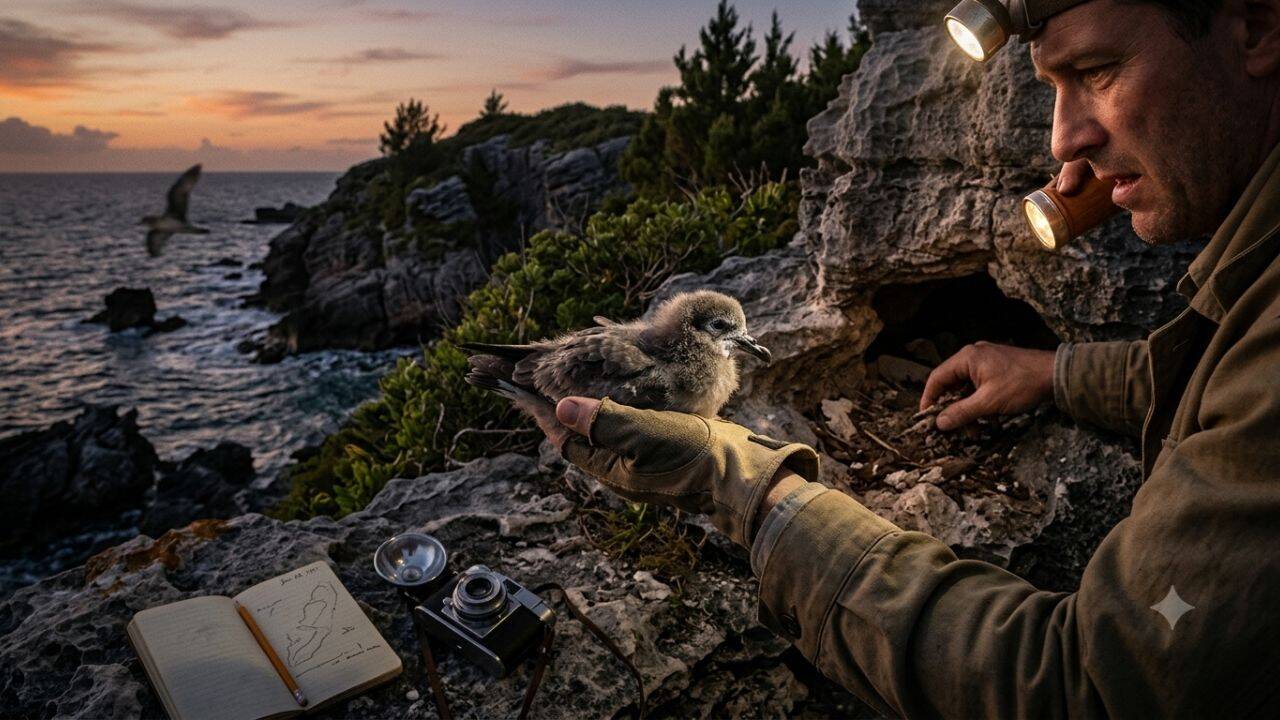
Robert Cushman Murphy, an ornithologist with the American Museum of Natural History, stood on a narrow, treacherous ledge of Castle Harbour. Beside him was Louis Mowbray, the curator of the Bermuda Aquarium, and a young boy named David Wingate, whose fascination with the island's wild edges bordered on obsession. They were not looking for a miracle. They were looking for remnants.
Armed with a fragile hope and a battered net, they climbed where sensible people refused to tread. They were searching for shearwaters, smaller seabirds that might share the rocky burrows.
Then, David reached into a dark crevice.
What happened next defies the neat, orderly rows of taxonomic tables. His fingers brushed against soft, warm feathers. A creature—defiant, confused, and fiercely alive—squirmed in the dark. Pulling it out into the glaring Bermuda sun, they stared at a web-footed apparition with a hooked black bill and eyes like polished jet.
It did not look like a scientific breakthrough. It looked like an impossibility.
They held a corpse that had resurrected.
Bringing something back from extinction is not a cinematic moment of triumphant music and instant recovery. It is a grueling, decades-long exercise in heartbreak and microscopic margins.
After that breathless afternoon in 1951, the reality of the cahow's situation set in with brutal clarity. There were no flocks. There were no hidden colonies waiting across the horizon. There were, at most, eighteen surviving pairs clinging to existence on tiny, storm-battered islets that were little more than eroding rock chunks.
Enter David Wingate, who grew from that eager young boy on the ledge into the island’s lone guardian.
Imagine spending your entire life crouching in the guano-scented dirt of a deserted rock, playing the role of matchmaker, architect, and bodyguard to a species that did not know you were trying to save it. The primary threat wasn't just historical overhunting anymore; it was real estate. The larger, aggressive white-tailed tropicbirds—locally known as cahow chicks' fiercest rivals—were stealing the limited nesting burrows, killing the defenseless petrel chicks before they could even fledge.
Wingate did not write a memo. He picked up concrete and tools.
To save a bird that spends years soaring over the open ocean without ever touching land, Wingate had to outsmart nature. He designed and built custom wooden and concrete baffles—narrow tunnels leading into the nesting burrows that allowed the smaller cahows to slip inside while physically blocking the bulkier tropicbirds. It was an act of brutal, loving engineering.
Day after day, year after year, he returned to the rocks. When hurricanes battered the islets, washing away nests and threatening the fragile population, he rebuilt them. When rats swam across from neighboring islands, he instituted desperate eradication programs. He became the voice for a creature that could only speak in the dark.
Consider what happens when you push a species to the absolute edge of the abyss. You discover how thin the thread of biodiversity really is.
By the turn of the twenty-first century, those eighteen pairs had slowly, painfully multiplied into a little over a hundred birds. But safety on a crumbling rock in the middle of a warming ocean is an illusion. Castle Harbour's nesting islets were shrinking, battered by rising seas and increasingly violent hurricanes fueled by a changing climate. The birds were running out of room.
Conservationists faced a terrifying question: What do you do when the ark is sinking?
You build a new one.
In a bold, unprecedented translocation effort, scientists and conservationists led by figures like Dr. Jeremy Madeiros began moving fledging cahow chicks from their crowded, vulnerable home islets to Nonsuch Island—a protected, predator-free nature reserve that had been painstakingly restored to its pre-colonial forest state.
Think about what it takes for a seabird to accept a new home. These creatures possess an internal compass refined by millions of years of evolution. They imprint on their birth burrow with laser-like precision. When they return from years of wandering the vast expanse of the North Atlantic, they do not look for a generic island; they look for the exact patch of dirt where they hatched.
Scientists had to trick that compass.
For weeks, conservationists hand-fed the relocated chicks, playing recordings of adult cahow calls through hidden speakers tucked into artificial burrows. They created an acoustic phantom neighborhood. The chicks grew, imprinted on Nonsuch Island, tested their wings in the salt spray, and finally launched themselves into the vast blue horizon.
Then came the agonizing wait. Would they remember? Would they come back?
Years passed. The tension on Nonsuch Island was thick enough to cut with a knife.
And then, one foggy night, a shadow dropped out of the sky, wailing into the dark, and waddled straight into an artificial burrow on Nonsuch Island. It had found its way home. Today, dozens of nesting pairs call Nonsuch their sanctuary, establishing the first new colony of the species in over four centuries.
The story of the Bermuda petrel is not a soothing bedtime tale about how nature always heals itself. Nature does not heal itself; it bleeds until we intervene.
Every single cahow alive today is a survivor of a narrow, razor-thin bottleneck carved out by human carelessness and rescued only by human obsession. They are living proof that extinction is not a permanent geological law, but a policy choice we can reverse if we care enough to crawl out onto the rocks and get our hands dirty.
Out on the open ocean tonight, thousands of miles from land, a dark shape skims the crest of a massive grey wave, its wings barely grazing the foam. It does not know it was supposed to be a ghost. It does not know that generations of humans gave up sleep, comfort, and certainty just to hear its cry echo across the dark water one more time.
It just flies.
And as the wind picks up over the Atlantic, the night fills once more with the wild, beautiful noise of a world that refused to let go.