Paper makes a specific sound when it crosses a diplomatic desk. It is not the sharp snap of a gavel, nor the thunder of boots on asphalt. It is a dry, indifferent whisper.
Yet in Dhaka, that whisper carries the weight of thousands of graves.
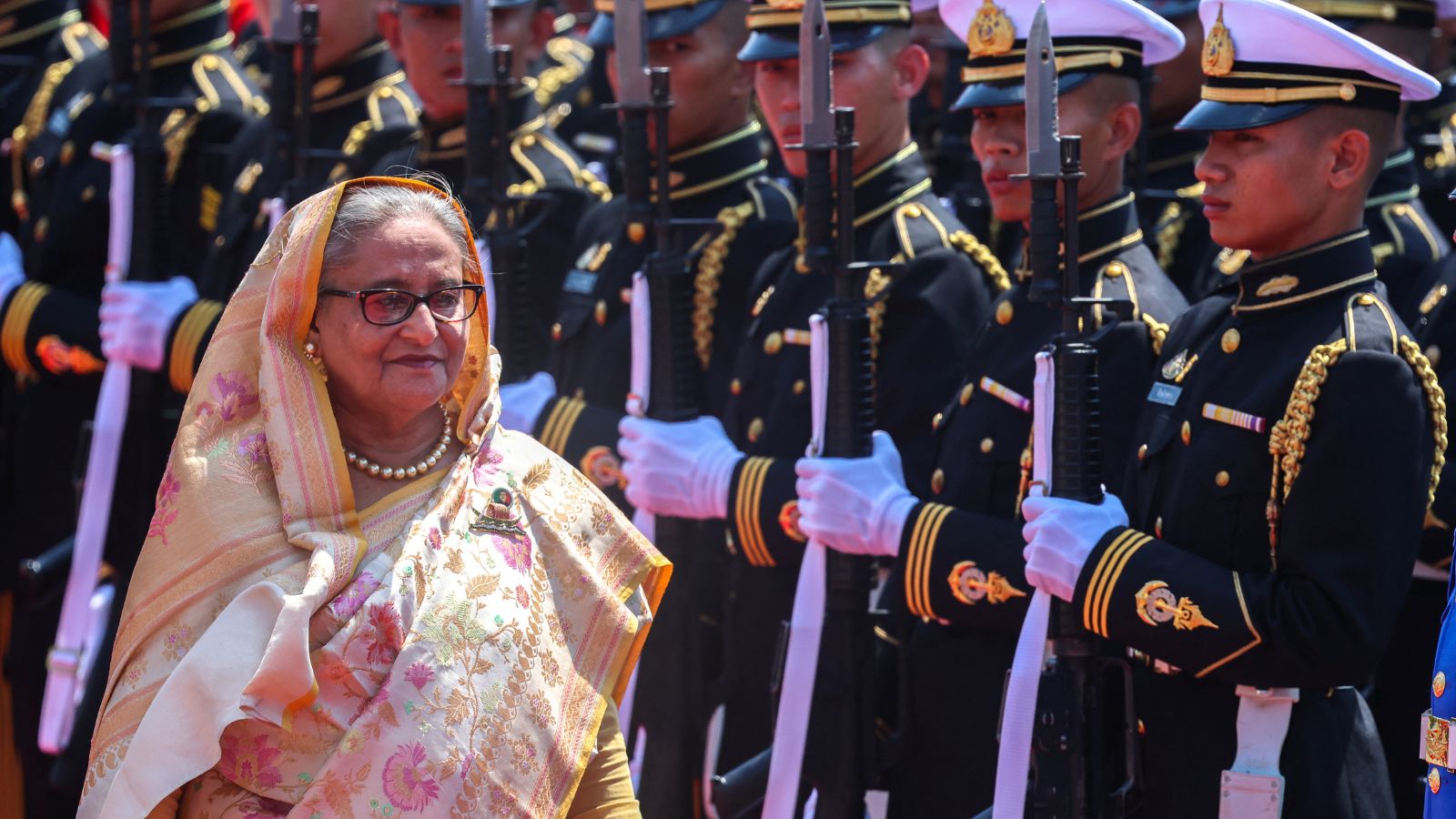
According to statements made by officials in Bangladesh’s interim administration, a formal extradition request has been dispatched to New Delhi, demanding the return of former Prime Minister Sheikh Hasina. In the blunt vocabulary of the current leadership, the woman who ruled the nation with an iron grip for fifteen consecutive years is no longer an exiled stateswoman. A Bangladeshi minister explicitly labeled her a "convicted criminal," signaling that the diplomatic niceties that once cushioned South Asia’s most consequential bilateral relationship have finally eroded into open legal warfare.
To read that headline in a standard news brief is to miss the tremor beneath the floorboards. Diplomatic cables and extradition treaties look sterile on a screen. They feel like the exclusive property of men in dark suits arguing over clauses written in 2013.
They are not.
To understand what happens when one nation demands its former ruler back from a neighbor that sheltered her, you have to step away from the podiums and stand on the cracked concrete of Dhaka’s Uttara district during the monsoon rains of July 2024.
The Weight of July
Consider a hypothetical composite—let us call him Tariq, though his story is stitched together from the verified testimonies of hundreds of families who still keep laminated photographs of their sons near the front door. Tariq is twenty-two. He studies engineering. He does not belong to a political party, nor does he care about the grand ideological feuds that have divided Bangladesh since its bloody birth in 1971. He cares about a civil service quota system that seems rigged against his generation.
When Tariq walks onto the street with a cardboard sign, he expects tear gas. He expects water cannons. In South Asian politics, street protests are a grimly familiar choreography.
He does not expect snipers.
Between July and August 2024, the streets of Bangladesh turned into a killing ground. According to preliminary findings from the United Nations Human Rights Office and local medical records, well over six hundred people—some estimates push past a thousand—were killed in the crackdown that preceded Hasina’s abrupt flight by military helicopter to India on August 5. Blinded students filled the wards of the National Institute of Ophthalmology, their corneas shredded by metallic pellets fired at close range.
Now, picture Tariq’s mother sitting in a cramped apartment two years later. She watches the evening news. She hears a minister in the interim government, led by Nobel laureate Muhammad Yunus, declare that Hasina is a "convicted criminal" and that India has officially been asked to hand her over.
For that mother, the phrase extradition request is not a legal mechanism. It is a ledger demanding balance.
Two Realities, One Border
Wait. Pause right here, because this is where the story splits into two irreconcilable truths, and pretending otherwise would be dishonest.
If you sit in Dhaka today, the moral calculus appears blindingly simple. A leader presided over a regime accused of enforced disappearances, torture cells known as Aynaghar (the House of Mirrors), the dismantling of democratic institutions, and the slaughter of unarmed youth. Following her ouster, Bangladesh’s International Crimes Tribunal—the very court Hasina’s own government once empowered to try war criminals from the 1971 independence war—issued arrest warrants and pursued convictions against her and her inner circle for crimes against humanity and corruption. Calling her a "convicted criminal," as the Bangladeshi minister did, reflects the fierce domestic consensus that justice cannot be symbolic. It requires a defendant in the dock.
Now cross the border. Sit in a quiet, heavily guarded bungalow in New Delhi.
From the perspective of India’s security establishment, Sheikh Hasina is not a monster. She is the anchor that held together the eastern flank of South Asia for a decade and a half.
When Hasina returned to power in 2009, India’s northeastern states—connected to the mainland by a narrow, vulnerable strip of land known as the Siliguri Corridor—were plagued by separatist insurgencies that frequently found sanctuary across the Bangladeshi border. Hasina dismantled those camps. She handed over insurgent leaders to New Delhi. She opened transit routes, cracked down on radical Islamist groups hostile to India, and turned a historically prickly neighbor into New Delhi’s most reliable regional partner.
In the cold, unsentimental arithmetic of statecraft, abandoning an ally who risked everything for your security sends a lethal message to every other leader in the neighborhood. If India hands Hasina over to face a tribunal in Dhaka—a tribunal her supporters and several international legal observers argue operates under immense political pressure and lacks full due-process guarantees—what leader in Kathmandu, Colombo, or Thimphu will ever trust New Delhi’s word again?
Here lies the trap.
Bangladesh’s interim government cannot survive politically if it appears weak on bringing Hasina to justice; the street that overthrew her is watching every move. India cannot survive strategically if it is seen as betraying its staunchest regional ally. Both positions are entirely logical within their own borders. Together, they form a collision course.
The Architecture of a Loophole
When people hear that Bangladesh and India signed an extradition treaty in 2013—and amended it in 2016 to make the transfer of fugitives even easier—they naturally assume the paperwork settles the matter. It seems straightforward: one country asks, the other complies.
Diplomatic treaties, however, are rarely built like steel cages. They are built like houses with deliberately unlocked back doors.
To understand how New Delhi can stall, deflect, or outright refuse Dhaka’s demand without technically tearing up the 2013 treaty, look closely at the fine print embedded in almost every international extradition agreement:
- The Political Offense Exception: Under Article 6 of the India-Bangladesh treaty, extradition may be refused if the offense is deemed to be of a "political character." While amendments narrowed this exemption for specific violent crimes like murder and terrorism, defining where state crackdown ends and political persecution begins gives New Delhi vast legal room to maneuver.
- The Good Faith Clause: Article 8 allows a requested state to refuse surrender if it appears the accusation is not made "in good faith in the interests of justice." Given the fierce political upheaval in Dhaka, Indian legal teams can argue for years over whether a fair trial is possible in a nation still convulsing from revolution.
- The Pace of Courts: Even if New Delhi wanted to comply, extradition in a constitutional democracy like India is not an executive decree. It triggers a judicial process that can be appealed all the way to the Supreme Court of India—a journey that routinely takes five to ten years.
Time, in diplomacy, is a weapon. Every month that the request sits in a legal review committee in New Delhi, the immediate fury in Dhaka cools slightly, or mutates into frustration directed at the interim government itself.
What Happens When Neighbors Stop Talking
I have spent years watching how high-level diplomatic freezes bleed down into ordinary lives, and the pattern never changes. Politicians argue about sovereignty; border guards start shooting at shadows.
Consider the sheer physical entanglement of these two nations. Bangladesh is wrapped on three sides by India, sharing a porous, winding border of over four thousand kilometers—the fifth-longest land border in the world. Fifty-four rivers flow from India into Bangladesh, carrying the silt and water that feed one hundred and seventy million people.
When relations sour over a single person sitting in a New Delhi safe house, the friction shows up in places that have nothing to do with politics.
It shows up in the sudden tightening of Indian export restrictions on onions or rice, sending kitchen budgets in Dhaka spiraling overnight. It shows up in stalled visa processing at Indian consulates, leaving thousands of middle-class Bangladeshis who travel to Kolkata or Chennai for cancer treatments and heart surgeries stranded without care. It shows up in the rhetoric of hardliners on both sides of the fence, where every minor border skirmish or dispute over river water is suddenly weaponized as proof of betrayal.
I will admit something that analysts rarely say out loud: nobody in either capital actually knows how to climb down from this ledge.
The interim government in Dhaka is caught between a rock and a revolution. Led by technocrats, activists, and student representatives rather than seasoned party bosses, it derives its legitimacy entirely from the promise of accountability. If a minister steps up to a microphone and calls Hasina a "convicted criminal," it is because anything less sounds like treason to the families who buried their children in July. Yet the more aggressively Dhaka demands her return, the harder it becomes for New Delhi to yield without looking weak before its own domestic electorate.
Meanwhile, Hasina herself remains an active ghost in the machine. From exile, her statements—circulated through social media and loyalists—continue to rattle Dhaka’s fragile calm, reminding everyone that the Awami League, the party that led Bangladesh’s independence movement, has deep roots that cannot simply be legislated out of existence.
The Invisible Ledger
Step back and look at the broader pattern across South Asia over the last decade. From the Maldives to Sri Lanka, and now in Bangladesh, smaller nations are increasingly pushing back against what they perceive as New Delhi’s heavy-handed regional dominance. When a domestic uprising topples a leader widely viewed as "India’s favorite," the backlash inevitably splashes onto India itself.
For New Delhi, sheltering Hasina is a test of loyalty. For Dhaka, prosecuting her is a test of sovereignty.
Yet beneath the grand words—sovereignty, justice, treaty obligations, strategic autonomy—lies a much simpler, heavier reality. A nation cannot heal while its former ruler watches from across the fence, untouchable and unrepentant. At the same time, a region cannot prosper when its two most intertwined neighbors turn a legal dispute into a permanent cold war.
That piece of paper sitting on a desk in New Delhi carries an official seal, a list of charges, and a demand for a prisoner. Outside the ministry walls, the monsoon clouds gather over the Ganges delta, indifferent to treaties, waiting to see whether the water will bring life or another flood.