The air at 26,000 feet does not belong to human beings.
It is thin, metallic, and painfully cold. Every breath feels like swallowing broken glass. Up here, in Mount Everest’s Camp Four, the human body is actively dying. Cells starved of oxygen begin to wither. Brains swell. The mind plays cruel tricks, turning the howling wind into the voices of lost loved ones.
Survival in this place requires absolute, ruthless efficiency. You strip away everything that is not essential to keeping your heart beating for the next sixty seconds.
But when the climbers descend, victorious or defeated, they leave behind a different kind of ghost.
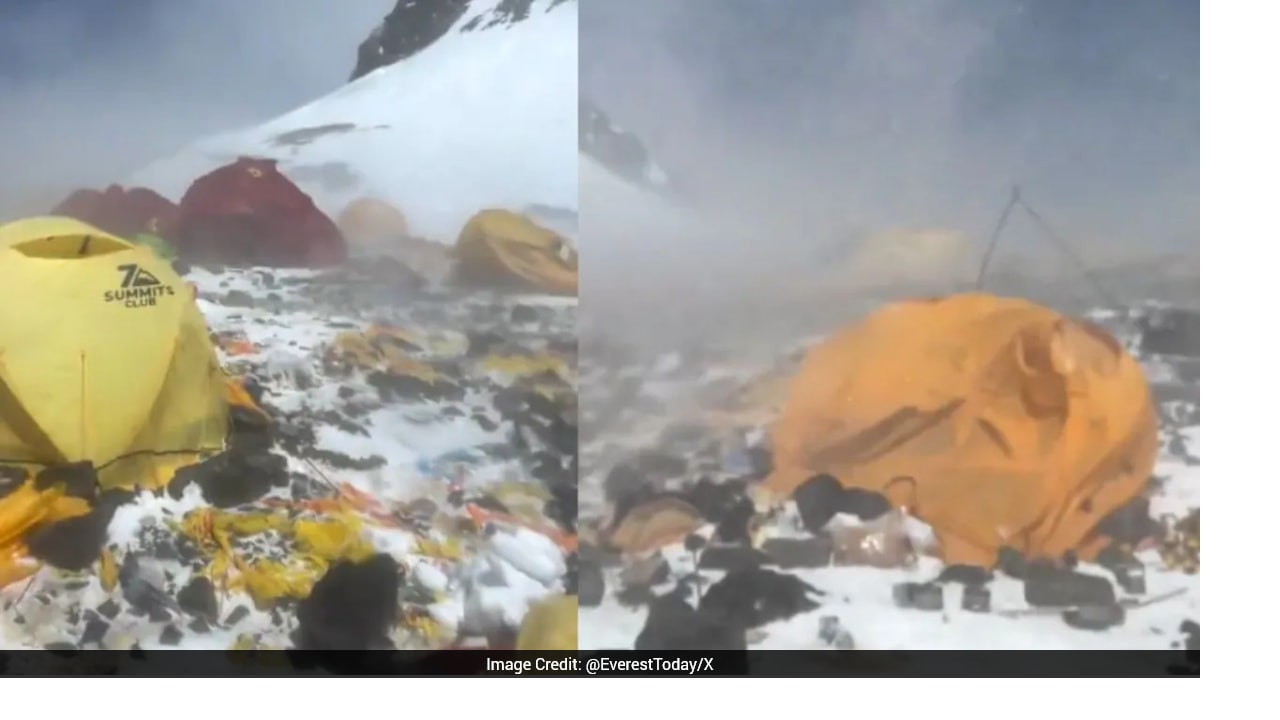
Imagine a bright yellow nylon tent. It is torn to shreds by winds that scream at hurricane force. Inside that tent sits a crumpled pile of neon-green oxygen bottles, empty fuel canisters, discarded food wrappers, and human waste frozen solid into the ice. This is not a hypothetical image. It is the literal reality of the Death Zone in 2026. Recent viral drone footage filmed at Camp Four exposed a sprawling, high-altitude junkyard that the world was never supposed to see so clearly.
We have romanticized the roof of the world for over a century. We view it as a pristine cathedral of ice and snow, a proving ground for the ultimate human triumph.
The truth is much filthier.
The Weight of an Empty Bottle
To understand how a sacred mountain becomes a landfill, you have to look at the math of survival.
When a commercial climber pushes for the summit, they are supported by an invisible infrastructure. For every paying client, there is a small army of local Sherpa guides who carry the literal weight of the expedition. They haul the heavy canvas tents. They carry the cooking gas. Most importantly, they carry the supplemental oxygen cylinders.
A single full oxygen bottle weighs around seven pounds. When it is full, it is life itself. It keeps the blood flowing to frozen fingers and toes. It keeps the cognitive fog at bay.
But once that bottle is empty, its value drops to zero.
To a climber operating on 30% of the oxygen available at sea level, seven pounds feels like seventy. Every ounce is a gravitational anchor pulling them down into the abyss. When the choice is between carrying an empty steel cylinder down a treacherous, icy ridge or dropping it into the snow to save your own toes, human nature wins every single time.
The problem is accumulation. One climber leaves a bottle. A decade later, ten thousand climbers have passed through.
The ice does not digest our trash. It preserves it. The intense solar radiation melts the top layers of snow during the brief spring climbing window, unearthing decades of hidden garbage. Old batteries from the 1990s sit next to modern plastic energy gel packets dropped last week.
It is a historical timeline of human consumption, frozen in perpetuity.
The Invisible Sherpa Burden
Let us look at a man we will call Dawa.
Dawa is thirty-four years old. He has summited Everest seven times. His lungs have adapted to the altitude over generations, but his spine feels every single foot of the climb. Dawa does not climb for glory. He does not write best-selling books about his spiritual awakening on the mountain. He climbs because a single two-month climbing season can earn him enough money to send his children to school in Kathmandu for the entire year.
On a standard descent, Dawa is already carrying his own gear, his client’s spare gear, and perhaps helping a exhausted climber navigate the treacherous blue ice of the Lhotse Face.
Now, consider the moral calculus of the clean-up.
The government of Nepal requires a $4,000 garbage deposit per team, which is refunded only if the expedition brings back a specific weight of trash. Some operators treat this simply as a cost of doing business. It is a line item in a budget that easily tops $60,000 to $100,000 per climber.
When an expedition abandons Camp Four in a rush to beat an incoming jetstream storm, who goes back for the tents?
The responsibility falls squarely on men like Dawa.
To clean up Camp Four, a Sherpa must climb back into the Death Zone, chop frozen nylon out of solid ice using an ice axe—a process that can take hours of agonizing physical labor—and strap sixty pounds of jagged, frozen garbage to their backs. They must then descend the Hillary Step and the Western Cwm, crossing ladders balanced over bottomless crevasses, all while carrying the literal refuse of wealthy foreigners.
We are not just polluting a mountain. We are outsourcing our ecological sins to a population that risks their lives to clean them up.
The Illusion of the Eco-Expedition
Every year, the marketing glossies promise a cleaner season. We hear about "eco-expeditions" and new biodegradable waste bags. We read about volunteer clean-up drives that collect tons of trash from Base Camp.
Base Camp is easy.
At 17,500 feet, Base Camp has helicopter access, running water in the spring, and plenty of thick air. You can set up a recycling system there. You can have garbage bins.
The lie of Everest sustainability is that we judge the health of the mountain by what happens at the bottom, while ignoring the catastrophic degradation happening at the top. The higher you go, the lower the accountability becomes.
At Camp Four, there are no park rangers. There are no trash police. There is only the survival instinct and the blinding white fog.
When a storm hits, tents are abandoned with everything inside them. Food spoils, batteries leak toxic chemicals into the snow, and the wind tears the fabric apart, scattering microplastics across the glaciers that feed the rivers millions of people downstream rely on for drinking water.
The snow is melting faster now. Climate change is peeling back the white blanket of the Himalayas, revealing that our highest monument to human achievement is actually built on a foundation of discarded plastic.
The Final Ascent
The sun sets over the Khumbu Valley, painting the peaks in shades of deep violet and burning orange. From a distance, Everest looks untouched. It looks infinite.
But up close, high above the clouds, a piece of blue plastic tarp snaps violently in the wind, anchored to the ice by an old climbing rope.
We have treated the world’s highest peak like a bucket-list theme park. We pay our money, we collect our summits, we take our selfies, and we leave the cleaning to the mountain and the people who call it home.
The true cost of climbing Everest is not measured in dollars, nor is it truly measured in the risk to human life. It is measured in the heavy, silent weight of what we leave behind when we think no one is watching.