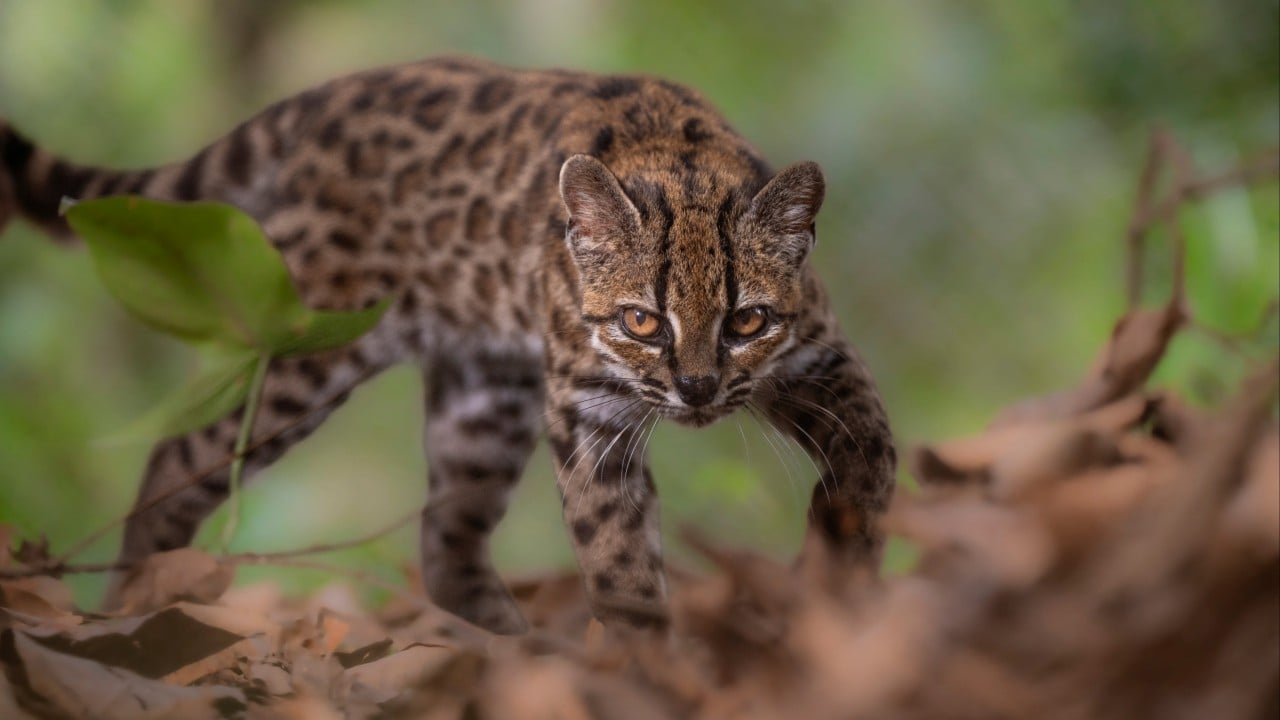
Deep within the misty slopes of the Bolivian Yungas, a tiny, spotted predator has quietly rewritten a century of zoological history. Known locally for generations as the tilcayo, this diminutive feline—weighing barely three pounds and measuring smaller than many domestic house cats—has been formally identified as a brand-new species to science, Leopardus tilcayo. It marks the first time in over a hundred years that a fresh feline species has been officially described.
Yet, beneath the wave of scientific celebration lies an unsettling truth. Finding a new mammal in the twenty-first century is not merely a triumph of modern taxonomy or genomic sequencing. It is an indictment of how little we actually know about the ecosystems we are actively dismantling. By the time researchers managed to isolate the genetic lineage of the tilcayo—determining that its ancestors diverged roughly 1.4 million years ago—the cloud forests sheltering it were already fracturing under the pressures of agricultural expansion, infrastructure projects, and climate disruption.
For decades, local communities in Nor Yungas had no trouble identifying the animal. To rural residents, the tilcayo was simply a familiar, elusive fixture of the mountain flank, passed down through oral tradition. When National Geographic Explorer and Bolivian biologist Paola Nogales-Ascarrunz first encountered a captive individual at the Senda Verde wildlife sanctuary, she realized that museum collections and historical taxonomies had completely missed what rural populations already knew.
The oversight stems from a long-standing blind spot in classical biology known as cryptic speciation. For generations, small spotted cats across Central and South America—collectively referred to as tiger cats or oncillas—were lumped into broad categories based on superficial physical traits. A pelt here, a skull there; if it had rosette spots and lived in a tree, it was categorized as an established species.
It required modern genomic extraction to shatter those tidy assumptions. Mitochondrial and nuclear DNA sequencing revealed that the tiger cat group is not a single coherent lineage, but a complex web of isolated populations that split off during ancient climate fluctuations. As glacial periods reshaped South America, moist montane forests shrank into isolated pockets, acting as climatic refugia. These natural green islands trapped small populations of felines, forcing them to evolve in isolation until they became entirely separate species, completely invisible to visual classification alone.
The formal description of Leopardus tilcayo alongside a newly minted subspecies in Peru, Leopardus tigrinus antisuyo, proves that biodiversity inventories are dangerously incomplete. If science can entirely miss a distinct species of carnivore living in a heavily traveled Andean transit corridor, entire communities of insects, amphibians, and epiphytes are vanishing into extinction registers before humanity even devises names for them.
The immediate threat facing the tilcayo is not a lack of scientific curiosity, but a catastrophic loss of habitat. The Yungas cloud forest is an ecological transition zone sitting between the high Andes and the Amazon basin. It is an engine of endemic life, uniquely vulnerable to human encroachment. Road construction slices through the steep slopes, cutting wildlife corridors into isolated fragments. Small-scale agriculture and coca cultivation creep higher up the mountain, while climate shifts force cloud layers upward, drying out the exact mist-drenched microclimates the tilcayo depends on for survival.
Compounding the problem is a severe data vacuum. Because the tilcayo was only recently recognized as a distinct taxonomic entity, wildlife authorities possess zero reliable estimates for its total population density. Researchers do not know its exact home range boundaries, its specific dietary preferences beyond basic carnivory, or its baseline reproductive rates.
When a species is scientifically invisible, it cannot be prioritized for protection under national environmental laws or international treaties like CITES. Conservation frameworks rely on documented population numbers and mapped habitats. Without that baseline, an animal can slide quietly from undiscovered to extinct without triggering a single regulatory alarm.
The revelation of the tilcayo forces a reckoning within the global conservation community. For too long, funding and media attention have flowed toward charismatic megafauna—jaguars, spectacled bears, and giant otters—while the smaller architects of forest ecosystems are ignored. Yet a three-pound apex predator plays a vital regulatory role in controlling rodent and small mammal populations within the cloud forest understory.
Naming the cat after the local term used by Yungas residents represents a vital shift in how modern field biology operates. Ethnotaxonomy—recognizing the empirical knowledge of indigenous and rural communities—bridges the gap between academic institutions and the people who share a backyard with rare wildlife. If conservation efforts in Bolivia are to succeed, they must transition from top-down academic decrees to community-led land stewardship that values the forest not as an abstract carbon sink, but as a living home.
The tilcayo survived for over a million years hidden in the damp mountain mists of the Andes, weathering glacial cycles and tectonic shifts. Whether it can survive the next fifty years of human development remains an open question.
The forest is growing quieter, and the margins for error are gone.