Seventeen years is a long time to carry a ghost.
Ask anyone who has lived with an amputation, and they will tell you that the hardest part isn't the missing weight at the end of the sleeve. It isn't the awkwardness of balance, or the sideways glances from strangers on the subway, or even the dull, throbbing ache of a limb that refuses to stop hurting for something that is no longer there.
No. The hardest part is the numbness.
For nearly two decades, Dennis Sorensen lived in that numb space. In 2003, a firework accident during a New Year’s celebration took his left hand below the elbow. In an instant, the world went quiet on that side of his body. He adapted, of course. Humans are terrifyingly resilient creatures; we can learn to tie shoes with our teeth, write with our toes, and navigate a hostile environment with half the tools we were born with. Dennis built a life. He learned to manage.
Yet, every time he reached out to hold his sons, his hand met their skin with the dead, flat resistance of plastic and metal. He could grip a cup, but he had to look at it to know he was holding it. If he closed his eyes, the cup might as well have vanished into thin air. His brain was shouting commands into a void, waiting for an answer that never came.
Nerves are stubborn things. They do not simply die when a limb is severed; they remain in the residual stump, frayed ends searching desperately for the pathways they used to travel. For years, those nerves screamed into silence.
Until the day science decided to answer back.
To understand what happened next, we have to talk about how a human hand actually works. We tend to think of it as a tool, like a hammer or a wrench. It is not. It is an organ of perception. When you pick up a fresh peach, your brain processes a staggering symphony of data in milliseconds: the soft fuzz of the skin, the slight give of the flesh beneath, the cool temperature, the precise amount of pressure required to lift it without bruising the fruit.
A traditional prosthetic hand is a machine. It opens. It closes. It does not feel.
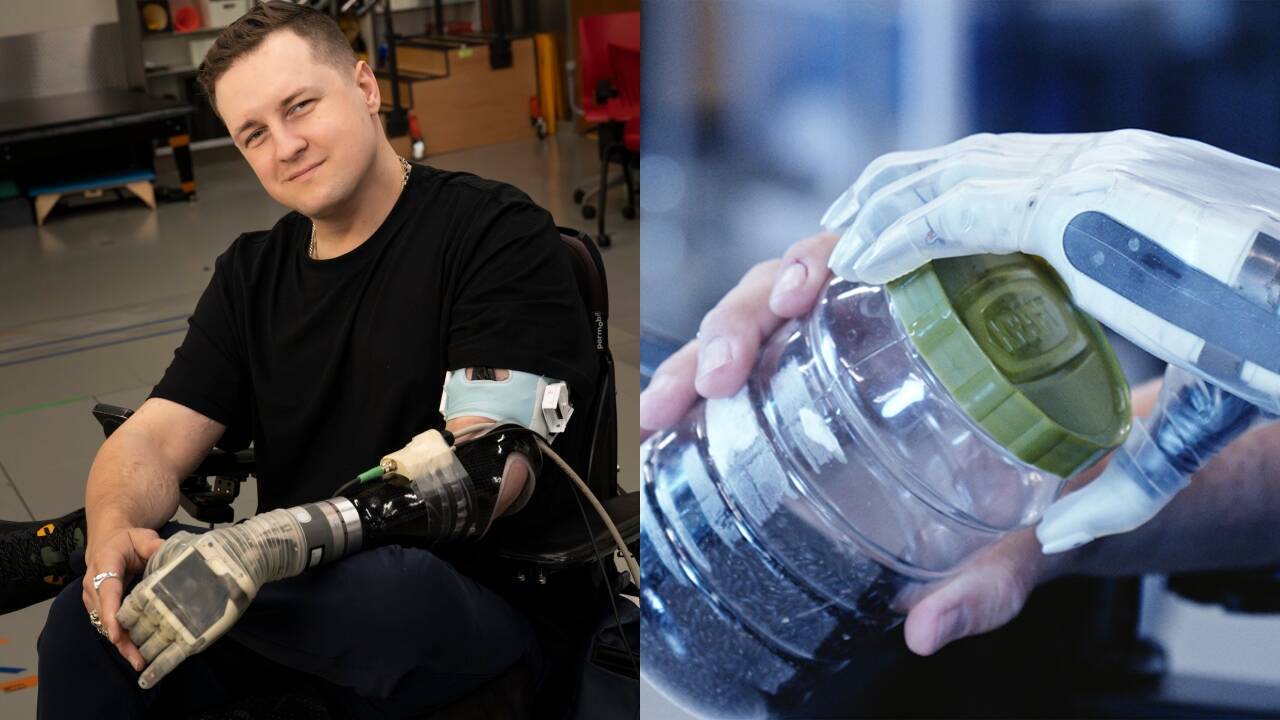
When researchers at the École Polytechnique Fédérale de Lausanne in Switzerland, alongside a team of European neuroscientists and engineers, first approached Dennis, the goal was not just to build a better machine. The goal was to bridge the chasm between flesh and silicon.
They designed a bionic hand equipped with an array of sensors. These sensors were wired to artificial tendons that measured tension. When the hand gripped an object, the sensors translated that physical force into electrical impulses—the exact same language spoken by the human nervous system.
Then came the surgery. Surgeons threaded tiny, hair-thin wires directly into the median and ulnar nerves of Dennis’s upper arm.
Imagine plugging a high-speed fiber-optic cable into a telegraph machine.
The first test in the laboratory was unassuming. Dennis sat in a chair, a bulky array of computers humming in the background. The bionic hand was attached. He was blindfolded.
A researcher placed a small wooden cylinder in the artificial palm and asked him to close his fingers.
Dennis closed his hand. And then, he froze.
He didn't just feel the pressure of the wood. Decades of silence shattered. His brain, receiving the electrical signals translated from the sensors, interpreted them as touch. He could tell if the object was hard or soft. He could tell if it was round or square. He could feel the weight of it resting against his palm.
Later, in interviews, he would struggle to find the exact words. It wasn't a magic trick. It was a homecoming.
We often look at technological advancements through the lens of cold utility. We talk about efficiency, about productivity, about market viability. We reduce breakthroughs to bullet points in quarterly reports. But the true measure of human ingenuity is found in the quiet, visceral moments of restoration.
Consider what happens when a person regains the ability to feel the world.
It is not just about holding a wooden cylinder in a sterile laboratory. It is about holding the hand of someone you love without having to constantly calculate your grip strength. It is about reaching out in the dark and knowing, with absolute certainty, what you are touching. It is about closing the loop of a human circuit that was brutally severed by fate.
Of course, the road from a laboratory prototype to everyday life is steep. The technology used in Dennis's initial breakthrough required wires running out of his arm to external computers—a setup practical for a hospital room, but hardly suited for walking down the street to buy groceries. The challenge for researchers ever since has been miniaturization, durability, and translation. How do you fit a supercomputer into a forearm? How do you keep neural interfaces stable for decades inside a living, moving body?
Progress in biotechnology is rarely cinematic. It does not happen in a single, roaring explosion of genius. It crawls forward, inch by painful inch, funded by small grants, fueled by sleepless nights in sterile labs, and tested by brave individuals willing to let scientists plug wires into their nervous systems.
Today, the technology has evolved. Implantable systems are becoming more integrated, wireless protocols are improving, and the resolution of artificial touch is getting sharper. We are learning how to make metal and bone and nerve speak the same language fluently.
Yet, the core of the story remains deeply human.
Seventeen years is a long time to live in the dark. It is a long time to forget what the world feels like on the other side of a barrier.
When Dennis Sorensen finally opened his hand during those trials, he wasn't just testing a piece of equipment. He was proving something fundamental about who we are as a species. We are creatures that refuse to accept permanent loss. When a door is slammed shut by tragedy, we pick the lock. When a nerve is severed, we wire it back together.
We reach into the dark, and we find a way to touch the light again.