Rain falls differently in Derry than it does in Donegal.
Technically, it is the exact same cloud drifting eastward off the Atlantic, heavy with salt and cold, dropping its load onto green hills that have never known a fence high enough to stop the wind. Yet if you drive three miles west out of the city center along the Culmore Road, something invisible shifts. The white lines painted down the center of the asphalt abruptly turn yellow. Speed limits switch from miles per hour to kilometers per hour. The currency in your pocket—British pounds sterling—suddenly becomes foreign tender, replaced by the Euro.
You have crossed an international border without seeing a single guard, a gate, or a concrete barrier.
For decades, that invisible seam has been held together by a delicate, exhausting miracle of diplomacy known as the Good Friday Agreement. Signed in 1998, it ended thirty years of sectarian bloodshed—The Troubles—by agreeing to a simple, radical premise: Northern Ireland would remain part of the United Kingdom for as long as a majority of its people wished it, and it would join the Republic of Ireland only when a majority on both sides voted for it. Until then, people could be British, Irish, or both, and the border would fade into the mist.
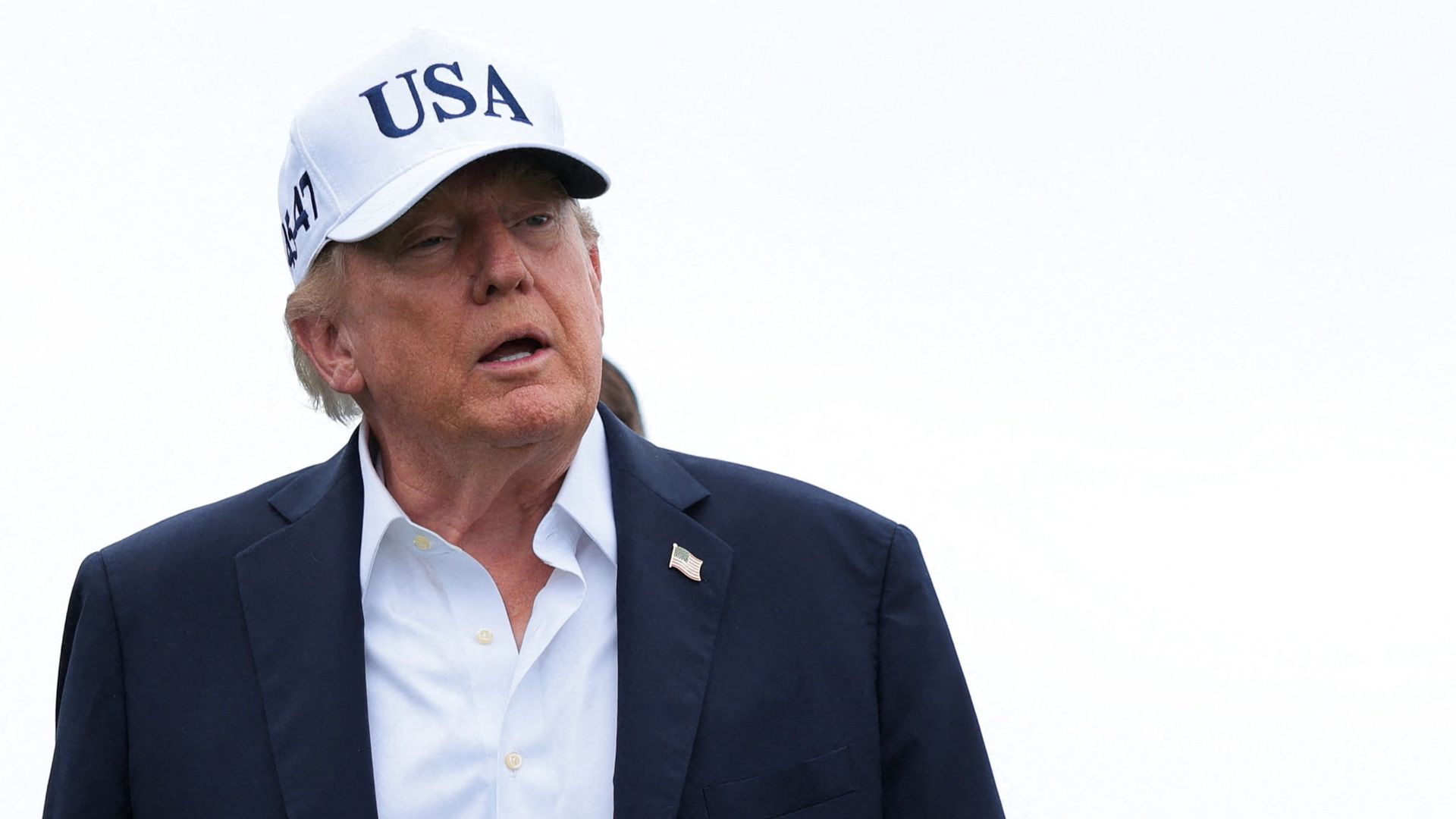
Then, an American president stepped up to a microphone, brushed aside decades of diplomatic caution, and casually tossed a match onto the dry grass.
The Echo Across the Atlantic
When Donald Trump speaks about Irish reunification, the reaction in Washington, London, and Dublin is immediate and visceral. Critics—ranging from British unionist politicians to seasoned foreign policy analysts—have repeatedly accused him of reckless meddling, arguing that off-the-cuff remarks from the Oval Office or the campaign trail risk destabilizing one of the most fragile peace settlements in modern history.
Trump, true to his political instincts, has consistently brushed that criticism off. To him, the logic appears straightforward, almost transactional: a single island, one landmass, an obvious geographical whole. Why shouldn't it be united?
To understand why those words land like thunderclaps in Belfast and Derry, you have to step away from podiums and press briefings and stand in a kitchen in East Belfast or a pub in West Belfast. You have to look at the people who live on top of the fault line.
Consider a hypothetical family—let’s call them the Hendersons, living in a terraced house off the Newtownards Road in Belfast. To the Hendersons, the Union Jack flying from the lamppost outside isn't an abstract political symbol or a real estate inefficiency. It is the fabric of their identity, paid for in generations of service, family memory, and community survival. For them, talk of a united Ireland doesn't sound like tidying up a map. It sounds like erasure.
Now walk two miles west across the city, past the towering brick and steel "peace walls" that still divide neighborhoods every night at dusk. Sit with another hypothetical family—say, the Gallaghers, whose grandparents remember being treated as second-class citizens in their own hometown, denied housing and voting rights because of their Catholic heritage and nationalist aspirations. To the Gallaghers, the partition of Ireland in 1921 was an unnatural wound carved into their country by an outgoing empire. Reunification isn't a disruption; it is the long-overdue healing of an amputated limb.
When an American president talks up reunification—even casually, even while shrugging off the blowback—he isn't just offering commentary. He is tipping the scales of a psychological balance that took thousands of lives and decades of agony to achieve.
The Weight of the American Voice
Why does an American leader’s opinion carry so much voltage on an island three thousand miles away?
History.
The United States is not a neutral bystander in Irish affairs. More than thirty million Americans claim Irish ancestry, a diaspora forged in the crucible of the Great Famine of the 1840s, when over a million people starved and another million fled on coffin ships bound for Boston, New York, and Philadelphia. That shared bloodline gave Irish nationalism a powerful, wealthy, and fiercely vocal constituency inside American politics.
In the 1990s, that influence became the engine of peace. President Bill Clinton took the extraordinary step of granting a visa to Gerry Adams, the leader of Sinn Féin—the political wing of the Irish Republican Army—over the furious objections of the British government and the U.S. State Department. Clinton appointed former Senate Majority Leader George Mitchell as special envoy, and Mitchell spent years locked in windowless rooms in Belfast, coaxing bitter enemies toward compromise.
The Good Friday Agreement succeeded precisely because Washington played the role of the honest broker. The United States guaranteed the rules of the game without dictating the winner.
That is why Trump’s willingness to vocalize support for reunification—and his dismissal of the resulting uproar—breaks every rule in the diplomatic playbook. Critics point out that under the terms of the 1998 accord, the British Secretary of State for Northern Ireland is the only person legally empowered to call a border poll, and only when it appears likely that a majority would vote for change. By championing reunification from the outside, critics argue, Trump undermines the principle of consent that keeps unionists engaged in power-sharing.
Yet Trump’s defenders—and many Irish nationalists who quietly welcome his remarks—see something else entirely. They see a leader refusing to be bound by diplomatic euphemisms. To them, the demographic and political realities on the island are already shifting beneath everyone's feet, and pretending otherwise is just polite denial.
The Numbers Beneath the Surface
Strip away the rhetoric, and the ground in Northern Ireland really is moving.
For a century after partition, Northern Ireland was deliberately engineered to have a permanent Protestant, unionist majority. In 1921, Protestants made up roughly two-thirds of the population. Politics was a zero-sum census: whoever had the headcount held the power.
Then came the 2021 census, published in 2022. For the first time in Northern Ireland’s history, people from a Catholic background outnumbered those from a Protestant background—45.7 percent to 43.5 percent.
Shortly before that, Sinn Féin—a party whose core mission is a united Ireland—became the largest party in the Northern Ireland Assembly, securing the role of First Minister for Michelle O'Neill. For the first time since the state was founded, a nationalist sat at the top of Stormont, the parliament building on the hill overlooking Belfast.
At the same time, Brexit violently jolted the constitutional landscape. While the United Kingdom as a whole voted to leave the European Union in 2016, Northern Ireland voted to remain. Because no one wanted to bring back customs checkpoints and watchtowers along the 310-mile land border with the Republic of Ireland—which remained in the EU—London and Brussels eventually agreed to keep Northern Ireland aligned with the EU’s single market for goods.
The unintended consequence? A regulatory border appeared in the Irish Sea, separating Northern Ireland economically from Great Britain. For many unionists, it felt like the beginning of the end—a slow-motion detachment from the country they love.
And yet, numbers don't vote by themselves. People do.
The Question Nobody Wants to Price Out
Here is the truth that rarely survives a soundbite: wanting a united Ireland in your heart and voting for one in a polling booth are two vastly different things.
Opinion polls conducted across Northern Ireland and the Republic consistently show a fascinating, stubborn gap. While support for reunification has grown—especially among younger voters frustrated by political dysfunction in Belfast and the economic fallout of Brexit—a clear majority in Northern Ireland still hesitates when the question moves from poetry to spreadsheets.
Think of a united Ireland like merging two massive, deeply indebted family businesses that have kept separate books for a hundred years.
Northern Ireland relies heavily on an annual financial subsidy from the British Treasury—known as the subvention—which runs into billions of pounds every year to fund public services, pensions, and infrastructure. The United Kingdom’s National Health Service (NHS), despite its severe post-pandemic strain and long waiting lists, provides healthcare free at the point of use. In the Republic of Ireland, despite a booming economy fueled by multinational tech and pharmaceutical giants, many residents pay out of pocket to see a general practitioner, and housing costs in Dublin have spiraled into a generational crisis.
If the border vanished tomorrow, who pays the pensions? What happens to the 30 percent of Northern Ireland’s workforce employed in the public sector? How do you absorb a population of nearly two million people—roughly a third of whom deeply resent the new flag flying over their heads—into a state of five million without tearing the social fabric apart?
These are the questions that keep economists in Dublin and civil servants in London awake at night. They are complex, unglamorous, and terrifyingly expensive.
They are also entirely absent from a offhand remark at a golf resort or a rally stage.
The Risk of Casual Words
I remember walking along the Peace Bridge in Derry a few years ago on a gray November afternoon. The bridge curves gracefully across the River Foyle, linking the predominantly nationalist city side with the historically unionist Waterside. Teenagers in school uniforms were laughing as they walked home together; a young father pushed a stroller past a plaque celebrating reconciliation.
That bridge exists because people spent years learning how to choose their words carefully. In Northern Ireland, language isn't just communication; it is territory. Calling the second-largest city "Derry" signals one allegiance; calling it "Londonderry" signals another. Saying "the North of Ireland" versus "Northern Ireland" tells a stranger who your grandparents were.
When you live inside that kind of linguistic minefield, you develop an acute sensitivity to tone. You learn that peace isn't the absence of disagreement—it is the shared agreement not to detonate the room when you disagree.
That is why critics bristle so fiercely when Donald Trump brushes off concerns about his reunification talk. To diplomats and community leaders on the ground, shrugging off criticism isn't a sign of strength; it is a sign of distance. It is the luxury of someone who gets to fly away when the headlines fade, leaving local leaders to calm the anxieties stirred up in their wake.
Unionist politicians immediately seize on such remarks as proof that Washington has abandoned neutrality, hardening their resistance to cooperation. Nationalist politicians feel pressure from their base to push harder and faster for a border poll, even if the groundwork isn't ready. The middle ground—the growing cohort of voters in Northern Ireland who identify as neither unionist nor nationalist, who simply want functioning hospitals, good schools, and clean streets—gets squeezed out by the noise of ancient tribal drums.
The Inevitable Conversation
Still, it would be dishonest to pretend that silence is a strategy.
You cannot put the genie back in the bottle. Brexit broke the constitutional stillness that had settled over Ireland after 1998. Demographic shifts are irreversible. Conversations about what a "New Ireland" might look like—citizen assemblies, academic task forces, quiet discussions in Dublin boardrooms—are already happening, with or without an American president weighing in.
The tragedy isn't that people are talking about reunification. In a democracy, every constitutional future deserves an honest, open debate.
The danger lies in treating a generational transformation like a real estate deal. Reunification, if it ever comes, will not happen because a powerful outsider declared it makes sense. It will happen only if millions of neighbors who have spent a century eyeing each other across brick walls decide they trust each other enough to share a house.
As dusk settles over Belfast tonight, heavy steel gates along Cupar Way will be rolled shut and locked by police officers, just as they have been every single evening since 1969, sealing off the Falls Road from the Shankill Road until morning.
Three thousand miles away, the news cycle will have already moved on to the next controversy. On the ground, the gates will remain closed, waiting for the people who actually live behind them to decide when it is safe to open the doors.