The sea does not care about international sanctions. It only understands weight, buoyancy, and the relentless pull of the tide. On a cold, grey morning, a massive steel hull cuts through the choppy waters just outside British territorial limits. To the casual observer on a passing ferry, it looks like any other commercial oil tanker—rust-streaked, monolithic, and deeply utilitarian. But this ship is a phantom. It operates in the shadows, its transponders deliberately silenced, its true ownership buried under layers of shell companies in tropical tax havens. It carries a volatile cargo worth millions, funding a war thousands of miles away.
This is the reality of the Russian shadow fleet. For months, these aging, poorly insured vessels have played a high-stakes game of cat-and-mouse in the crowded shipping lanes of Europe. They bypass Western restrictions, keeping the economic engines of conflict humming. If you found value in this piece, you should check out: this related article.
Then, the routine broke.
The British armed forces received the coordinates. In a fast, precisely coordinated maritime operation, royal marines boarded the vessel, seizing control of the rogue tanker before it could slip away into the open ocean. It was a stark, physical manifestation of a geopolitical struggle that usually plays out on digital screens and bank ledgers. Shortly after the operation, Ukrainian President Volodymyr Zelenskyy publicly thanked the United Kingdom, turning a localized military intervention into a massive diplomatic statement. For another angle on this story, refer to the latest update from TIME.
To understand why a single ship matters so much, you have to look at the invisible network keeping these vessels afloat.
The Chemistry of Deception
A standard cargo ship communicates constantly. It broadcasts its position, its cargo, its destination, and its safety records via the Automatic Identification System (AIS). This transparency is what keeps global trade from collapsing into chaotic collisions.
The shadow fleet rejects this transparency entirely.
Imagine trying to drive a semi-truck down a major highway at night with the headlights turned off and the license plates spray-painted black. That is the maritime equivalent of "going dark." These tankers disable their AIS transponders to mask where they load their oil—frequently at Russian ports—and where they offload it.
The physical dangers are immense. Many of these ships are decades old, nearing the end of their operational lifespans. They often lack proper hull maintenance and are backed by obscure, non-Western insurance firms that would likely evaporate if a major disaster occurred. A single structural failure or a collision in a congested waterway like the English Channel could trigger an environmental catastrophe, coating miles of coastline in thick, black crude.
The UK intervention was not merely an enforcement of economic policy. It was a preventative strike against a looming ecological and security disaster.
The High-Stakes Boarding
The mechanics of the operation resemble something out of a thriller, but the risks were entirely real.
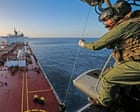
Helicopters hover low over the pitching deck of the tanker, the downwash whipping the sea into a white froth. Rigid-hulled inflatable boats (RHIBs) slam against the massive steel walls of the vessel. Royal Marines, weighed down by tactical gear, ascend the hull using caving ladders. Every second matters. The crew of a shadow tanker might attempt to destroy documents, delete digital navigation logs, or even alter the ship's course to enter international waters where legal jurisdictions blur.
The successful boarding and detention of the vessel sent an immediate shockwave through the maritime industry. For a long time, operators of the shadow fleet believed that the sheer complexity of maritime law, combined with the risk of military escalation, rendered them untouchable. They assumed Western powers would confine their protests to strongly worded press releases and updated sanctions lists.
The sight of armed British forces standing on the bridge of a seized tanker shattered that illusion.
The Ripple Effect in Kyiv
In Ukraine, where every day brings fresh challenges to the power grid, the economy, and the frontline, the news of the British operation provided a significant psychological and strategic boost.
President Zelenskyy’s rapid public acknowledgment underscored a vital truth: sanctions are only as strong as their physical enforcement. For months, Ukraine has urged its Western allies to move beyond financial bureaucracy and actively choke off the maritime pipelines funding the Russian war effort.
The equation is brutal in its simplicity. Every barrel of oil successfully smuggled by a shadow tanker translates directly into artillery shells, drones, and missiles targeted at Ukrainian infrastructure. By physically halting a tanker, the UK did more than disrupt a single supply chain. It demonstrated a willingness to use hard power to enforce international law on the high seas.
The Ghost Fleet’s Vulnerability
The operation reveals a critical flaw in the strategy of utilizing a shadow fleet. While digital finance can shift across borders in milliseconds, physical oil requires a physical ship. And physical ships must navigate specific, predictable geographic choke points.
The English Channel, the North Sea, and the Baltic straits are narrow, heavily monitored corridors. No matter how many fake companies a rogue operator sets up, the vessel itself remains a giant chunk of metal floating in highly regulated waters.
Consider the logistical nightmare now facing the coordinators of these illicit shipping routes. They must calculate the risk of their multi-million-dollar assets being seized by Western navies. Insurance costs for these already risky voyages will skyrocket. Fewer captains will be willing to take the helm of a ship that might end up boarded by elite military forces.
The UK's decisive action changed the calculus of risk. It proved that the ocean is no longer a safe haven for hidden commerce.
The grey tanker now sits quiet, its engines idling under the watchful eye of authorities, a silent monument to the fact that even the most invisible networks eventually have to face the reality of the physical world.