Cold.
Not the kind of cold that makes you zip up your parka on a brisk November morning, or even the kind that burns your nostrils during a Minnesota January, but an ancient, predatory absence of heat that strips away language, turns fingers into brittle sticks of chalk, and makes the simple act of drawing breath feel like swallowing crushed glass. At 29,032 feet above sea level, on the razor-thin spine of Mount Everest, the human body is not climbing. It is dying in slow motion.
Now, strap two pieces of fiberglass and steel to your boots, point your tips straight down a fifty-degree wall of blue glacial ice, and push off.
For decades, the mythology of Everest has been built entirely on the upward struggle. We know the names of the men who went up—Edmund Hillary, Tenzing Norgay, George Mallory—and we treat the summit as a finish line where the story neatly ends. Yet anyone who has ever spent time in the high mountains knows a terrifying secret that rarely makes it into the glossy adventure magazines. Going up is optional. Coming down is mandatory. And in the annals of Himalayan mountaineering, nobody has ever looked at the most lethal vertical mile on Earth and decided to ski it from the very top of the Hornbein Couloir.
Nobody, until Jim Morrison.
When Academy Award-winning filmmaker Jimmy Chin and ski mountaineer Jim Morrison recently sat down to discuss their upcoming Everest documentary, the press junket headlines reduced a decade of obsession, unspeakable tragedy, and superhuman grit into a neat little promotional soundbite. They called it a thrilling new extreme sports film. They talked about camera rigs and high-altitude logistics.
They missed the point entirely.
To understand why Chin and Morrison went back to the roof of the world—and why their film is shaping up to be the most haunting piece of cinema since Free Solo—you have to look past the spectacle of a man carving turns in the Death Zone. You have to look at the ghosts walking beside him in the snow.
The Weight of a Missing Partner
Picture a dining room table in Tahoe, California, quiet except for the hum of a refrigerator and the faint ticking of a wall clock.
This is a hypothetical scene, yet it mirrors the lived reality of every elite alpine family when the weather window closes on the other side of the globe. On the table lies a laminated topographic map of the north face of Everest, crisscrossed with red grease-pencil lines marking crevasses, serac fall zones, and rock bands that would turn a fall into a three-thousand-foot plunge. Beside the map sits an ice axe, its pick nicked from granite in the Karakoram, and a pair of ski goggles with the foam lining worn thin by sweat and frost.
For Jim Morrison, that map was never just geography. It was a shared language spoken with Hilaree Nelson.
If you follow big-mountain skiing, Nelson needs no introduction. She was the captain of The North Face athlete team, a mother of two, and arguably the greatest ski mountaineer of her generation. In 2018, Morrison and Nelson stood together on the summit of Lhotse—the fourth-highest mountain in the world, right next door to Everest—and made the first ski descent of the terrifying Lhotse Couloir. They were partners in the truest, most exposed sense of the word. When you are roped together on a ridge narrow enough to straddle like a horse, trust isn't a romantic ideal. It is a mechanical necessity.
Then came September 2022.
On the upper slopes of Manaslu, the eighth-highest peak on Earth, Nelson and Morrison reached the summit in brutal, shifting conditions. Minutes after clicking into their skis for the descent, a small slab avalanche triggered beneath Nelson's skis, sweeping her over a thousand-foot cliff on the south side of the mountain. Morrison skied down alone into a whiteout, searching frantically until the weather closed in, before returning days later on a helicopter long-line to recover the body of the woman he loved.
Pause and think about what happens to a human nervous system after a trauma like that.
Most of us, after surviving a car wreck on an icy highway, grip the steering wheel a little tighter for the next five years. Our brains are wired for self-preservation; we recoil from the stove that burned us. To lose your life partner on an eight-thousand-meter peak and then choose to return to an even higher, steeper, more unforgiving face on Everest seems, from the outside, like madness.
During their conversation about the film, Morrison spoke about this with a quiet, unadorned honesty that cuts straight through the macho posturing usually found in outdoor media. He didn't claim to be fearless. He didn't pretend that skiing Everest would somehow fix the hole left in his life. Instead, he revealed that the mountain had become the only place where the silence matched the grief inside his chest.
Why the Hornbein Couloir Defies Physics
To appreciate what Jimmy Chin had to capture through a frozen camera lens, we need to strip away the jargon of extreme skiing and look at the raw physics of the terrain.
Think of the steepest black-diamond ski run you have ever seen at a commercial resort. Stand at the top, look over the edge, and feel that familiar flutter in your stomach. That slope is probably around thirty-five degrees. Now, imagine tilting that hillside up to fifty or fifty-five degrees—so steep that if you reach out your hand while standing upright, you can touch the snow slope directly in front of your face.
Now, strip away the soft powder. Replace it with wind-scoured blue ice the texture of concrete, punctuated by jagged bands of dark limestone that have no snow on them at all. Remove seventy percent of the oxygen from the air, so your brain operates with the cognitive sluggishness of someone who has had four stiff drinks, and every muscular contraction floods your legs with lactic acid that your bloodstream lacks the oxygen to clear.
That is the Hornbein Couloir on the North Face of Everest.
First climbed in 1963 by Tom Hornbein and Willi Unsoeld during a legendary, survival-by-a-hair traverse of the peak, the couloir is a narrow, shadowy gash slicing straight down the upper northwest face. It is notorious among Himalayan veterans because the sun rarely touches it, leaving the snowpack rock-hard and unforgiving. In 2002, French snowboarder Marco Siffredi vanished in the Hornbein while attempting the first snowboard descent, leaving behind only a set of tracks disappearing into the clouds.
When Jimmy Chin talks about filming in that environment, you can hear the director warring with the mountaineer inside him.
Chin is a rare breed of artist. Before he won an Oscar for Free Solo or directed Meru and Nyad, he spent twenty years living out of the back of a Subaru in Yosemite Valley, learning how to hang from ropes with a heavy cinema camera while windstorms howled around him. He understands a fundamental truth that studio executives sitting in air-conditioned offices in Los Angeles never quite grasp: you cannot fake high-altitude terror.
In a Hollywood studio, a director can call "cut," adjust the key light, and ask the actor to look a little more exhausted on take four. On the North Face of Everest at 28,500 feet, there is no take two.
If Chin takes his mittens off for forty seconds to swap a frozen battery or clear frost from a telephoto lens, he risks permanent frostbite and the amputation of his fingers. If his camera rig slips from his tether, it doesn't just break—it becomes a lethal projectile hurtling toward climbers thousands of feet below. Worse still is the moral calculus every adventure filmmaker faces when the camera is rolling. At what point do you drop the lens to save your friend's life? And by standing there filming him, are you subtly encouraging him to push past a margin of safety he might otherwise respect?
The Art of Looking Without Interfering
I have spent enough cold nights shivering in snow caves in the Cascades and watching weather fronts roll across high passes to know how quickly bravado evaporates when the wind hits sixty knots. Out there, you learn to distrust anyone who talks about "conquering" a mountain. Mountains don't care about human ambition. They are indifferent piles of uplifted seabed and granite, governed entirely by gravity, thermodynamics, and time.
What makes Chin and Morrison's partnership so compelling on screen is their shared allergy to heroic mythology.
In their recent discussion of the documentary, both men leaned heavily into the vulnerability of the expedition. They talked about the days spent trapped inside shaking nylon tents, listening to the roar of the jet stream tearing across the summit ridge like a freight train passing three feet above their heads. They talked about the agonizing decisions around snow stability—reading the subtle signs of wind-slab formation, knowing all too well what happens when a hidden layer of weak sugar snow gives way beneath a pair of skis.
Consider what happens in the mind of a ski mountaineer standing at the entrance of a steep chute at extreme altitude.
Every instinct screams at you to lean back against the mountain, to hug the slope, to seek safety. Yet the fundamental law of steep skiing is entirely counterintuitive: you must throw your weight forward, down the fall line, committing your center of gravity over empty space so the edges of your skis can bite into the ice. Hesitation is fatal. If you lean back out of fear, your tails wash out, your edges lose grip, and you fall.
That physical paradox is the beating heart of the entire film.
Morrison had to lean forward into the void not just physically, but emotionally. Having already lost one life to the mountains, he had to trust his judgment, his preparation, and his partner behind the camera while making turns where a single caught edge meant certain death. And Chin had to match that commitment, positioning himself on exposed rock buttresses and hanging from fixed lines with a small, elite crew of Sherpa climbers and high-altitude cinematographers to capture the descent from angles that convey the sickening verticality of the face.
The Invisible Hands on the Mountain
No honest story about Everest can be told without acknowledging the people who make every Western expedition possible, and Chin has long been vocal about shifting the camera toward the Sherpa athletes who carry the heaviest loads.
For generations, mountaineering documentaries treated Nepali climbers as nameless background figures—silhouettes trudging through the Khumbu Icefall while a Western narrator spoke solemnly about destiny and personal triumph. That era is thankfully dying, and Chin's body of work has played no small role in dismantling it.
On an expedition as technical and dangerous as a Hornbein Couloir ski attempt, the Sherpa team isn't merely hauling oxygen bottles and setting up base camp tents. They are elite high-altitude alpinists breaking trail through waist-deep snow, fixing thousands of feet of rope across treacherous traverses, and reading the subtle moods of a mountain they have lived beside for centuries.
When you watch footage from Chin's expeditions, you notice the quiet intimacy between the climbers. There is no barking of orders. There are shared thermoses of sweet milk tea in cramped cook tents, quiet laughter over blistered feet, and a mutual recognition that once you step onto the upper mountain, national borders and sponsorships disappear. Everyone bleeds the same red blood on the white snow. Everyone breathes the same thin air.
Why We Watch Men Walk Along the Edge
Every time a film like this is announced, the same debate flares up in comment sections and dinner parties around the world.
Why do they do it? Isn't it selfish? What about the families left waiting at the bottom of the hill, staring at a satellite tracker dot that refuses to move for six hours?
Those aren't cynical questions; they are deeply human ones. And if you want a tidy, comforting answer, you won't find it in Jim Morrison's eyes or Jimmy Chin's camera frame.
We live in an era engineered to eliminate friction and risk. Our cars beep if we drift three inches out of our lane. Our phones alert us to mild rainstorms forty minutes before the first drop falls. We spend our days staring at glowing rectangles, insulated from weather, hunger, and physical consequence, yet strangely numb—as if by sanding off every sharp edge in our lives, we accidentally dulled our capacity to feel alive at all.
When we watch someone like Morrison click into his bindings at 29,000 feet, we aren't watching a daredevil chasing an adrenaline rush. Adrenaline is for thirty-second bungee jumps and roller coasters. You cannot sustain adrenaline over six weeks of freezing temperatures, brutal headaches, muscle wasting, and relentless psychological dread.
What we are watching is radical presence.
At fifty degrees on blue ice, with three thousand feet of exposure beneath your ski tips, there is no room for anxiety about next quarter's spreadsheets or regret over an argument from three years ago. Past and future collapse into a single, razor-sharp instant: plant the pole, unweight the tails, pivot the skis, set the edge, breathe. Repeat. Repeat. Repeat.
For a man carrying the unbearable weight of grief, that absolute concentration isn't an escape from reality. It is the purest form of survival.
The Frame That Stays Behind
When the lights eventually come up in theaters and living rooms after audiences watch Chin and Morrison's new documentary, the technical stats will fade quickly from memory. People will forget the exact vertical drop of the Hornbein Couloir, the model of cinema camera Chin modified to withstand minus-forty-degree winds, and the precise dates of the summit push.
What will remain is something quieter and far harder to shake.
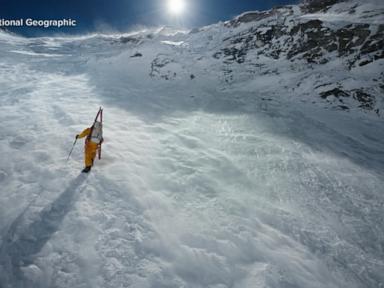
It is the image of a solitary figure paused high on a vast, indifferent wall of snow and shadow, framed against the curvature of the Earth where the blue sky begins to darken into the black of space. Beneath his skis lies an abyss that has swallowed legends whole. Behind him stands a friend holding a lens steady with frost-nipped fingers, bearing witness so the rest of us can glimpse what the human spirit looks like when stripped of every excuse and comfort.
The figure takes a slow, rattling breath through his mask, tips his weight forward over the edge, and drops into the white.