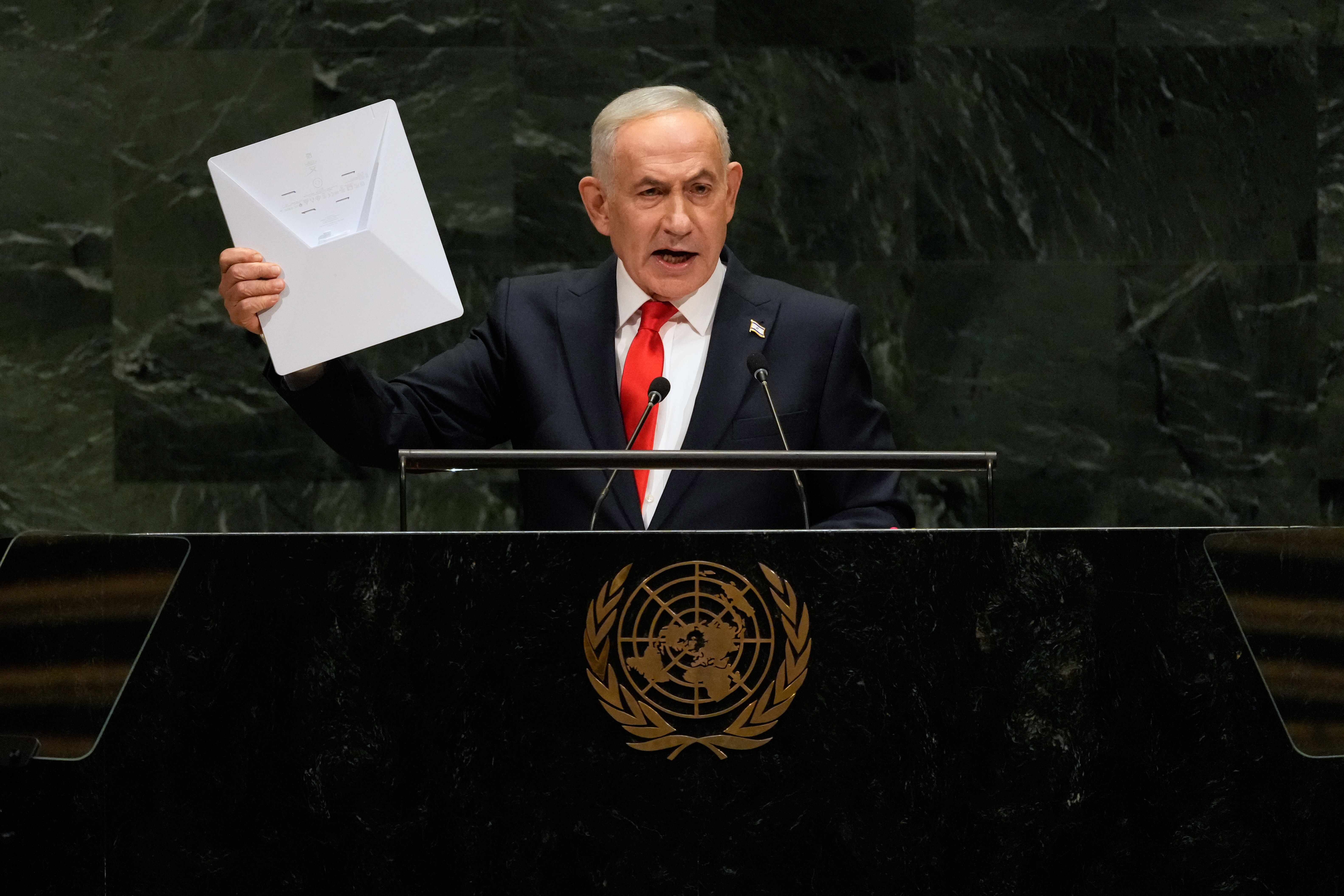
The marble of the General Assembly hall absorbs sound the way an open grave absorbs rain. It is a strange architecture, designed to project permanence while sheltering the most volatile disagreements on earth. When a leader steps toward that blue backdrop, shoes clicking against the floor in rhythmic cadence, the air in the room shifts. Papers rustle. Earphones adjust. Ambassadors who have spent decades perfecting the art of the poker face lean forward, waiting for the rupture.
Benjamin Netanyahu did not come to New York to whisper. He came to draw a line in the dirt of international diplomacy, using the most public forum humanity has managed to construct as a megaphone for his grievances.
Noise. Everywhere, noise.
Outside the glass walls of the United Nations headquarters, the streets of Manhattan pulse with the familiar, chaotic rhythm of sirens, megaphones, and chants that echo off concrete canyons. Inside, the noise is refined, translated into six official languages, whispered through interpreters sitting in glass boxes like translators at a high-stakes poker game. But on this day, the translation barely mattered. The emotional temperature of the room was already boiling before the Israeli prime minister even reached the microphone.
Critics had spent the preceding days circling the wagons. Among them, prominent figures like Columbia University scholar and activist Mahmoud Mamdani had articulated a counter-narrative that resonated deeply with a shifting global consensus—one that interrogated the structural roots of the conflict, the humanitarian catastrophe in Gaza, and the legal frameworks of occupation. To Netanyahu’s camp, these critiques were not merely political opposition; they were existential threats, moral inversions packaged in the polished language of academia and human rights.
When Netanyahu gripped the sides of the podium, his knuckles whitening slightly under the television lights, he addressed those critics directly. Not with diplomatic hedging. With fury.
He accused the international community of harboring a profound double standard. He pointed fingers at institutions that, in his view, obsess over Israel's military actions while turning a blind eye to the architects of terror surrounding its borders. Every sentence was a physical blow, calculated to tear down the carefully curated facades of neutrality that diplomats spend careers constructing.
Imagine sitting in the gallery overhead. Look down at the floor of the assembly. You see rows of delegates from nations small and large. Some stare straight ahead, jaws clenched, refusing to grant the speaker the validation of a nod. Others scribble furiously on legal pads, drafting rebuttals they know will change precisely no one's mind. A few seats sit conspicuously empty, delegations having walked out in a theatrical display of protest that has become its own ritual within these walls.
This is the theater of high-stakes survival.
To understand why Netanyahu rages against his critics, you have to strip away the polished podium, the television cameras, and the diplomatic protocol. You have to look at the psychological landscape of a nation that views itself as perpetually encircled. In that worldview, criticism is not an invitation to reform; it is a weapon designed to strip away the state's capacity to defend itself. When scholars and human rights advocates dissect government policy, the Israeli leadership hears the loading of a different kind of weapon—one aimed at their legitimacy on the world stage.
And that is where the tragedy truly deepens. Because both sides of this argument are trapped inside airtight narratives of victimhood and righteousness.
On one side stands the government of Israel, fighting for survival in a neighborhood that has historically sought its erasure, carrying the generational trauma of the Holocaust while executing military campaigns that leave cities in rubble and thousands of civilians dead. On the other side stand critics like Mamdani, pointing to the undeniable reality of stateless millions, the grinding machinery of occupation, and the moral rot that accompanies prolonged military rule over another people.
There is no common language here. There is only volume.
During his speech, Netanyahu held up props—maps, charts, visual aids designed to simplify complex geopolitical realities into stark binaries of good and evil. It is a populist tactic, ancient and effective. It tells the home audience that their pain is seen, that their leader is fighting the world on their behalf. But in the grand hall of nations, it sounded less like statesmanship and more like defiance. A man standing on a burning deck, shouting at the ocean.
The critics outside the hall, meanwhile, were assembling their own counters. In academic seminars, op-ed columns, and street protests, they argue that the current trajectory is morally unsustainable and legally indefensible. They argue that military dominance cannot purchase genuine security, and that erasing the political rights of Palestinians will ultimately hollow out the democratic soul of Israel itself.
Who is right?
The question is a trap. Both are right about the dangers they fear, and both are blind to the ways their own rigidity makes those dangers inevitable.
When the speech finally ended, the applause was predictably fractured. A scattering of approval from supportive delegates, matched by the cold, heavy silence of boycotts and folded arms. Netanyahu turned and walked away from the podium, his stride purposeful, his expression unchanged.
Out in the hallways, the real work resumed. Diplomats in Brioni suits huddled in corners, whispering into smartphones, trading gossip and analyzing the fallout. The interpreters packed up their headphones. The cleaning crews moved in with gray plastic bins, sweeping away discarded press releases and notes scribbled in a dozen different alphabets.
The U.N. General Assembly hall returned to its default state: a monument to human aspiration sandwiched between the reality of our enduring tribalism.
The speeches have faded. The transcripts are gathering digital dust in government archives. Yet the underlying fracture remains, raw and exposed, waiting for the next leader to step up to the marble, grip the edges, and raise the volume once again against the silence of a world that watches, paralyzed, as the old world burns.


