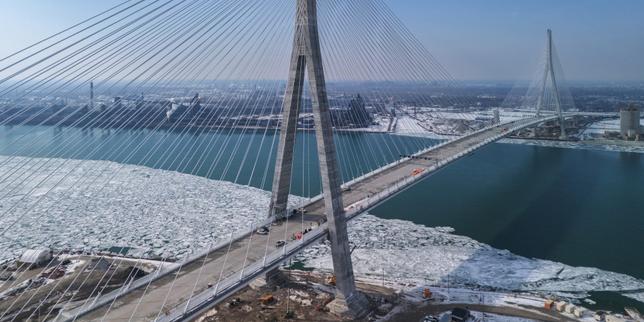
The media is mourning a bridge that is not yet open.
Mainstream business reporters are weeping over the latest delay of the Gordian international crossing between Windsor and Detroit. They treat the postponed completion date as a catastrophic failure of public infrastructure procurement. The headlines scream about lost economic momentum, supply chain bottlenecks, and bureaucratic incompetence.
They are looking at the wrong map.
A border crossing is not inherently valuable because it exists. It is valuable only if it optimizes a broader logistical network. The obsession with a fixed opening date misses the fundamental reality of continental freight: throwing massive concrete spans over a river does not solve structural supply chain friction.
Delaying the operational rollout of this multi-billion-dollar transit asset is a net positive for modern shipping logistics. It forces a hard, long-overdue recalibration of cross-border operations that carriers have avoided for decades.
The Bottleneck is in the Bytes, Not the Concrete
Mainstream analysts argue that every day the bridge remains unopened costs the manufacturing sector millions in idle truck time. This is a fundamental misunderstanding of how modern international logistics works.
I have spent years auditing supply chain networks across the Midwest corridor. I can tell you that asphalt is rarely the true cause of a border delay. A truck does not sit on the Ambassador Bridge for two hours because the road is narrow. It sits there because a Customs and Border Protection (CBP) digital manifest contains a typo, or because a food inspection certificate from the Canadian Food Inspection Agency (CFIA) has not cleared the digital portal.
Adding six more lanes of concrete merely moves the waiting room closer to the duty-free shop.
Building infrastructure without fixing regulatory data handling is like buying a faster processor for a computer connected to a dial-up modem. The Gordian crossing delay grants logistics providers an unexpected window to digitize their antiquated clearance protocols.
Consider the mechanics of the Free and Secure Trade (FAST) program. It is designed to expedite pre-approved commercial shipments. Yet, carriers routinely fail to utilize it effectively because their internal data pipelines are fractured. If the bridge opened tomorrow, the influx of volume would choke the existing digital infrastructure of both customs agencies. This delay gives operators breathing room to upgrade their automated broker interfaces.
The Myth of Redundant Infrastructure
A common talking point among regional politicians is that a new crossing provides crucial redundancy. They point to the 2022 Ambassador Bridge blockades as proof that a single point of failure can paralyze the automotive industry.
This argument is economically fragile. True infrastructure redundancy requires completely independent geographic routing, not an adjacent bridge terminating in the exact same metropolitan bottlenecks.
The Real Cost of Peak-Load Capacity
[Traditional Logistics View]
More Lanes -> Lower Congestion -> Higher Profitability

[The Contrarian Reality]
Excess Lane Capacity -> Over-Investment -> Margin Compression for Carriers
When you build massive infrastructure to satisfy peak-load demands—like a once-in-a-decade border shutdown—you create an asset that operates below capacity 90% of the time. The capital expenditure must be recouped. It will be recovered through aggressive toll structures that carriers will pass directly to shippers.
Imagine a scenario where the new bridge opens underutilized. Toll revenue plummets below projections. The public-private partnership (P3) consortium is forced to raise rates on commercial vehicles to service its debt. Suddenly, the "free market solution" becomes an expensive tax on every auto part crossing the Detroit River. By delaying completion, the operators defer depreciation costs and avoid locking in high operational overhead during a period of fluctuating freight volumes.
Why Shippers Must Pivot Immediately
Stop waiting for a ribbon-cutting ceremony to save your margin. It will not happen. Instead of praying for more asphalt, sophisticated logistics directors are restructuring their entire freight footprint to exploit the current delay.
- Decentralize Warehousing: Do not route everything through a single Michigan hub. Establish secondary distribution centers in Ohio or Indiana to access alternative crossings like Blue Water Bridge in Port Huron.
- Audit Your Customs Brokers: If your broker still relies on manual document processing, fire them. The delay means you have time to transition to customs partners utilizing API-driven, real-time clearing verification.
- Shift to Intermodal Rail: The real efficiency gains in cross-border trade are happening on tracks, not tires. CPKC and CN Rail are moving freight across borders with significantly less administrative friction per ton than regional trucking fleets.
The downside to this contrarian approach is obvious: it requires capital expenditure today to fix internal processes rather than relying on a public infrastructure project to bail out your inefficiencies. It forces companies to admit that their logistical failures are self-inflicted wounds, not the fault of government construction timelines.
The competitor articles will continue to whine about delayed timelines and political gridlock. Let them. While they wait for the concrete to dry, smart operators are fixing the invisible digital infrastructure that actually moves the world's wealth. The bridge will open when it opens. Until then, the delay is your greatest competitive advantage. Use it.