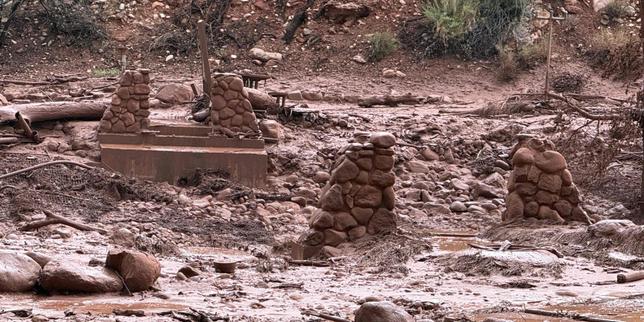
Flash floods in arid canyons are among the most lethal natural hazards on earth because they decouple local atmospheric conditions from downrange hydraulic impact. When a storm cell drops heavy precipitation miles away over impermeable sandstone basins, the runoff funnels into narrow slot canyons with zero prior warning for visitors below. Analyzing these incidents requires examining the interaction between watershed morphometry, soil saturation thresholds, and hydrodynamic wave propagation.
The primary driver of high-mortality events in environments like the Grand Canyon is the catchment-to-channel area ratio. Arid landscapes feature sparse vegetation and crust soils that prevent immediate water infiltration. When intense rainfall occurs, the runoff coefficient approaches one, meaning almost all precipitation transforms directly into surface flow. This water accumulates in steep, branching tributaries that act as natural chutes, accelerating gravitational velocity and transforming a standard stream into a high-density slurry of water, boulders, and debris.
Understanding the risk profile demands a breakdown of the three primary variables governing flash flood severity: precipitation intensity, basin concentration time, and channel constriction.
Precipitation intensity dictates the volume of water injected into the system per unit of time. Unlike prolonged stratiform rain that allows for gradual soil absorption, convective thunderstorms dump immense volumes over short durations. A storm dropping two inches of rain in thirty minutes over a ten-square-mile impermeable basin yields millions of gallons of water funneled toward a single narrow exit point.
Basin concentration time measures how rapidly water travels from the most distant point of the watershed to the outlet. In steep canyon country, this metric shrinks dramatically. Water moves through slickrock gullies at speeds exceeding standard river currents, leaving emergency management systems and recreationalists with windows of response measured in minutes rather than hours.
Channel constriction acts as a hydraulic multiplier. As a wide wash narrows into a vertical-walled slot canyon, the cross-sectional area decreases exponentially. According to the continuity equation in fluid mechanics, a sudden reduction in area forces a proportional increase in flow velocity. This surge creates a wall of water known as a bore wave, capable of sweeping away human bodies, structural fixtures, and mature trees with equivalent force.
Evaluating historical incidents reveals recurring failure modes in human response patterns. Visitors often misjudge risk because weather conditions at the canyon floor are benign while severe weather rages miles upstream. Traditional weather forecasts lack the hyper-local resolution required to predict exact gully accumulation zones, rendering general park advisories insufficient for tactical decision-making in remote terrain.
Mitigating exposure requires an operational shift from reactive search and rescue protocols to predictive spatial avoidance. Backcountry travelers must evaluate upstream radar imagery rather than local visibility, identifying cumulative catchment areas before entering narrow drainages. Park management strategies face a structural bottleneck: hardening remote wilderness against dynamic hydrological forces is physically impossible, meaning safety relies entirely on behavioral compliance and real-time sensor integration.
The economic and logistical cost function of rescue operations following these events involves severe resource allocation trade-offs. Deploying helicopter crews, swift-water rescue teams, and canine units into remote canyon corridors requires hours of mobilization, during the golden window of survivability diminishes rapidly. Hypothermia, blunt-force trauma from suspended debris, and entrapment in submerged crevices account for the majority of fatalities, operating independently of the initial drowning hazard.
Future resilience in canyon recreation depends on deploying automated acoustic and water-level telemetry systems at critical upstream bottlenecks. Transmitting real-time telemetry directly to designated satellite communication devices carried by backcountry permits would bypass the lag inherent in centralized agency alerts. Until such infrastructure is ubiquitous, flash flood survival remains a function of recognizing upstream meteorological signatures and maintaining strict temporal discipline during monsoon seasons.