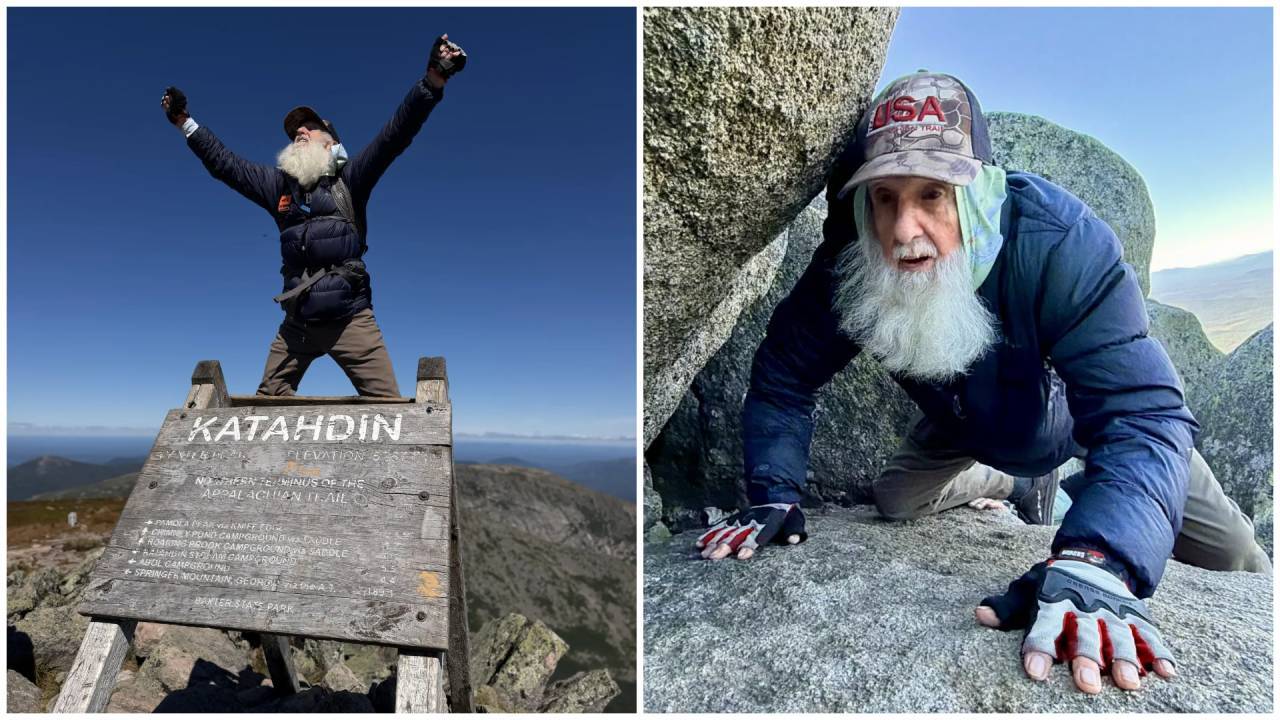
The Appalachian Trail does not care about your birthday. It does not care that your joints have turned to dry chalk, that your lungs have spent nearly a century filtering the air of this spinning planet, or that your grandchildren think you should probably stay inside where the floor is flat and predictable. The dirt path simply rises. It climbs over jagged quartzite ridges in Pennsylvania, scrambles through slick granite roots in New Hampshire, and demands that every human being who walks upon it pay the exact same toll in sweat, tendon, and heartbeat.
Dale Sanders paid it seventy-one times.
That is how many times he fell. Seventy-one distinct, ungraceful, bone-rattling crashes into the dirt, the rocks, and the unforgiving roots of a two-thousand-mile mountain chain. Most men at ninety-one are negotiating with gravity from the cushioned safety of a La-Z-Boy. They are measuring their world in the distance from the bed to the bathroom, perhaps taking a slow, cautious shuffle down the driveway to check the mail if the weather is agreeable. Dale measured his world in white blazes painted on trees, stretching from the lush green archways of Georgia all the way to the jagged, wind-scoured summit of Mount Katahdin in Maine.
To understand what happened on that trail, you have to abandon the modern obsession with comfort. We live in a culture engineered to eliminate friction. Every corner is rounded, every temperature is climate-controlled, and every physical inconvenience is met with an app or a pill. We treat aging as a slow-motion surrender, a quiet sliding into the shadows where we become fragile ornaments to be handled with care. Dale Sanders looked at that cultural script, ripped it into confetti, and ate two thousand miles of dust instead.
He was not doing this for the sake of a casual afternoon stroll. The numbers alone are enough to make a marathoner wince. Two thousand one hundred and ninety-three miles. That is the distance of walking across an entire continent, vertically. It requires climbing the equivalent of Mount Everest nearly sixteen times over. And Dale did it at an age when most people's birth certificates belong in a history museum.
When he reached the northern terminus in Maine, he did not just finish a hike. He reclaimed the crown. He smashed the record for the oldest person ever to thru-hike the Appalachian Trail, taking back a title he had previously set years earlier, only to watch someone else take it. That is the thing about records and about aging: they are moving targets. They wait for no one.
Think about what it takes to get up at dawn when you are ninety-one years old. Think about the stiffness that settles into the hips after sleeping on a thin foam pad on the hard floor of a nylon tent. The dampness of the mountain morning seeps into your bones before you even lace your boots. Most of us hit snooze when the bedroom is seventy degrees and the coffee maker is glowing warmly across the room. Dale woke up in the wilderness, packed his pack, and faced another twelve miles of uphill punishment.
Why?
The answer is deceptively simple, yet almost entirely lost on contemporary life. We have mistaken safety for living. We believe that by wrapping ourselves in bubble wrap, we can cheat time. But time collects its debt either way. It takes your strength whether you use it or waste it. Dale chose to spend his strength buying moments of raw, unadulterated existence.
Every fall was a lesson in humility. Seventy-one times, his feet betrayed him. Seventy-one times, gravity reminded him of his age. In a hypothetical world where we design our lives around avoiding embarrassment, seventy-one public stumbles would be enough to make anyone crawl back into obscurity. But Dale got back up. He dusted off his knees. He tightened his pack straps. Each recovery was an act of quiet defiance against the narrative that old age must look like a waiting room.
There is a profound psychological weight that comes with endurance sports at any age, but at ninety-one, it borders on the philosophical. The human mind is remarkably good at telling us to quit long before the body actually gives out. When your muscles scream, when your water filter clogs, when a cold rain has been falling horizontally for six hours, the voice inside your head becomes very persuasive. It tells you that you have nothing left to prove. It tells you that nobody would blame you for calling a shuttle, getting a hotel room, and going home to watch television.
Dale’s genius was that he stopped listening to that voice years ago. He realized that the discomfort of the trail is temporary, but the regret of quitting is permanent.
We look at figures like this and treat them as anomalies, as superheroes from another dimension who possess biological machinery the rest of us lack. That is a comforting lie. It lets us off the hook. It allows us to say, "Well, he's just built differently," so we don't have to examine our own sedentary habits. But biology is universal. Joints wear out, muscles atrophy, and skin thins. Dale experienced the same pain, the same exhaustion, and the same self-doubt that any hiker feels at mile five hundred. The difference wasn't his DNA. It was his stubborn refusal to let his birth certificate dictate the boundaries of his life.
Consider the sheer sensory overload of the trail. The smell of rotting pine needles after a summer downpour. The freezing shock of mountain stream water against sun-baked skin. The absolute silence of a high-altitude ridge just before the sun breaks over the horizon. These are things you cannot experience through a screen. They cannot be optimized, virtualized, or summarized in a bulleted list. They demand your physical presence. They require you to show up, skin in the game, ready to be battered by the elements.
When he crossed that final finish line, surrounded by family, friends, and fellow hikers who looked like they had been put through a shredder, there were no pyrotechnics. There was no corporate sponsorship blaring from giant speakers. There was just the wind, the granite, and a very old man who had walked across a mountain range because he still could.
The record will stand, no doubt. Someone younger, faster, or perhaps just as stubborn will eventually come along and try to break it. Records are built to be broken, just as bodies are built to break down. But that is missing the point entirely. The record is just a footnote in the ledger of human potential.
The real victory is the refusal to go quietly into the night. It is the understanding that life is not measured by the number of breaths you take, but by the moments that take your breath away—or, in Dale’s case, the moments that knock the wind out of you on a rocky ridge in Virginia and force you to laugh, pick yourself up, and keep walking.
The mountain is still there. The white blazes are still painted on the trees. And somewhere out on the horizon, the path keeps climbing.