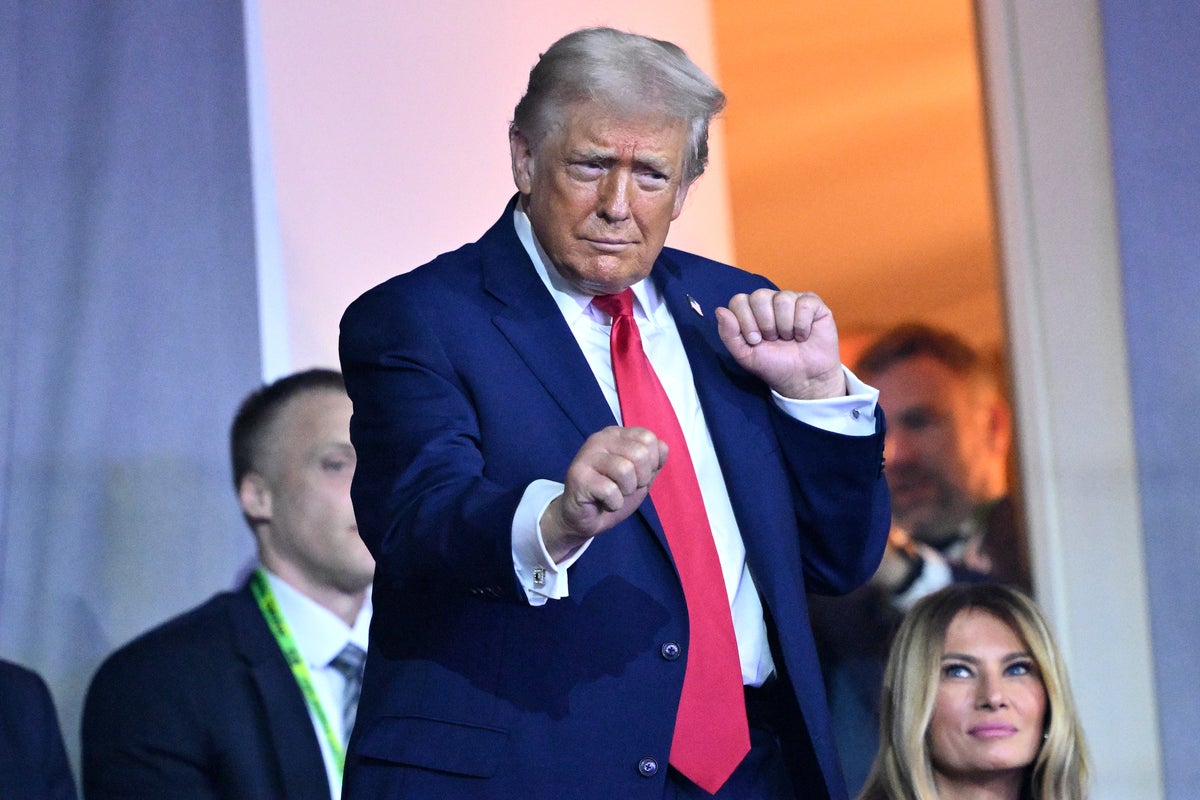
The air inside the stadium does not just vibrate; it bruises. Eighty thousand throats screaming in unison create a physical pressure, a wall of sound that rattles the concrete beneath your feet and thumps against your ribs. On the grass below, twenty-two men have spent the last two hours bleeding for a five-kilo orb of solid eighteen-karat gold. But up in the climate-controlled luxury suites, the game is entirely different. Up there, the grass is invisible, replaced by the optics of power.
When the final whistle blows, the tournament ceases to belong to the athletes. It transitions into the hands of the showmen.
Donald Trump’s preparation to hand over the FIFA World Cup Trophy represents something far larger than a standard post-match ceremony. It is the culmination of a deliberate narrative pivot. For decades, soccer was viewed by the American political establishment as an exotic import, a game played elsewhere, a sport that struggled to take root in the dirt of gridiron football and baseball diamonds. Now, it is the center of the universe. And in the eyes of the man preparing to step onto the presentation podium, the entire global spectacle is not just an international festival. It is an American conquest.
Consider the optics. The world is watching. Billions of eyes are glued to a single raised stage in the center of the pitch. Every flashbulb in the arena is aimed at the gleaming gold statuette, and standing right beside it is the president, ready to frame the global game as a domestic triumph.
The Sound of Eighty Thousand Judgments
Step into the concourse an hour before kickoff. You smell the spilled beer, the hot asphalt, the collective sweat of people who have traveled from Buenos Aires, Munich, Tokyo, and Ohio. They wear their flags like armor. The World Cup is a secular religion, perhaps the only truly global one left. It operates on a simple premise: for ninety minutes, nations can wage war without casualties.
When a head of state enters this arena, the atmosphere shifts. The crowd is not a monolith. Half of the stadium roars in approval; the other half boos with a ferocity that feels almost primal. It is a stark reminder of the underlying friction. Soccer fans are fiercely protective of their sport. They view it as a sanctuary from the sterile world of corporate politics. Yet, the collision between global sport and nationalistic branding is inevitable.
The preparation for this specific trophy presentation required weeks of logistical and political choreography. FIFA, an organization that guards its protocols with monastic devotion, usually prefers its ceremonies to be neutral, polite, and thoroughly sanitized. But neutrality vanishes when the host nation's leader decides to treat the entire tournament as a personal validation of national supremacy. The narrative being projected from the suite is unambiguous: we built the stages, we filled the seats, and therefore, the victory belongs to us.
It is a masterclass in political theater. The game itself provides the drama, but the ceremony provides the meaning. By positioning himself as the ultimate master of ceremonies, Trump reshapes the global perception of the event. It is no longer just a tournament hosted on North American soil. It becomes a testament to American dominance, an assertion that even the world's game operates under the American sun.
The Weight of the Metal
Gold is heavy. The World Cup trophy weighs exactly thirteen and a quarter pounds. It depicts two human figures holding up the Earth. Holding it requires two hands and a stable stance.
Think about the physical reality of that moment on the pitch. The confetti cannons are primed. The security detail is tense, eyes scanning the rafters. The winning players, exhausted to the point of collapse, are waiting to grasp the one thing they have chased since childhood. To them, that trophy is the physical manifestation of sacrifice. It represents broken metatarsals, lonely nights in foreign training academies, and the crushing weight of their countrymen's expectations.
Then comes the handoff.
When a politician steps between the player and the prize, the symbolism is unmistakable. The politician becomes the gatekeeper of glory. For Trump, this moment is the ultimate validation of a long-standing philosophy: winning is everything, and being seen with the winners is the next best thing. The celebration of the tournament as a US victory, regardless of which two teams actually competed on the grass in the final minutes, is a calculated rhetorical strategy. It reframes hospitality as ownership.
The strategy works because human beings are hardwired to respond to pageantry. We look at the center of the stage. We remember the image of the handoff long after we forget the specific tactical substitutions made in the seventy-third minute. The photograph of the presentation will be printed in newspapers from London to Johannesburg, and in every single one of those photos, the American president will be the anchor of the frame.
The Invisible Stakes on the Pitch
Let us look closer at what is actually being celebrated. It is not merely the athletic prowess of the players. It is the sheer scale of the execution. The infrastructure required to move millions of people across continents, to secure massive metropolitan hubs, and to broadcast a flawless signal to every corner of the planet is a demonstration of raw logistical might.
When the tournament is claimed as a domestic triumph, the claim is rooted in this structural success. The argument is simple: no one else could have staged a show this massive. No one else could have turned a sporting event into a geopolitical statement of this magnitude.
But this grand narrative often ignores the quiet realities occurring just outside the stadium gates. Consider the local street vendors, the stadium janitors, the security personnel working twelve-hour shifts in the stifling heat. To them, the tournament is not a grand statement of national exceptionalism. It is a grueling, exhausting marathon. Their labor is the unseen foundation upon which the entire glittering apparatus rests. When the trophy is lifted, their contribution is subsumed into the larger, louder story of national pride.
The contrast is sharp. On one hand, you have the raw, unvarnished emotion of the sport—the tears of the losers, the ecstatic disbelief of the victors. On the other hand, you have the cool, calculating calculus of political capital. The magic of the event lies in how these two opposing forces manage to occupy the exact same patch of grass at the exact same time.
The Final Chord
The lights will eventually go out. The eighty thousand fans will file out into the night, leaving behind a sea of plastic cups and discarded flags. The stadium will fall silent, the echoes of the roars fading into the midnight air.
What remains is the imagery. The memory of the golden trophy glittering under the stadium lights, passed from the hands of power into the hands of athletic royalty. The celebration of the event as a national victory is a reminder that in the modern world, sport is never just sport. It is a mirror reflecting our desires for status, dominance, and validation on the global stage.
The true victor of the tournament is not just the team that scores the most goals. It is the entity that successfully captures the narrative, turning a simple game of foot-ball into an enduring monument to their own influence. As the president steps off the podium and the confetti settles onto the damp grass, the message left behind is clear: the world came to play, but America held the prize.