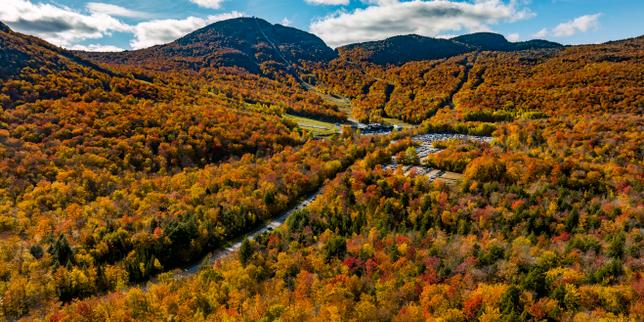
The air changes first. It loses that heavy, sun-soaked thickness of July and acquires a sudden, razor-sharp clarity that makes you want to draw breath deep into your chest, even if it aches. Out east, in the Laurentian hills of Quebec and along the winding ridges of Ontario, the green world grows restless. Trees that stood silent and dark through the humidity of midsummer begin to burn.
Listen. Can you hear it?
Nothing. Absolutely nothing. That is the true sound of autumn in Canada.
Every September, a quiet migration begins. It is not the dramatic, high-altitude flight of geese cutting V-formations across a slate-sky. It is terrestrial, deeply human, and remarkably coordinated. Millions of people pack wool sweaters into the boots of sedans, point their hoods toward the national parks and rural byways, and chase an illusion. Or perhaps, something more real than we care to admit. They are chasing the foliage. In French, they call it la flambée des couleurs. The blazing of the colors.
To understand why this annual pilgrimage matters, you have to stand where I stood three years ago: knee-deep in fallen sugar maple leaves outside of Huntsville, watching a couple from Toronto argue quietly over the lens setting of a camera while a child stared upward, utterly transfixed by a canopy that looked less like botany and more like an oil fire frozen in time.
The statistics are dry, but they tell a massive story. Tourism data from destinations like Ontario’s Cottage Country and Quebec’s Eastern Townships show that autumn brings a staggering influx of visitors—accounting for millions of day trips and overnight stays that inject hundreds of millions of dollars into rural economies just as the summer crowds vanish. Hotels that empty out after Labor Day suddenly find themselves booked solid for three consecutive weekends in October. Campgrounds overflow. Small-town bakeries sell out of apple tarts by noon.
Yet, numbers miss the point entirely. The economics are merely the scaffolding for an emotional necessity.
Consider what happens next: the physiological shift. Modern life keeps us trapped in shades of concrete and the flat, blue glare of screens. We live in environments engineered for constant productivity, where color is compressed into pixels. Then autumn arrives in Canada with a violence of pigment. It is a biological reset button.
When chlorophyll breaks down in the autumn air, it reveals the secrets the trees have been hiding all summer. The carotenes and xanthophylls—golds and yellows—step forward from the shadows. And the anthocyanins, born of crisp autumn nights and bright autumn days, paint the maples in crimsons and scarlets that defy belief.
(As a hypothetical scenario, imagine a corporate project manager from downtown Montreal, someone whose calendar is a patchwork of colour-coded stress blocks, pulling off the highway near Mont-Tremblant. Within twenty minutes of walking under a cathedral of red oaks, their heart rate drops. The shoulders lower. The urge to check email fades, replaced by an ancient, quiet attentiveness.)
This isn't just poetry. Psychologists call it attention restoration theory. Nature doesn't demand our directed, exhausted focus; it commands our soft fascination. And Canadian autumn is soft fascination turned up to an IMAX volume.
The geography of this phenomenon is vast, stretching from the Atlantic provinces across the Canadian Shield and down the St. Lawrence River valley. But the staging is delicate. A single hard frost too early can mute the brilliance. A torrential downstorm of rain and wind can strip the branches bare overnight, leaving travelers staring at a landscape of naked, wet charcoal.
That fragility is part of the magic. You cannot schedule awe. You cannot book a ticket for peak color with the precision of a train timetable. You have to watch the weather reports, talk to locals at roadside diners, and gamble. You have to be willing to drive an extra fifty kilometers down a dirt road just because a gas station attendant muttered that the ridge behind the lake "is really starting to turn."
This shared vulnerability creates a strange, beautiful camaraderie among strangers. At every lookout point along the Cabot Trail in Nova Scotia or the scenic parkways of Algonquin Provincial Park, people stand side-by-side in silence. They don't know each other’s politics, languages, or professions. For a few lingering moments, they are united by a common witness. They are watching the earth change its clothes.
We forget, in our haste to conquer time, that decay can be magnificent. Autumn in Canada is not a dying; it is a grand, defiant performance before the long sleep of winter. It teaches us a radical patience.
The leaves fall, drifting down to carpet the damp earth, feeding the roots for the cycle to begin anew. The crowds pack up their cameras, return to the cities, and plug back into the grid. But they carry something back with them. A residue of gold. A memory of red that refuses to be forgotten until the snow covers the ground, whispering of next year.



