The neon signs of Hong Kong’s financial district do not blink; they stare. From the 45th floor of a glass tower overlooking Victoria Harbour, the water looks less like a sea and more like a dark sheet of obsidian, cut through by the brilliant green-and-white hulls of the Star Ferries. For years, this view was the ultimate prize for a new breed of digital wealth creators. But lately, the glass feels less like a shield and more like a magnifying glass catching the harsh afternoon sun.
Down in the streets, a man we will call Mr. Chen stands near the Central Pier. He is forty-two, wearing a crisp white shirt with the sleeves rolled up, staring intensely at his smartphone screen. Chen is not a billionaire, nor is he a day trader looking for a quick thrill. He is a middle-class saver from Shenzhen who, up until recently, crossed the border regularly to manage what he calls his "rainy day fund."
On his phone is the bright, playful interface of Futu, the digital brokerage giant that revolutionized how a generation of retail investors interacted with global markets. The app is fast. It is sleek. But Chen’s thumb hovers over the screen with a visible, quiet hesitation.
He represents the human pulse behind a massive corporate pivot.
Futu, along with its rivals, is facing an undeniable reality. The wind from Beijing has changed. What was once a gray area—allowing mainland Chinese investors to seamlessly trade stocks in Hong Kong and New York through digital platforms—has solidified into a firm, regulatory wall. The mainland business is shrinking, forced back by the tightening grip of capital controls and data security laws. Yet, even as the tide pulls back from the mainland, the company is doubling down on the neon-lit streets of Hong Kong.
This is not just a story about regulatory compliance or shifting balance sheets. It is a story of survival, identity, and the high-stakes game of keeping a foothold in a changing world.
The Invisible Border in the Cloud
To understand why Chen is hesitant, one must understand the invisible architecture that built the digital brokerage boom. For nearly a decade, the border between mainland China and Hong Kong existed in two entirely different dimensions. Physically, it was a checkpoint with passport stamps and luggage scans. Digitally, it was a highway.
Fintech companies built beautiful, frictionless bridges. A user in Shanghai could open an account in minutes, convert their wealth, and buy shares of tech giants listed an ocean away. It felt modern. It felt unstoppable.
Then came the reckoning.
Regulators in Beijing made it clear that cross-border brokerages operating without specific domestic licenses were running afoul of the law. The message was delivered not with a sudden hammer blow, but with a series of systematic, escalating warnings. First came the public criticisms regarding data privacy. Then came the removal of apps from mainland app stores. Finally, the stark declaration: new mainland users could no longer be onboarded.
Imagine building a high-speed railway, laying thousands of miles of track, and perfecting the engine, only to have the terminal station closed at the border.
For Futu, the math changed overnight. The vast pool of over a billion potential users was suddenly fenced off. The company had to publicly acknowledge that its mainland brokerage business would inevitably contract. The golden goose had not just flown away; it had been grounded by decree.
The Psychology of the Retail Bastion
But a company is not a static object. It is a collection of capital, code, and human ambition. When one door slams shut with a metallic echo, the survival instinct demands that you look at the floor beneath your feet.
For Futu, that floor is Hong Kong.
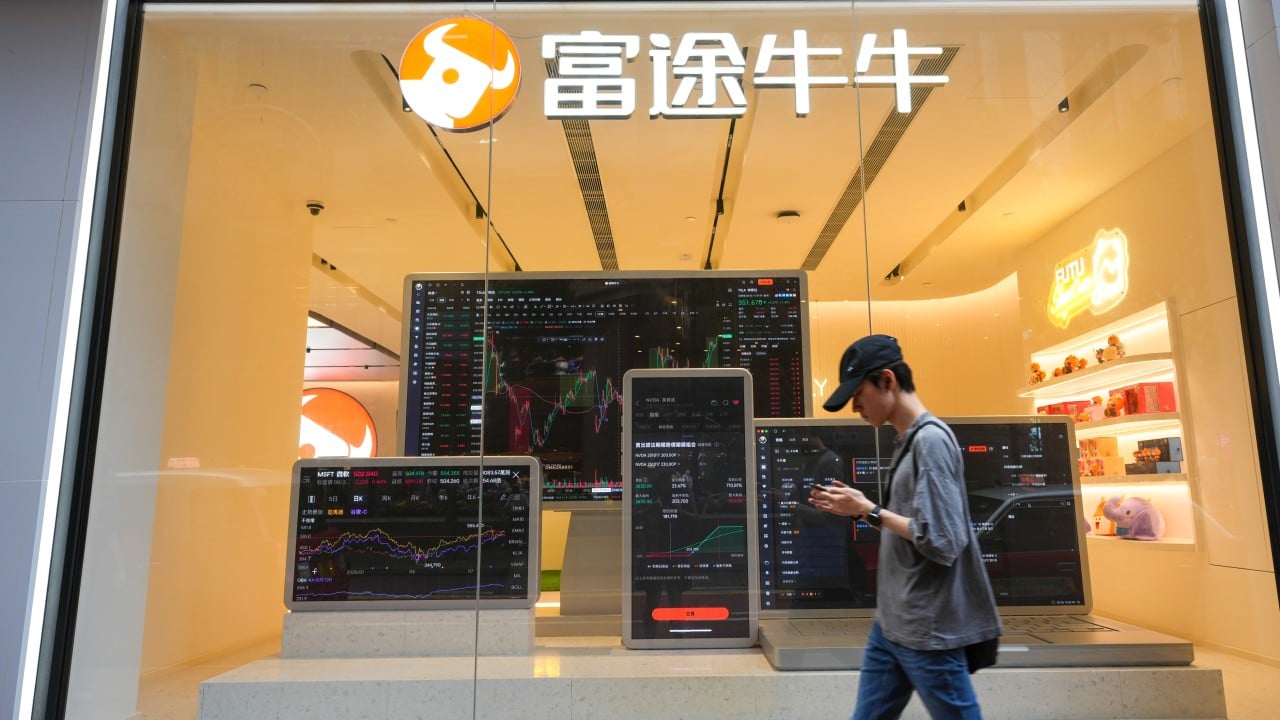
While the mainland market cools to a freeze, the physical and digital presence of Futu in Hong Kong is expanding in ways that defy the traditional digital-only playbook. Walk through Mong Kok, Causeway Bay, or Tsim Sha Tsui, and you will encounter something unusual for an app-based company: brick-and-mortar stores.
They are bright, dressed in the company’s signature green, looking less like traditional, wood-paneled brokerage houses and more like high-end smartphone boutiques.
Why would a tech company, born in the cloud, invest in expensive Hong Kong real estate?
Trust is a physical commodity.
Consider the older generation of Hong Kong investors, people like Ms. Wong, a retired schoolteacher who lives in a modest apartment in New Territories. She does not trust an algorithm with her life savings. She wants to look a human being in the eye. When she sees a physical store on her daily walk to the market, the app on her phone transforms from an abstract piece of software into a permanent institution.
By vowing to maintain and expand these physical outlets, the company is executing a psychological maneuver. They are signaling stability to a nervous market. They are saying: We are not going anywhere. In a city that has weathered profound economic and social shifts over the past few years, permanence is the ultimate currency.
The High-Stakes Math of Staying Local
The strategy is not without intense friction. Hong Kong is one of the most expensive real estate markets on Earth. Renting retail space in prime shopping districts requires a massive, continuous outflow of capital.
Consider the financial trade-offs at play:
| Operational Variable | Mainland China Market (Past) | Hong Kong Market (Present/Future) |
|---|---|---|
| User Acquisition Cost | Low (Viral digital growth) | High (Hyper-competitive, physical presence needed) |
| Regulatory Risk | High (Unpredictable cross-border policy) | Manageable (Structured under local HK authorities) |
| Physical Overhead | Negligible (Cloud infrastructure) | Substantial (Prime retail storefronts) |
| Market Saturation | Low (Massive untapped population) | High (Deeply penetrated financial hub) |
The transition from the left column to the right column is painful. It requires a fundamental rewiring of corporate DNA. You cannot run a localized, physical-heavy business with the same wild profit margins as a borderless software platform.
Every square foot of a Causeway Bay store must justify its existence through local account openings, wealth management upsells, and brand loyalty. The company can no longer rely on the sheer volume of a billion-person market. They must wring more value from a city of seven and a half million.
The Human Cost of the Shift
Behind the corporate announcements and strategic vows lie the quiet anxieties of the people who keep the gears turning.
Inside the company, engineers who once optimized servers for millions of concurrent mainland users are now refocusing their efforts on localized features for Hong Kong residents—integrating local payment systems, tailoring content to the specific nuances of Cantonese financial vocabulary, and building out wealth management tools for an older, wealthier demographic.
There is a distinct vulnerability in this pivot. To admit that your primary engine of growth is shrinking is an act of corporate humility that markets rarely reward gently. Stock prices fluctuate. Analysts dissect every syllable of executive commentary.
But for the employees on the ground, the mission has shifted from conquest to defense.
Outside the physical outlet in Central, a young staff member in a green polo shirt explains the platform's new mutual fund features to an elderly gentleman. The young man speaks with patience, his voice competing with the roar of double-decker buses and the chatter of pedestrians. He is the human face of an abstract corporate strategy. If he fails to convince the gentleman in front of him, the shiny glass storefront becomes nothing more than an expensive billboard.
Beyond the Harbor
The true stakes extend far beyond the balance sheets of a single fintech firm. What is happening here is a microcosm of a broader, historic realignment. Hong Kong has always functioned as a dual entity: a gateway into China for global capital, and a gateway out of China for domestic wealth.
As the gateway out tightens, Hong Kong must reinvent its purpose. It cannot merely be a transit point for mainland money. It must become a self-sustaining ecosystem of financial technology that serves its own populace and projects outward into Southeast Asia and beyond.
The retreat from the mainland is absolute. There is no political magic wand that will reverse the regulatory posture of Beijing. The digital wall is built, the bricks are cured, and the mortar is dry.
But the harbor remains open.
As twilight falls over Central, the neon lights sharpen against the darkening sky. Mr. Chen finally puts his phone in his pocket, takes a slow sip of his iced lemon tea, and looks toward the ferry terminal. He hasn't closed his account. He hasn't moved his funds. He is watching, waiting to see if the green storefronts stay illuminated through the winter.
The battle for the future of digital wealth is no longer being fought in the sprawling tech parks of Shenzhen or the regulatory offices of Beijing. It is being fought step by step, store by store, on the crowded, expensive pavements of Hong Kong.