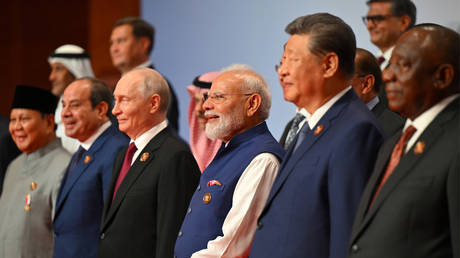
Ink dries on paper. Microphones capture the polite clatter of applause. Flashbulbs freeze a moment in time, turning flesh and bone into flat, historical pixels.
We look at photographs of leaders meeting in air-conditioned halls in New Delhi and we see only protocol. We see titles. Prime Minister Narendra Modi. Vice President Jessica Alupo. We see flags draped with geometric precision, the heavy silence of guarded rooms, and the stiff formality of statecraft.
We forget the blood beneath the ink.
History is rarely made by grand declarations shouted from podiums. It is forged in the quiet spaces between sentences. It happens when two people representing millions of unseen faces sit across a polished mahogany table, weighed down by the hopes of generations who have known what it means to be overlooked by the map-makers of the world.
Consider what happens next in that New Delhi room.
The air is cool, smelling faintly of imported cedar and polished brass. Outside, the capital hums with the relentless, dizzying energy of twenty million souls navigating dust, exhaust, and ancient dreams. Inside, time slows down. Jessica Alupo adjusts her posture. Narendra Modi leans forward, hands clasped, listening with an intensity that strips away the theater of diplomacy.
Distance is a cruel architect. New Delhi and Kampala are separated by thousands of miles of blue water, arid plains, and shifting sands. For decades, that physical chasm dictated a kind of mutual invisibility. Empires drew lines across globes, splitting families, economies, and futures into neat, manageable categories that served only the distant capitals of old powers.
But maps are living things. They bleed. They tear. They heal.
To understand why a bilateral meeting between India and Uganda on the sidelines of a global summit matters, you have to look past the economic output metrics and the trade deficit sheets. You have to walk through the streets of Jinja, where the White Nile spills out of Lake Victoria like liquid glass. You have to listen to the whispers of families whose grandfathers crossed the Indian Ocean in wooden dhows, carrying little more than copper coins, religious texts, and an unshakeable resilience.
They built shops. They built railways. They built lives. And then, history fractured. The dark years of the 1970s scattered those communities to the wind, turning thriving homes into memories whispered across dinner tables in London, Toronto, and Mumbai.
Yet memory has a stubborn root.
When Vice President Alupo sits with Prime Minister Modi, she is not merely representing a government department or an administrative register. She is carrying the living proof of a shared survival. Uganda is a country young in spirit, vibrant with a median age that pulses with restless ambition. Millions of young Ugandans wake up every morning wanting what the youth of Mumbai or Bengaluru want: a fair shot at code, commerce, clean water, and dignity.
They want to write software. They want to farm their rich, volcanic soil with tools that do not break their backs. They want a world where their voice echoes louder than the charity appeals broadcast by foreign television stations.
And India, once tethered to its own grueling struggle against the architecture of colonial extraction, understands this language intimately.
This is why the conversation in New Delhi goes deeper than typical diplomatic pleasantries. It touches on the architecture of the future. When developing nations talk to each other today, they are no longer asking for permission. They are comparing notes on how to survive a shifting global economy that often feels rigged against them.
Technology transfer. Agricultural innovation. Healthcare access. These are not just bureaucratic buzzwords. They are the difference between a child growing up with a fighting chance or a life swallowed by preventable despair.
Let us be honest about the discomfort of modern international relations. For centuries, wealth and power flowed in one direction: from the Global South upward, feeding the machinery of distant industrial centers while leaving local populations to harvest the scraps. Every bridge built, every loan negotiated, every trade pact signed carried a hidden asterisk of debt and dependency.
That script is aging.
When nations that share historical scars look each other in the eye, the dynamic shifts. It becomes collaborative. It becomes personal.
Think of a Ugandan doctor trained on Indian medical advancements returning to a rural clinic outside Kampala, bringing sight to an elderly farmer who thought the world would simply fade to gray. Think of an Indian engineer working alongside a Ugandan agronomist to map soil humidity using satellite data, ensuring that a sudden drought does not wipe out a season's harvest.
These are the invisible threads holding the modern world together. They do not make prime-time television. They do not trend on digital feeds. But they are infinitely more powerful than any sanction or tariff.
The meeting in New Delhi is a brick placed in a wall that has been centuries in the making. It is the realization that if the future is going to look different from the past, the countries that bore the brunt of the old world order must write the rules of the new one together.
Modi knows the weight of expectation. India’s ascent on the global stage is a complex tapestry of triumph and staggering inequality, a nation racing against time to lift hundreds of millions out of poverty while claiming its rightful place as a technological and diplomatic titan. Alupo knows the fierce, protective pride of a nation guarding its sovereignty while hungry for transformation, refusing to be reduced to a footnote in someone else's geopolitical strategy.
When they shake hands, the flashbulbs pop. The cameras capture the moment.
Then the doors close. The press leaves. The real work begins.
In that quiet room, away from the roaring crowds and the performative theater of global summits, two nations look past the distance between them. They see a reflection of their own struggles, their own ambitions, and their shared refusal to remain secondary characters in the story of human progress.
The water keeps flowing out of Lake Victoria, carving its way north toward the Mediterranean. The monsoons keep sweeping across the Indian subcontinent, bringing life to parched earth. And across the vast expanse of land and sea, the connection deepens, quiet and unyielding, waiting for the rest of the world to catch up.