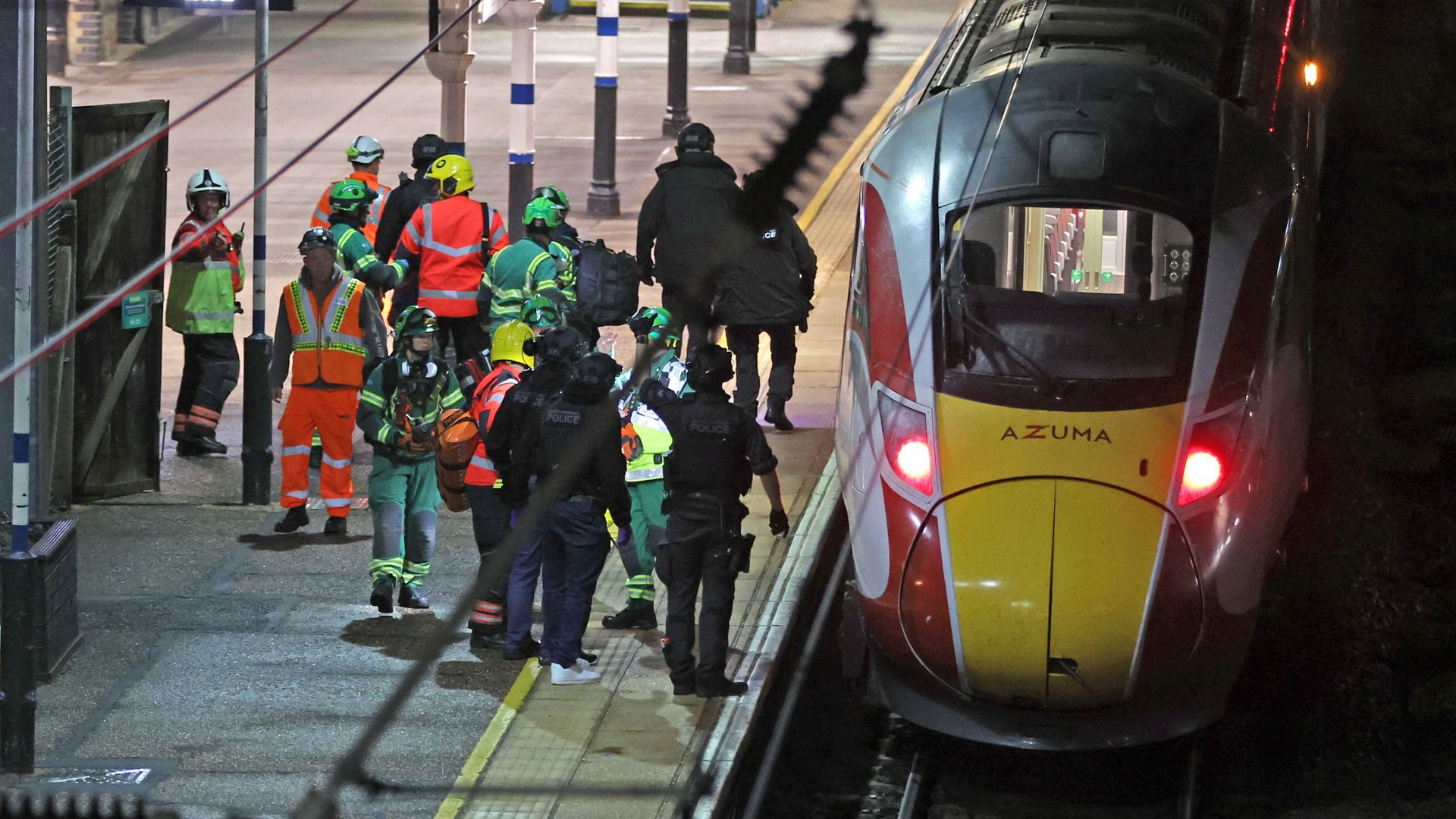
Imagine sitting alone in a reinforced metal box, controlling a multi-ton vehicle moving at seventy miles per hour, and suddenly hearing someone screaming about a knifeman stabbing people in the carriages behind you. You can't just pull over to the curb. You can't immediately run back to help without putting hundreds of other passengers at risk. When a train driver hears someone screaming about a stabbing onboard, every single second is governed by strict emergency protocols, split-second judgment calls, and heavy psychological pressure.
Most news reports focus on the immediate chaos in the passenger carriages, the arrival of armed police, or the tragic aftermath. Those headlines grab attention. Yet they rarely explain what actually happens inside the cab, why trains don't always slam their brakes in the middle of nowhere, and what you should realistically do if you ever find yourself trapped in a carriage during a violent attack.
Let's break down the reality of rail emergency response, why driver decisions look counterintuitive from the outside, and the exact steps that save lives when a knife attack happens on public transit.
The Split-Second Reality Inside the Driver's Cab
A train cab is designed to isolate the operator from distractions. Thick bulkhead doors, engine noise, and track clatter create a acoustic barrier between the driver and the passenger saloon. For a driver to hear someone screaming over that mechanical hum, the panic on the other side of the door has to be absolute.
Once that alarm registers—whether through direct shouting at the cab door, an intercom alert, or a passenger pulling the emergency pass-com—the driver faces an immediate dilemma. Panic makes people want the train to stop right now. Instinct tells you to hit the emergency brake and open the doors.
In rail operations, doing that in the wrong location is one of the worst mistakes a driver can make.
Think about what happens if a train stops inside a deep tunnel, on a high viaduct, or in a remote rural cutting with steep embankments and electrified third rails. First, passengers trapped in a carriage with an attacker have nowhere to run if the doors stay locked, or they risk fatal electrocution and falls if they force the doors open onto live tracks. Second, emergency services cannot reach a train stranded miles from road access.
Rail safety authorities across the UK, Europe, and North America train drivers on a specific counterintuitive rule. Unless the train is derailing or actively on fire, the priority is almost always to keep moving until reaching the next accessible station or designated road-rail access point.
Why Emergency Alarms Don't Automatically Halt the Train
A common misconception among commuters is that pulling the red emergency handle immediately locks the wheels and brings the train to a screeching halt. That used to be true on older rolling stock decades ago. Today, it's mostly false.
Modern passenger trains use what the rail industry calls a Passenger Communication System (often shortened to pass-com) equipped with an override function. When someone pulls that handle, an alarm sounds in the cab and a CCTV feed from that specific carriage often pops up on the driver's monitor. The brakes might begin to apply automatically, giving the driver a brief window—usually around three to five seconds—to press an override button.
Drivers use that override constantly during security incidents. Here is why that matters so much during a stabbing:
- Station containment: By overriding the brake and driving straight into the next platform, the driver brings the incident directly to waiting police, paramedics, and station staff.
- Controlled evacuation: Platforms provide level access so hundreds of panicked people can exit quickly without breaking ankles on track ballast.
- Communication continuity: Underground tunnels and deep cuttings often kill standard mobile signals, whereas stations have dedicated emergency radio repeaters that keep the cab connected to the signaller and British Transport Police or local transit authorities.
When a driver hears screaming about a knifeman, their hands are busy hitting the override, keying the GSM-R (Global System for Mobile Communications – Railway) emergency button, and requesting a priority clear path into the nearest station. That emergency radio call overrides all routine rail traffic, alerting the signaller to hold other trains and dispatch armed response units to the exact platform number.
The Problem With Open-Gangway Trains
If you've commuted on modern commuter rail or subway systems built over the last fifteen years, you've probably noticed a major design shift. Older trains had separate carriages connected by heavy, narrow sliding doors. Modern trains increasingly use open-gangway designs—long, continuous walkthrough tubes from the front cab to the rear cab.
Transit agencies love open gangways because they increase passenger capacity by roughly ten percent and allow riders to spread out evenly down the train. From a daily comfort standpoint, they're great.
From a violent crime standpoint, they change the tactical reality completely.
On older compartmentalized trains, a heavy door between carriages acted as a physical barrier. Passengers could flee into the next car and brace the door shut, buying crucial minutes until the train reached a station. On an open-gangway train, there are no doors between carriages. A person with a weapon has an unobstructed line of sight and a clear path down the entire length of the train.
I've spoken with transit security planners who openly admit this creates a tough trade-off. You cannot easily redesign thousands of modern train sets overnight. Instead, railway operators rely heavily on live-monitored CCTV, rapid station arrival protocols, and passenger awareness to bridge that gap. Knowing whether you're on a walkthrough train or a compartmentalized train immediately changes how far you need to move to put distance between yourself and a threat.
What You Should Actually Do During a Transit Knife Attack
Most people freeze during the first few seconds of a violent incident. Your brain tries to rationalize screaming as a drunken argument, a prank, or loud music. That normalcy bias wastes the exact window you need to get clear.
Counter-terrorism and transit police agencies—including the UK's Run, Hide, Tell framework and the US Department of Homeland Security's transit guidelines—emphasize specific actions tailored to enclosed rail environments. Forget heroic movie stunts. Focus on basic survival mechanics.
1. Move Away Immediately Instead of Filming
It sounds obvious, yet bystander footage from almost every major transit attack shows dozens of people standing frozen with their phones raised while an attacker is yards away. If you hear screaming about a knife or see a surge of people running toward your end of the carriage, drop whatever you're doing and move in the same direction immediately. Don't stop to grab heavy luggage from overhead racks. Bags can be replaced; you can't.
2. Use Carriage Doors as Tactical Barriers
If you are on a train with doors separating the carriages, get through the door and hold it shut or wedge it using whatever heavy objects are available—a wheeled suitcase, a backpack, or your own body weight braced against the frame. Heavy transit doors aren't bulletproof, and they won't stop someone indefinitely, but most attackers on trains are opportunistic and won't spend two minutes trying to pry open a jammed sliding door when the train is already slowing down for a station.
3. Communicate Specifics to the Cab
If you are near the front of the train or standing next to a passenger emergency intercom, press the button and state clearly what is happening. Drivers dealing with sudden chaos need short, actionable facts rather than frantic yelling. Say the carriage number if you see it printed above the gangway door, state that someone has a knife, and confirm if people are injured. That single piece of data allows the signaller to request trauma paramedics alongside armed police before the wheels even stop turning.
4. Stay Off the Tracks Unless There Is No Other Choice
When a train stops short of a platform because someone pulled the emergency brake without the driver overriding it, trapped passengers often try to pull the manual door release handle and jump onto the tracks. Think twice before doing that unless the attacker is actively breaching your immediate area and you have zero escape route inside the train. Live third rails carry anywhere from 600 to 750 volts DC, and overhead lines carry 25,000 volts. Passing trains on adjacent tracks also move silently and fast. Only exit onto the track bed as an absolute last resort, and move away from the rails toward the boundary fence immediately.
The Invisible Aftermath for Rail Workers
News cycles move on within forty-eight hours once an attacker is arrested and the station reopens. For the driver who heard those screams through the bulkhead door, the incident doesn't end when the shift finishes.
Train drivers operate largely in isolation. Unlike police officers or paramedics who work in pairs and expect to confront violent emergencies as part of their daily job description, a train driver's primary role is mechanical operation and signal compliance. Being thrust into a mass-casualty knife incident—hearing victims screaming yards away while powerless to leave the cab until the train is safely berthed—triggers severe acute stress and post-traumatic stress disorder at rates similar to first responders.
Rail unions and major operators have had to overhaul their trauma support systems over the last decade because of this exact scenario. Modern rail protocols now mandate immediate relief drivers at the incident station, mandatory clinical trauma assessments, and phased return-to-work programs. You can't expect someone who just listened to a violent attack unfold outside their cab door to simply clear the signals and drive the next commuter service down the line.
Preparing for Your Next Commute
You don't need to ride public transit in a state of constant paranoia. Statistically, rail travel remains one of the safest ways to move through a major city, with violent incidents representing a tiny fraction of billions of annual passenger journeys.
Still, passive awareness costs nothing and takes five seconds when you board. Notice whether your train has doors between carriages or an open walkthrough layout. Spot where the emergency intercom button sits near the vestibule doors. Keep your headphones at a volume where you can actually hear what's happening in the carriage around you, especially during late-night or off-peak journeys when stations are quieter and staffing is thinner.
The next time you see a headline about a train driver hearing screams and rushing a train into a platform, you'll understand the split-second calculation behind it. Staying calm, recognizing the reality of rail safety systems, and moving decisively when alarms sound gives both you and the crew at the front of the train the best possible chance of getting everyone home safely.