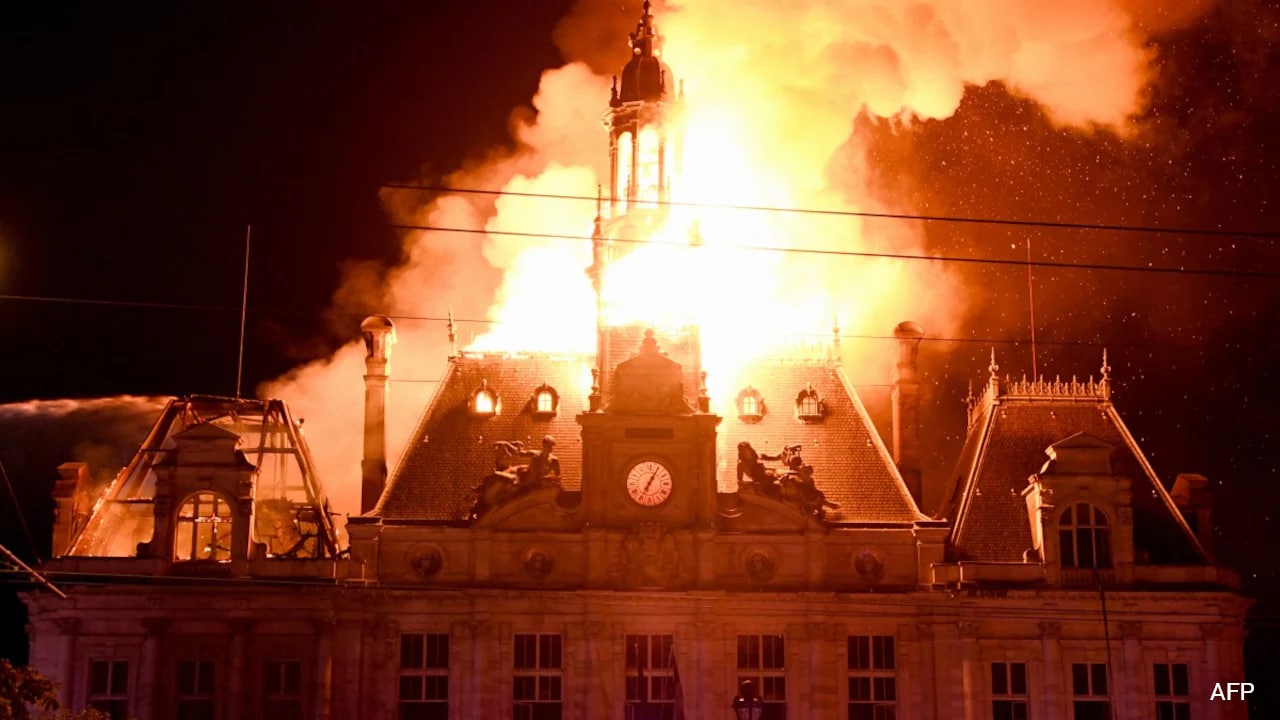
Shattered glass crunches under a leather boot. Smoke clings to wet granite, thick enough to taste like burnt pine and hot iron.
Standing on a street corner after a civic clash leaves a sound inside your chest that has nothing to do with sirens. It is the dull thud of a heavy door hitting a stone threshold. It is the hiss of water meeting glowing timber. When a building as old and deliberate as the town hall of Limoges—the Hôtel de Ville in west-central France—becomes the focal point of street violence and fire, people tend to reach for neat, cold nouns. Damage. Clashes. Protests. Restoration costs. For a deeper dive into this area, we recommend: this related article.
Cold nouns are easy. They keep us safe from the messiness of grief and anger.
Yet when a municipal building that stood through two world wars is scorched and broken during domestic unrest, something stranger and more unsettling happens than property damage. A shared memory gets bruised. Even if you have never walked up the steps of Limoges Town Hall to register a birth, apply for a permit, or watch a local council debate the price of school lunches, you know what that building represents. It is the physical address of ordinary civic life. To get more details on the matter, extensive coverage can be read on The Guardian.
To understand why the destruction of a historic town hall hits so hard, we have to look past the headlines and trace what really burns when public stone meets civil rage.
The Weight of Civic Stone
Limoges has a long memory. Situated in the Haute-Vienne department, the city has long been tied to craft, porcelain, enamel, and working-class grit—a place where labor movements, political arguments, and municipal pride have rubbed shoulders for generations.
Across France, a town hall—an Hôtel de Ville—is never just a collection of offices where clerks stamp forms. Architecturally, Limoges Town Hall was built in the late nineteenth century, a period when French civic architecture favored imposing facades, sculpted detail, and a sense of permanence meant to project stability across centuries. Think of it as a visual anchor: a place saying, Whatever storms blow through the Republic, the local house of the citizens remains standing.
Surviving the First and Second World Wars gives a building a kind of quiet authority. Those conflicts reshaped Europe through artillery, occupation, rationing, and loss. A municipal structure that made it through decades of global upheaval carries an unspoken promise of endurance. People start treating its walls like part of the natural geography of the town.
Then came the clashes.
When street protests spiral into rioting, vandalism, and arson, the target is rarely random. A bus shelter gets smashed because it is in the way. A bank window gets broken because it symbolizes wealth or authority. A town hall gets attacked because it sits right at the intersection of grievance and visibility. It is close enough to touch, big enough to burn dramatically, and symbolic enough to turn a local scuffle into a national story.
Let's use a metaphor to see how that shift works. (Metaphor) Imagine a family dining table that has survived three generations of holiday arguments, spilled wine, and tight budgets. One night, someone flips it onto its side in a fit of fury. Even if the wood doesn't split completely, the room feels different the next morning. You aren't just looking at splintered oak; you are looking at a boundary that used to hold everyone in place.
That is what happens when civic stone is damaged in domestic clashes. The building was built for orderly argument, petitions, speeches, and slow bureaucracy. When fire and projectiles arrive instead, the room flips.
Inside the Smoke: A Hypothetical Morning After
Facts give us the skeleton of an event, but people live in the muscle and nerve. To feel what a night of clashes does to a town like Limoges, consider a hypothetical character—let's call her Claire, a municipal archivist or civil servant who arrives at dawn with a thermos of coffee and a key ring that suddenly feels pointless. (Hypothetical scenario)
Claire turns the corner onto the square and stops.
Before she even smells the soot, she sees the tape. Plastic yellow or red ribbons fluttering against blackened stone. A firefighter's hose snaking across wet pavement. A shattered pane of glass catching the early gray light like a broken mirror.
Inside, if she is allowed past the doors, the air feels heavy. Paper swells with water. Charred wood leaves black smudges on fingers that were meant to turn pages. A clerk's desk—the exact spot where a retired baker came last Tuesday to ask about pension paperwork or a young couple came last month to file marriage documents—sits under a layer of ash and foam.
I recognize that knot in the stomach because I have stood beside scorched public spaces myself and felt how quickly a familiar room turns strange. You look for the routine details—a wall clock, a potted plant, a framed list of local mayors—and instead you find water stains and ruined plaster.
In that moment, a quiet doubt creeps in. If we cannot keep our own shared rooms intact during an argument, what are we actually building?
That question is uncomfortable. It doesn't fit neatly on a political placard or a social media clip. Yet it sits right at the heart of why stories about historic town halls being destroyed in clashes linger long after the debris is swept away.
Why People Clashes Turn Toward Institutions
Why do clashes reach this breaking point in the first place?
No single grievance explains every riot or violent protest. In modern democracies, anger often builds slowly before it explodes. Rising living costs, perceived neglect of provincial towns, frustration with distant decision-makers, and sharp polarization can turn simmering resentment into street confrontation.
But there is also a psychological spiral at work during crowds and clashes.
Consider what happens when tension rises in a public square. At first, people gather to be seen and heard. Maybe they are angry about taxes, public services, policing, or national politics. When lines form—police on one side, protesters on the other—the atmosphere thickens. Shouts echo off stone walls. Tear gas or flashbangs or thrown objects raise adrenaline until rational planning gives way to reaction.
Once a crowd crosses the line from demonstration into destructive clashes, momentum takes over. A few individuals break glass or light fires. Others film it. Others cheer or push forward. Soon, a historic building that stood peacefully for over a century becomes a stage for rage.
Wait. Let's be honest about something complicated here.
Calling a building "sacred" or treating every clash as pure madness can sometimes blind us to why people were in the street to begin with. A person whose neighborhood feels forgotten or whose paycheck no longer covers basic groceries may view official buildings not as warm civic homes, but as cold fortresses that never listen.
Still, there is a massive difference between demanding change and setting fire to the place where civic life is organized. Destruction doesn't make a distant government wiser or more responsive. Often, it does the opposite: it shifts the entire conversation away from the original grievance and toward broken windows, injured officers, arrested demonstrators, and repair bills.
What Survives Wars Can Still Fall to Anger
There is a bitter irony in watching a structure that outlasted world wars get battered in domestic clashes.
World wars are external catastrophes on a massive scale—armies, bombers, front lines, occupations. When a building survives them, we tell ourselves a story of resilience. We think: Nothing can touch this place now.
History doesn't actually work that way.
Survival in 1918 or 1945 never guarantees immunity in 2026. Stone cracks under heat regardless of whether the flame came from a military shell or a Molotov cocktail. Timber burns the same way. Glass shatters at the same impact.
Even more fragile than the masonry is the habit of restraint.
A healthy democracy relies on a fragile agreement: we can fight fiercely with words, strikes, votes, and peaceful assembly, yet we agree not to burn down the common house. When that agreement frays, the damage is measured in more than euros and man-hours. Trust erodes. Neighbors take sides. Officials harden their posture. Activists feel cornered.
If you're wondering how a community ever recovers from watching its town hall burn or crumble in clashes, the honest answer is: slowly, unevenly, and rarely without scars. Repairs can replace charred beams and reset cracked windows. Insurance or public funds can pay contractors. Restoring confidence takes longer. It requires people to look across political divides and remember that the building belongs to everyone—the protester, the mayor, the firefighter, the shopkeeper, the quiet retiree reading in the park.
The Quiet Stakes Behind the Headlines
When you read a short news report about clashes damaging a historic town hall, it is tempting to scroll past after thirty seconds. Another day, another European city, another flare-up.
Pause for a second.
Think about what disappears when public trust is scorched. You don't lose everything overnight. You lose small things first. You lose the sense that public spaces are safe places to gather without fear. You lose patience with compromise. You start seeing fellow citizens as enemies rather than neighbors you disagree with.
The real tragedy of a historic town hall being destroyed in clashes isn't just that a landmark took a beating. It is that a symbol meant to hold a community together became a casualty of its divisions.
Stones don't speak, and granite doesn't forgive. Yet when the smoke clears and the scaffolding goes up, the choice left behind is starkly human: will the next chapter be written with more fire, or with the hard, unglamorous work of rebuilding a house everyone can live in?
Rain runs black down a scorched facade, washing ash into the cobbles while a single light flickers on behind a boarding of raw plywood.