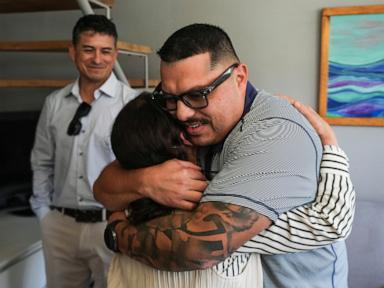
They want you to cry at the airport footage.
They want you to share the video of a weeping Chilean mother hugging two middle-aged strangers after four decades of separation, hit the heart reaction, and feel like the universe finally balanced its ledger. It is clean. It is emotional. It wraps a forty-year human rights atrocity in a neat, cinematic bow. Also making headlines lately: The Impossible Handshake in Jerusalem (And the Arithmetic That Makes It Necessary).
And it is a complete distraction from the actual crime.
The mainstream press loves these reunion stories because tears generate clicks without requiring institutional accountability. When outlets run headlines celebrating a Chilean mother finally meeting the children stolen from her under Augusto Pinochet’s regime, they frame the story as an individual miracle rather than a systemic cover-up that remains largely intact today. More details on this are detailed by BBC News.
Stop treating DNA reunions as happy endings. They are forensic crime scenes.
The Lie of the "Benevolent" Adoption Pipeline
The lazy consensus in international media treats the theft of up to 20,000 Chilean children between the 1970s and 1990s as a tragic byproduct of Cold War chaos—or worse, as misguided charity where poor babies were "saved" by wealthy Western families in the United States, Sweden, France, and the Netherlands.
That narrative is pure fiction.
Investigations by Chilean special judges, including Mario Carroza and later Alejandro Aguilar, alongside advocacy groups like Nos Buscamos (We Are Looking For Each Other), exposed an organized, profit-driven trafficking network. This was not a series of clerical errors during a turbulent political era. It was a supply chain.
Doctors, nurses, social workers, Catholic priests, and family court judges actively collaborated to harvest infants from vulnerable, impoverished, or politically targeted women. The mechanics were brutally consistent:
- The Phantom Stillbirth: Mothers were told their newborns died minutes after delivery. Hospital staff refused to show the body, claiming the facility had already handled the burial to "spare the mother's grief."
- The Coerced Signature: Illiterate or heavily sedated women were handed blank or falsified documents under the guise of hospital discharge forms, unknowingly signing away their parental rights.
- The State-Sanctioned Laundering: Once the child was separated, corrupt officials generated fraudulent birth certificates, erasing the biological mother entirely and routing the infant through state agencies like Sename (National Service for Minors) directly to foreign adoption brokers.
Foreign adoptive parents paid tens of thousands of dollars in "administrative fees" and "donations." The market demanded healthy infants. Chilean institutions manufactured the supply by declaring living children dead.
Why Tearful Reunions Let Guilty Institutions Off the Hook
When a DNA database like MyHeritage or FamilyTreeDNA finally matches a 42-year-old accountant from Seattle with a 65-year-old grandmother in Santiago, the media frames the technology as a savior.
Think about what that actually means.
Private, commercial ancestry companies are doing the investigative work that the Chilean state, the Catholic Church, and foreign governments refused to do for forty years. Mothers and stolen children are literally paying out of pocket to spit into plastic tubes because official judicial archives remain sealed, incomplete, or actively obstructed.
I have watched human rights lawyers and investigators spend years hitting brick walls in Santiago courtrooms while PR teams spin individual reunions into feel-good press releases. Every time a news outlet publishes a soft-focus profile about two strangers learning to communicate through Google Translate, the public absorbs a dangerous subliminal message: The problem is fixing itself.
It is not fixing itself.
For every reunion broadcast on the evening news, thousands of mothers are dying without ever knowing if their children survived infancy. Thousands of adoptees are living under fabricated identities, completely unaware that their "loving" adoption papers were forged by state-backed traffickers.
Celebrating the reunion without indicting the machinery turns a massive crime against humanity into a Hallmark movie.
Dismantling the "Better Off" Fallacy
If you bring up the criminality of these adoptions in polite company, someone will inevitably deploy the ultimate conversation-ender: "At least they grew up with opportunities in America or Europe instead of poverty in Chile."
This argument is morally bankrupt and legally irrelevant.
- Kidnapping is not social welfare. You do not get to steal another human being's child because you have a higher household income and better local schools. Under international law—specifically the UN Convention on the Rights of the Child—preserving a child's identity, nationality, and family relations is a fundamental right, not a luxury reserved for the affluent.
- The psychological toll is permanent. Adoptees who discover their origins were fabricated do not simply shrug and thank their lucky stars for a Western passport. They experience profound identity fragmentation, survivor's guilt, and severe trauma. Imagine discovering at age forty that your entire life story—your birthday, your medical history, your mother's supposed abandonment of you—was a lie fabricated to facilitate a financial transaction.
- The biological mothers suffered lifelong torture. Forced disappearance is recognized under international law as a continuous crime. A mother told her baby died, denied a grave to mourn, and haunted by the suspicion that her child is alive somewhere on earth endures an ongoing psychological torment that never resolves until the truth is proven.
The "better off" narrative exists solely to soothe the consciences of the receiving countries that turned a blind eye to glaring red flags in adoption paperwork.
The Complicity Nobody Wants to Audit
The media loves blaming Pinochet. Putting all the blame on a dead dictator is convenient because you cannot put a corpse on trial.
The uncomfortable truth is that the child trafficking network outlived the military junta. While the peak of the thefts occurred during the 1973–1990 dictatorship, documented cases continued well into the 1990s after Chile's return to democracy.
Why? Because the bureaucracy did not change overnight. The same doctors still ran the maternity wards. The same social workers still processed the files. The same religious orders still managed the orphanages. And the foreign embassies in Santiago kept stamping the visas.
Consider the receiving nations. Sweden alone received over 2,000 Chilean adoptees during this period, largely facilitated by the Swedish Adoption Centre. The United States, France, Germany, Italy, and the Netherlands absorbed thousands more. Did immigration officials in Washington, Stockholm, or Paris never wonder why so many healthy Chilean newborns were suddenly being abandoned by mothers who mysteriously vanished the moment they gave birth?
They did not ask because they did not want to know. The demand for adoptable babies in the Global North was exploding, and Chile had positioned itself as a reliable, compliant supplier.
Admitting this requires acknowledging an ugly reality: Western demand directly subsidized Latin American child theft.
What People Get Wrong About DNA Databases and Investigations
When people read about these reunions, they assume there is a massive government task force actively matching families. There isn't.
If you look at how these cases actually break open, the reality is sobering:
- Non-profits carry the burden. Organizations like Nos Buscamos, founded by Constanza del Río (herself an adoptee who discovered her own adoption was irregular), and Hijos y Madres del Silencio have done the heavy lifting. They manually cross-reference hospital logs, travel records, and DNA kits donated by private companies.
- The judicial system moves at a glacial pace. While Chile appointed special judges to investigate illegal adoptions—uncovering thousands of suspicious cases—prosecutions have rarely resulted in actual prison time for the architects of the scheme. Many perpetrators have died of old age; others hide behind statutes of limitations or claim they were merely following standard procedures of the era.
- Language and culture create a second separation. Even when a DNA match hits 100%, the reunion is rarely seamless. A 68-year-old working-class woman in Valparaíso and a 44-year-old software engineer in California do not share a language, a culture, or forty years of shared memory. They are biological relatives bound by a shared crime, forced to build a relationship from scratch while grieving the decades stolen from them.
To be fair, genetic genealogy has achieved what decades of FOIA requests and court petitions could not. Without commercial DNA testing, most of these mothers would have gone to their graves with nothing. That utility is undeniable.
However, relying on consumer tech to solve state-sponsored kidnappings is an indictment of the justice system, not a triumph of it.
How to Actually Cover—and Confront—This Crisis
If journalists, policymakers, and citizens want to stop participating in the whitewashing of international adoption fraud, the framing has to change immediately.
1. Stop calling them "irregular adoptions."
Language shapes accountability. "Irregular adoption" sounds like someone forgot to notarize a form in triplicate. Call it what it was: forced disappearance, child trafficking, and identity theft. When a hospital tells a mother her living baby is dead and hands that baby to a broker for cash, that is not an administrative irregularity.
2. Demand bilateral state-funded DNA banks.
The burden of proof cannot rest on impoverished elderly women scraping together money for commercial ancestry kits or waiting on non-profit donations. Both Chile and the receiving countries—especially the US, Sweden, and France—must fund free, universal, state-administered genetic registries with cross-border legal recognition, alongside mandatory declassification of all adoption and embassy visa records from 1970 to 2000.
3. Audit the receiving agencies.
Western adoption agencies that brokered these placements still exist, often rebranded or merged into modern organizations. They hold the original ledgers, financial receipts, and correspondence with Chilean intermediaries. Governments must subpoena those archives rather than letting private agencies hide behind donor and client privacy laws.
4. Center the crime, not the tears.
Next time a viral video surfaces of a mother and child embracing at an airport after forty years, look past the hugs. Ask who signed the fake death certificate. Ask which judge approved the exit visa. Ask which agency collected the fee. And ask why none of them are in a prison cell.
Until the people who stole those children face the same relentless scrutiny as the families trying to find them, every tearful reunion is just another reminder that the perpetrators got away with it.