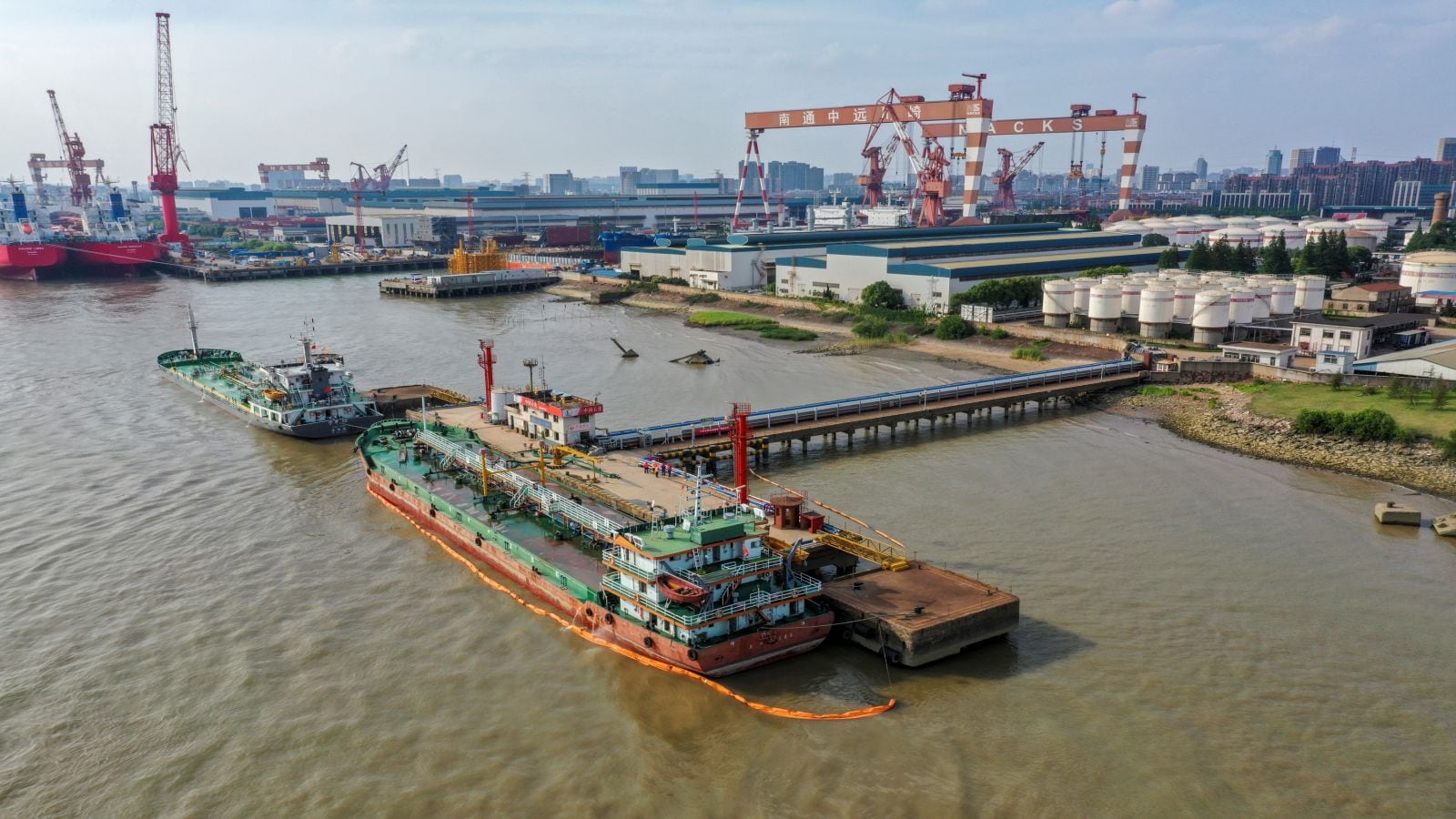
Beijing has abruptly lifted its tight restrictions on refined fuel exports for the remainder of July, a move that allows private mega-refiners to flood Asian markets with gasoline and diesel after a four-month state-enforced lockdown. The policy shift reverses emergency measures implemented in March when the escalations of the US-Iran conflict threatened global crude flows through the Strait of Hormuz. By permitting private giants like Zhejiang Petroleum & Chemical Co. to resume overseas shipments, China is signaling that its domestic stockpiles are saturated, even as the broader energy market braces for renewed volatility.
The decision has caught regional markets off guard. For months, international analysts watched China hoard its fuel, assuming Beijing was preparing for a prolonged global energy blockade. The sudden opening of the spigots exposes a different reality. Domestic fuel demand inside the world’s second-largest economy is faltering, forcing regulators to choose between suffocating their own industrial refiners or letting cheap product bleed into a fragile global market. Don't miss our previous coverage on this related article.
The Secret Influx of Iranian Crude
To understand why Beijing is suddenly comfortable letting millions of tons of fuel leave its shores, one must look at what happened in the dark during the height of the Middle East crisis. When the conflict between Washington and Tehran intensified earlier this year, Western analysts predicted a catastrophic shortfall in Chinese oil imports. The opposite occurred.
China deployed its extensive shadow fleet of unflagging tankers to absorb millions of barrels of heavily discounted crude that other nations refused to touch. During the brief window when the United States temporarily eased oil sanctions on Tehran, followed by an immediate snapback under the current American administration, Iran managed to rush an estimated 40 to 50 million barrels of crude out of its storage terminals. To read more about the background of this, Reuters Business offers an in-depth breakdown.
The vast majority of that oil went to one destination.
Chinese independent refiners, often called "teapots," became the primary beneficiaries of this geopolitical fire sale. Before the conflict, these private entities accounted for roughly 90 percent of Iran’s illicit oil exports. When the war disrupted conventional trade routes, the volume did not shrink. It consolidated. The sudden influx of cheap crude allowed Chinese refineries to run at maximum capacity, filling domestic commercial inventories to the absolute brim.
Now, those inventories are overflowing.
Squeezing the Independent Refiners
The policy pivot marks a dramatic shift in how Beijing manages its domestic energy architecture. Since March, the Ministry of Commerce and the National Development Reform Commission had restricted export privileges exclusively to state-owned enterprises like Sinopec and PetroChina. These state giants were forced to operate under strict monthly allocation quotas, designed to guarantee that domestic manufacturing and transport sectors faced zero shortages.
Private refiners were entirely cut off from the lucrative international market. This protectionist wall created an unsustainable domestic imbalance.
Zhejiang Petroleum & Chemical Co., which operates one of the largest single-site refining complexes on earth, was forced to halt all overseas shipments for more than 90 days. For an operation of that scale, idling capacity or storing unsold product is an expensive logistical nightmare. Margins compressed rapidly as domestic commercial consumption failed to keep pace with the sheer volume of crude being processed.
By granting a temporary reprieve for July, Beijing is throwing a lifeline to these private conglomerates. Regional traders estimate that total exports of gasoline, diesel, and jet fuel will hit approximately 3 million metric tons this month. This is a massive leap from the initial state projections, which assumed exports would barely cross the 2 million ton threshold.
It is a pressure-valve strategy.
The Collapsing Asian Refining Margin
The consequences of China’s sudden policy reversal are already rippling through regional trading hubs from Singapore to Tokyo. The immediate threat is an oversupplied market that will inevitably crush the profitability of competing refiners across Asia.
+--------------------------------------------------------------+
|             Estimated July 2026 Fuel Export Volumes         |
+------------------------------+-------------------------------+
| Initial Government Estimate  | 2.0 Million Metric Tons       |
+------------------------------+-------------------------------+
| Revised Target Post-Reprieve | 3.0 Million Metric Tons       |
+------------------------------+-------------------------------+
The spread between Asian gasoline prices and Dubai crude has already tumbled toward its lowest level since late March. This spread, which serves as a benchmark for refinery profitability across the continent, is shrinking because regional markets cannot easily absorb an extra million tons of Chinese product. Refiners in South Korea, Japan, and India are suddenly facing a brutal competitive environment. They buy crude at prevailing market rates, while their Chinese counterparts are processing discounted Iranian barrels and dumping the finished product next door.
The short-term relief for consumers in import-dependent Asian nations is obvious. Transportation fuel prices, which have fueled persistent inflation throughout the spring, are expected to cool. Yet this relief comes at the expense of structural stability for non-Chinese energy companies.
The August Trap
Nothing about this policy shift implies a permanent return to free-market dynamics. Industry sources tracking the allocations emphasize that the relaxation is strictly bounded to the month of July. Regulators have explicitly refused to commit to similar volumes for August or September.
This creates a tactical dilemma for global oil traders. If China closes the gates again next month, the current drop in fuel prices will reverse instantly, trapping anyone who shorted the market based on July’s numbers. Beijing is playing a week-to-week game, balancing the survival of its private refining sector against the unpredictable nature of the ongoing maritime friction in the Middle East.
The underlying vulnerability remains unchanged. If fresh infrastructure attacks target key shipping lanes later this month, the Chinese government will not hesitate to slam the export doors shut once again to protect its internal economy.
A Flawed Rebalancing Act
The decision to open the gates reveals a deeper structural weakness inside the Chinese economy that state media rarely acknowledges. If domestic industrial activity, long-haul trucking, and consumer spending were truly performing at baseline expectations, there would be no need to dump millions of tons of refined fuel onto the international market. The surplus exists because the domestic economic engine is running cold.
Refining crude oil is a continuous process. You cannot easily turn off a mega-refinery without incurring catastrophic operational costs. When domestic demand drops, the fuel must go somewhere.
By allowing private refiners back into the export market, Beijing is effectively exporting its domestic economic slowdown. The global energy market is being used as a dumping ground for the excess industrial output that China’s own internal market cannot digest. This strategy protects Chinese jobs and stabilizes corporate balance sheets in Zhejiang and Shandong, but it does so by exporting margin compression to the rest of the world.
The international energy sector must now adjust to a reality where China acts as a unpredictable swing exporter. Decisions are no longer made purely on commercial logic, but rather on the shifting calculations of a state apparatus managing wartime disruptions and domestic economic stagnation simultaneously. The extra shipments leaving Chinese ports this week are not a sign of economic strength. They are the visible smoke from an overheating domestic inventory engine trying to find an emergency exhaust.