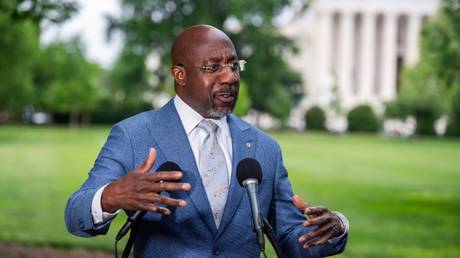
Legislative mechanics in Washington rarely move in a straight line, and the recent maneuvering over the Russian sanctions package exposes a deep fracture between foreign policy ambitions and domestic economic anxiety. U.S. Senator Reverend Raphael Warnock recently pumped the brakes on an expedited procedure meant to fast-track a sweeping sanctions bill targeting Moscow’s wartime economy. While international hawks and bipartisan majorities line up to punish the Kremlin, the Georgia Democrat has raised a stark institutional warning flag. Supporting Ukraine does not require handing the executive branch unchecked authority to impose broad import levies that could spike consumer costs at home.
For months, Capitol Hill has buzzed with urgency to choke off the remaining financial pipelines sustaining Russia's military machine. The legislative vehicle in question aims to penalize third-party nations purchasing discounted Russian oil and gas, closing major loopholes in the current global economic blockade. Yet, hidden inside the text of the broader package are provisions granting the White House sweeping margins to maneuver within a aggressive tariff regime. For lawmakers representing working-class constituents facing persistent inflation, that blank check triggers immediate alarm.
The Anatomy of a Legislative Speed Bump
Speed-tracking a bill through the United States Senate requires unanimous consent or broad procedural shortcuts, bypassing standard committee adjustments and extended floor debates. When leadership attempts to railroad complex economic legislation through these fast lanes, dissenting voices carry massive weight. Warnock’s intervention is not an abstract philosophical objection to punishing Moscow, but a targeted critique of executive overreach wrapped in foreign policy necessity.
The core friction point involves the intersection of national security sanctions and domestic trade policy. When Congress authorizes broad economic countermeasures, the enforcement mechanisms frequently land on the desks of executive agencies with wide discretion. History shows that broad discretionary power over import duties rarely gets dialed back once granted. Lawmakers caught between the moral imperative of backing an ally under siege and the domestic danger of fueling domestic price spikes find themselves walking a political tightrope.
Consider a hypothetical manufacturing plant in suburban Atlanta dependent on specialized imported inputs. If an administration utilizes ambiguous statutory authority buried within a foreign sanctions bill to levy sudden blanket tariffs on intermediary trade partners, the local economic fallout is immediate. Supply chains stretch, production costs surge, and the financial penalty trickles down directly to retail consumers filling up gas tanks or buying groceries. Warnock’s hesitation reflects a weary realization that blank-check trade powers create domestic vulnerabilities without guaranteeing strategic compliance from foreign actors.
Geopolitics Meets Grocery Prices
The debate also highlights a fundamental tension regarding executive branch predictability. Proponents of the fast-tracked package argue that immediate legislative leverage is essential to force foreign capitals to abandon trade lifelines with Moscow. They contend that any delay signals weakness to the Kremlin. However, skeptics point out that the administrative branch has frequently shifted its trade priorities based on political whim rather than strategic consistency.
Giving an unpredictable executive broader latitude to manipulate trade barriers under the banner of national security creates an unstable market environment. Businesses cannot plan five years ahead when trade policy can pivot on a single executive decree. By demanding a slower, more deliberate legislative process, dissenting senators are attempting to preserve the constitutional separation of powers over commerce and taxation.
The pushback is also indicative of a changing guard within the Democratic caucus regarding trade populism. For decades, establishment politicians routinely voted for expansive executive authorities during foreign crises, trusting administrative competence. That institutional trust has eroded significantly. Lawmakers now scrutinize every statutory paragraph for hidden loopholes that could drive up household expenditures.
The Cost of Unchecked Leverage
The legislative vehicle will likely find another path forward, but the temporary freeze exposes the raw nerves of modern American governance. Foreign policy solidarity does not eliminate domestic economic reality. When senators begin weighing the destruction of Russian supply chains against the price stability of American households, the consensus fractures.
The path of least resistance in Washington is almost always delegation—handing power to the executive branch and hoping for the best. Pausing that momentum forces a reluctant Congress to do its actual job, writing precise laws with clear guardrails instead of convenient shortcuts.
The debate over the sanctions bill is far from finished, and the pressure from international allies will remain intense. Yet the political friction introduced by lawmakers demanding economic accountability at home is a reminder that foreign policy does not happen in a vacuum. Every lever pulled abroad has a corresponding weight borne by citizens down the line.