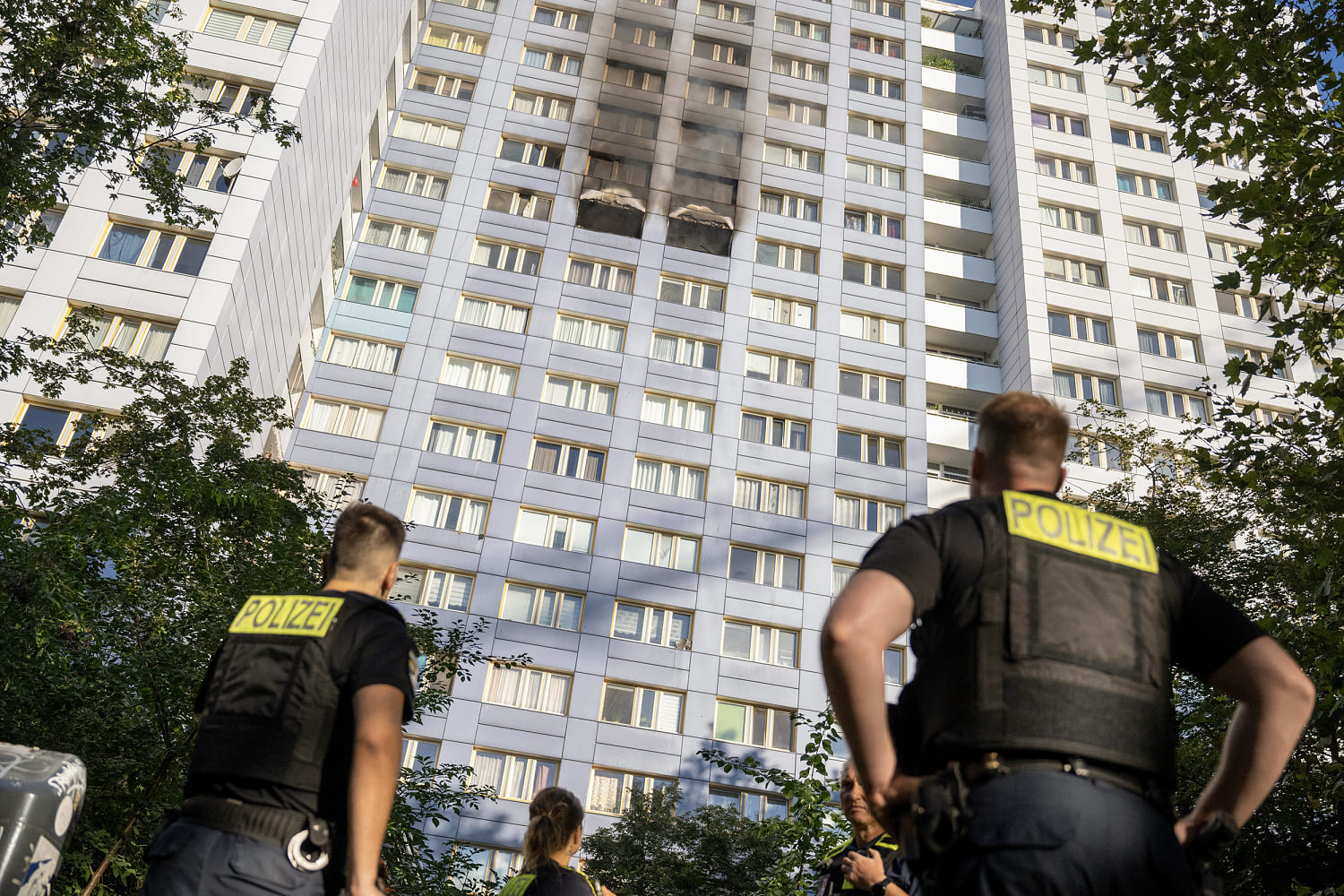
High-rise structural fires impose severe operational constraints on municipal emergency response teams, forcing a binary calculation between internal structural suppression and external rescue interventions. When vertical evacuation routes are compromised by thermal plume expansion and smoke migration, occupants face existential risk profiles that require immediate tactical mitigation. The documented incident in Berlin, involving an eleventh-floor occupant executing a descent into the arms of ground-level emergency personnel, highlights the limits of standard high-rise life safety systems and the critical dependency on improvised ground interventions.
Understanding the structural failure modes of high-rise architecture during a major thermal event requires examining the thermodynamics of fire propagation in enclosed vertical shafts. Vertical shafts, including stairwells and elevator shafts, act as thermal conduits via the stack effect, drawing hot gases upward at velocities that frequently outpace human descent capabilities. When these internal conduits become untenable, occupants are physically displaced toward exterior perimeters. The eleventh-floor elevation presents a distinct physical threshold: kinetic energy accumulation from a fall at this height exceeds human survivability parameters under standard impact conditions, rendering unassisted egress lethal and forcing absolute reliance on exterior rescue mechanisms or air-supported intervention assets.
The Operational Anatomy of Vertical Egress Failure
Standard high-rise building codes mandate compartmentalization, fire-rated stairwells, and mechanical smoke control systems designed to maintain tenable conditions during an active fire event. When these engineered safeguards fail due to structural breach, power loss, or fire severity exceeding design thresholds, a systemic breakdown occurs across three core variables:
- Thermal Barrier Degradation: Interior temperatures within corridors escalate rapidly, destroying non-rated doors and allowing radiant heat flux to compromise human physiological endurance within minutes.
- Mass Smoke Infiltration: Toxic combustion products, primarily carbon monoxide and hydrogen cyanide, migrate through pressure differentials, inducing cognitive impairment and physical incapacitation before direct flame contact occurs.
- Egress Route Blockage: Structural debris, localized structural sagging, and panic-induced bottlenecks stall horizontal movement toward designated safe refuges.
When these variables converge, occupants are restricted to exterior building features, such as ledges, balconies, or window frames. This spatial confinement eliminates traditional evacuation vectors and shifts the tactical burden entirely to external emergency services.
External Extraction Dynamics and Kinetic Constraints
Emergency rescue operations operating from the exterior face severe physical limitations dictated by equipment reach and deployment velocity. Aerial ladder trucks and articulating platforms represent the primary mechanical assets for elevated rescues, yet their operational envelopes are bound by strict physical constraints:
- Height Restrictions: Standard municipal aerial apparatus rarely exceed ten to twelve stories in operational effectiveness, placing an eleventh-floor incident at the absolute margin or beyond the mechanical reach of conventional ladders.
- Setup Time and Ground Footprint: Deploying outriggers, stabilizing heavy chassis, and elevating booms requires precise spatial clearance and time—variables often compressed by the rapid kinetics of a developing flashover.
- Improvised Ground Interventions: When mechanical elevation assets are delayed, obstructed by terrain, or out-of-reach, ground personnel must pivot to rapid deployment of pneumatic jumping cushions, net systems, or improvised catch mechanisms.
The deployment of a ground-level catch system for an eleventh-floor descent represents an extreme variance from standard protocol. The physics of falling bodies dictate that an object dropped from an eleventh floor (approximately 33 meters) attains a velocity of roughly 25 meters per second prior to impact. Absorbing this kinetic energy safely requires specialized deceleration media that distribute the stopping force over a controlled displacement distance, minimizing peak deceleration forces on the human body.
In the Berlin incident, the absence of a fully deployed mechanical cushion forced a direct personnel-supported interception. This intervention introduces significant human error variables and severe injury risks to both the falling occupant and the catching personnel, illustrating a tactical failure of primary technological safety nets and a fallback to high-risk human execution.
Systemic Vulnerabilities in Urban High-Rise Density
The frequency of high-rise structural emergencies demands a critical audit of urban firefighting doctrine, building material science, and occupant safety education. Modern construction trends favor lightweight composite materials, glass curtain walls, and open-plan interior layouts. While architecturally efficient, these design paradigms can accelerate fire spread and reduce the time-to-collapse structural integrity window compared to legacy masonry and reinforced concrete construction.
Furthermore, evacuation models frequently assume that all occupants will utilize stairwells simultaneously. When behavioral studies demonstrate that occupants hesitate during initial alarm phases, the resulting evacuation wave is delayed, placing late-stage evacuees directly into compromised vertical corridors. This behavioral lag interacts negatively with the accelerated growth rate of modern synthetic-fuel fires, which generate high-density smoke loads much faster than legacy cellulosic materials.
Strategic Mitigation and Tactical Re-Engineering
To reduce reliance on extreme, high-risk interventions such as exterior leaps or ground-level manual catches, municipal emergency management and structural engineering must align around three preventative engineering vectors:
- Mandatory Automatic External Suppression Upgrades: Retrofitting legacy high-rise residential and commercial assets with high-reliability sprinkler grids to suppress ignition events before thermal plumes breach compartment boundaries.
- Enhanced Smoke Compartmentalization: Implementing active compartmentalization systems that dynamically seal vertical shafts upon sensor-detected particulate or thermal anomalies, preserving stairwell integrity for extended durations.
- Secondary Exterior Evacuation Infrastructure: Integrating exterior descent devices, such as permanent slide chutes or automated external evacuation hoists, directly into building structural frameworks for high-floor occupants trapped above the reach of municipal ladders.
Municipal deployment protocols must also integrate predictive modeling tools that map high-rise fire spread against local traffic congestion and apparatus arrival times, identifying spatial vulnerabilities before an incident escalates to the point of structural failure. Transitioning high-rise life safety from reactive rescue operations to fail-safe containment architectures remains the only viable strategy to eliminate the necessity of high-altitude tactical improvisations.