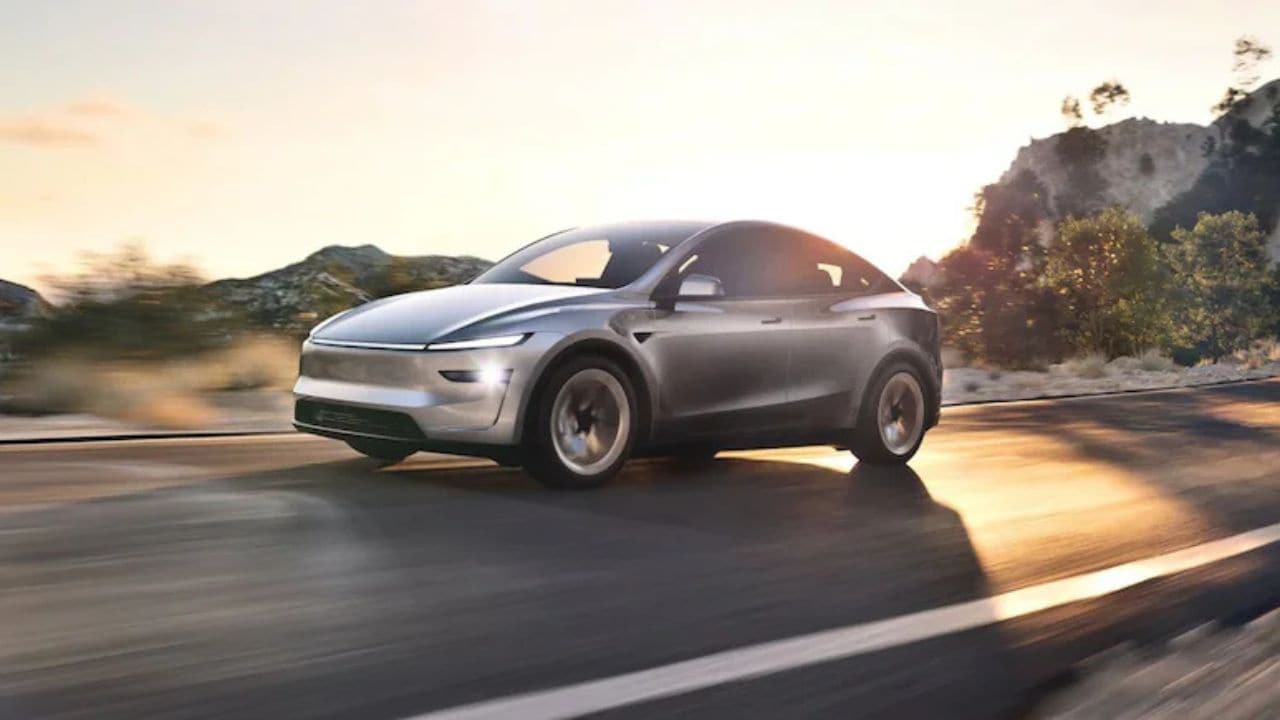
Picture a Tuesday evening on the Olympic-daero expressway cutting through the heart of Seoul. Rain slicks the asphalt into a black mirror, reflecting the neon bleed of Gangnam skyscrapers and the red brake lights of ten thousand commuters inching home. Inside a sleek electric sedan, a driver—let’s call him Min-jun, a hypothetical composite of thousands of early adopters across South Korea—rests his fingertips lightly against the bottom of the steering wheel. He paid nearly nine million won, roughly seven thousand US dollars, for a software package marketed under a phrase that sounded like salvation from the daily grind: Full Self-Driving.
He expected a chauffeur. What he got was an anxious intern.
When the highway curves sharply near the Han River, the car hesitates, its cameras squinting through the glare of wet tarmac and flickering LED signage. A chime pierces the cabin. Blue warning lights flash across the screen. Hands on the wheel. Immediately. Min-jun’s pulse spikes as he jerks the steering column back into alignment, his heart hammering against his ribs while a delivery truck roars past in the adjacent lane. In that split second of cold sweat, the gap between Silicon Valley’s soaring rhetoric and the stubborn, unforgiving physics of Seoul traffic becomes painfully clear.
That gap is precisely what drew the scrutiny of South Korea’s Fair Trade Commission, culminating in regulatory findings and reports that Tesla misled South Korean buyers about the actual capabilities of its autonomous driving software.
The Anatomy of a Nine-Million-Won Illusion
To understand why regulators stepped in, you have to look beyond the software code and examine the architecture of desire. Cars have never been mere transportation; they are rolling projections of who we want to be and what burdens we wish to escape. For decades, automakers sold horsepower, leather, and freedom from the open road. Then came the digital era, and the product shifted from steel to prophecy.
In South Korea, one of the most hyper-connected, tech-enthusiastic automotive markets on earth, Tesla’s Autopilot and Full Self-Driving (FSD) packages arrived wrapped in the aura of inevitability. Buyers clicked through online configurators, adding millions of won to their purchase price based on marketing language that promised automated lane changes, traffic light recognition, and—eventually—complete autonomy without human intervention.
Words matter. Especially when they carry price tags equivalent to a year of university tuition.
South Korean antitrust watchdogs examined how Tesla advertised these features on its local website and in promotional materials. Regulators found that the company presented its driver-assistance suite in ways that led ordinary consumers to believe the vehicles could drive themselves safely under real-world conditions, rather than functioning strictly as Level 2 driver-assistance systems requiring constant human supervision and immediate intervention.
Think of it like buying a smoke detector advertised as an automated fire department. A smoke detector is an extraordinary piece of safety engineering—it alerts you, monitors the room, and buys you precious seconds—but if you go to sleep assuming it will physically douse the flames while you dream, the misunderstanding isn't merely semantic. It is existential.
Why Seoul Is Not Palo Alto
Anyone who has driven through both Northern California and central Seoul knows they are different planets wearing the same asphalt. In the wide, sun-drenched boulevards of Silicon Valley, lane markings are crisp, intersections follow predictable grids, and traffic flows with a certain suburban predictability.
Seoul is a vertical, kinetic labyrinth.
Here, delivery scooters weave through millimeter-wide gaps between buses like silver fish darting around whales. Construction zones bloom overnight, rerouting four lanes of traffic with blinking orange cones and hand-waving flaggers. Complex underground tunnels split into three exits within two hundred meters, while GPS signals bounce erratically off concrete canyons.
When South Korean buyers paid extra for Full Self-Driving capability, many discovered that core urban features promised in overseas demonstrations were either absent, delayed indefinitely by local regulatory approvals, or severely limited on Korean roads. Even basic functions struggled with the sensory overload of dense East Asian urbanism. Yet the marketing narrative remained stubbornly utopian, selling tomorrow’s dream at today’s cash register without adequately foregrounding the fine print: that the human in the driver's seat remained legally, morally, and physically responsible for every millimeter of travel.
Consumer advocacy groups in South Korea began collecting testimonies from frustrated owners. The pattern was unmistakable. Buyers felt they had not purchased a finished product, nor even a transparent beta test, but an expensive ticket to fund someone else’s research and development while shouldered with all the liability.
The Psychology of Automation Complacency
There is a well-documented phenomenon in aviation and human-factors engineering known as automation complacency. When a machine performs reliably ninety-five percent of the time, the human brain quietly checks out. Evolution wired us to conserve energy, not to stare intently at an empty stretch of road while a computer handles the steering for forty minutes straight.
I remember the first time I tested an advanced lane-centering system on a long stretch of highway at dusk. For twenty miles, the car glided effortlessly through gentle bends, maintaining distance from the sedan ahead with eerie precision. My shoulders dropped. My grip loosened. Without consciously deciding to, my mind drifted from the asphalt to an argument I’d had earlier that morning. Then, without warning, a shadow cast by an overpass confused the forward optical sensors, and the car suddenly braked hard at sixty-five miles per hour. The seatbelt locked across my collarbone like an iron bar. My hands flew to the wheel, trembling, acutely aware of how thin the margin had been between technological marvel and multi-car pileup.
That vulnerability is the invisible tax of half-built autonomy.
When marketing language inflates expectations—calling a supervised driver-aid "Full Self-Driving"—it actively accelerates automation complacency. It nudges tired commuters after a twelve-hour shift in Yeouido to trust the software just a little more than the sensors deserve. Regulators in Seoul recognized that deceptive advertising in the automotive sector isn't just a matter of unfair commercial competition or consumer refunds; it is a public safety hazard traveling at highway speeds.
Regulators Draw a Line in the Asphalt
South Korea’s Fair Trade Commission (KFTC) has earned a reputation across Asia for refusing to be dazzled by global tech giants. Whether scrutinizing app store monopolies, semiconductor pricing, or battery-range claims, Seoul’s watchdogs tend to ask a refreshingly blunt question: Does the reality match the receipt?
In their investigation into Tesla’s self-driving claims—alongside separate scrutiny over cold-weather battery range exaggerations—regulators zeroed in on consumer deception under South Korea’s Act on Fair Labeling and Advertising. Under Korean law, companies cannot lure buyers with exaggerated performance claims and then hide behind dense user-manual disclaimers buried dozens of clicks deep after payment clears.
Consider what happens next when a government enforces that standard.
First, it strips away the halo of tech exceptionalism. For years, Silicon Valley operated under the unspoken creed of "move fast and break things," treating regulatory friction as an annoying speed bump on the road to disruption. That ethos works fine when a buggy social media app crashes on your phone; you force-quit the screen and move on with your afternoon. You cannot force-quit a two-ton steel vehicle hurtling toward a concrete divider in the rain.
Second, it forces a reckoning over how artificial intelligence is sold to the public. Across every industry, corporations are rushing to slap autonomous, intelligent, and self-operating labels onto tools that still require heavy human babysitting. South Korea’s crackdown sent a clear signal reverberating from Seoul to Brussels and Washington: aspirational engineering is not a license for misleading commerce.
What Buyers Actually Paid For
To see the friction clearly, look at the gap between what the promotional copy implied and what the hardware actually delivered on Korean pavement:
- The Promise: Seamless point-to-point navigation, automated city-street driving, and imminent hands-free autonomy that would appreciate in value over time.
- The Fine Print: Strict Level 2 classification requiring constant hand pressure on the steering wheel, visual attention on the road, and immediate human takeover during complex merges, inclement weather, or unmapped construction.
- The Local Reality: Years of waiting for full urban feature rollouts due to localized mapping hurdles, strict traffic regulations, and road geometries that baffled neural networks trained predominantly on North American highways.
For many South Korean owners, the frustration wasn't born from hating the technology. Quite the opposite. These were people who loved innovation enough to wire millions of won upfront to support it. Their anger stemmed from feeling treated like marks rather than partners—sold certainty when the reality was experimental.
The Weight of the Steering Wheel
Trust, once fractured in a machine, repairs slowly. Ask any driver who has felt their car lunge unexpectedly toward a guardrail, or watched a dashboard screen misidentify a flashing yellow caution light as an open green corridor. After that moment, you never quite sit back against the headrest the same way again. Your calves stay slightly tensed near the brake pedal. Your eyes dart constantly between the windshield and the visualization display, babysitting the very algorithm you paid to relieve your stress.
And perhaps that is the deepest irony of the entire controversy.
People buy self-driving software to buy back their peace of mind—to turn the exhausting, white-knuckle choreography of modern commuting into a quiet sanctuary. Yet when marketing outpaces engineering, the opposite happens. The driver becomes an unpaid safety test pilot, paying thousands of dollars for the privilege of supervising a machine that cannot yet be trusted alone, in traffic conditions the software wasn't built to master.
Back on the Olympic-daero expressway, the rain finally eases into a fine mist rising off the Han River. The red taillights ahead stretch toward the horizon like glowing embers in the dark. Inside his cabin, Min-jun reaches down to the touchscreen, taps through two sub-menus, and switches off the automated lane-change feature. He wraps both hands firmly around the leather wheel at ten and two, feeling the familiar, honest vibration of the tires gripping wet Seoul asphalt, driving himself the rest of the way home.