The bells in Bern do not ring to wake you up. They ring to remind you that everything is in its proper place.
On a crisp Sunday morning in the Swiss capital, the sandstone arcades of the old town absorb the sound like thick wool. People walk toward the local polling stations with folded paper ballots tucked into coat pockets, their expressions unreadable, their steps unhurried. There are no shouting matches on the cobblestones. No partisan banners block the view of the snow-dusted Alps on the horizon. To an outsider, this is the ultimate sanctuary—a country that has turned staying out of other people’s fights into both a high art and a lucrative business model.
Silence.
For over two hundred years, that single word has been the bedrock of Swiss survival. While empires crumbled, borders bled, and neighbors tore one another apart in two world wars, Switzerland stood behind its mountain walls, holding a lantern in one hand and a ledger in the other, insisting that it belonged to no side.
Until now, that silence has been treated as an instinct. Today, it is being put in a cage.
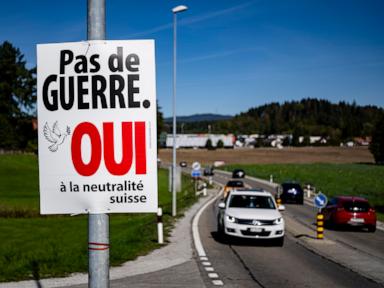
Across all twenty-six cantons, Swiss voters are deciding the fate of a constitutional amendment pushed by the right-wing Swiss People’s Party, known locally as the SVP. On paper, the "Neutrality Initiative" looks like a dry legal clarification—a few sentences added to the federal constitution to ensure Switzerland never joins a military alliance and, far more consequentially, never imposes non-military sanctions unless ordered to do so by the United Nations Security Council.
Read it again. Slowly.
If this measure passes, Switzerland would be legally barred from aligning itself with European Union sanctions against aggressor nations, effectively neutralizing its ability to freeze the assets of oligarchs, block the sale of dual-use technology, or join international economic boycotts whenever a permanent member of the UN Security Council—such as Russia, China, or the United States—raises a hand to veto action.
The Dinner Table in Zurich
To understand why a few paragraphs of legal text have split families down the middle from Geneva to St. Gallen, consider a hypothetical dinner table in a quiet Zurich suburb.
At one end sits Lukas, a sixty-four-year-old retired precision engineer who spent forty years manufacturing components for watchmakers and medical devices. He remembers the Cold War. He remembers his father keeping an army rifle in the closet and rations in the cellar, convinced that Swiss neutrality was the only thing standing between their valley and a Soviet tank column. When Lukas looks at the news today—war grinding on in Eastern Europe, trade wars fracturing global supply chains, energy prices spiking—his instinct is to pull the drawbridge up. To him, when Bern adopted European Union sanctions against Moscow in 2022, Switzerland didn't take a moral stand. It broke a sacred promise. It made itself a target.
At the other end of the table sits his daughter, Elena, thirty-two, who works in compliance at a mid-sized private bank near Paradeplatz. She deals with the real-world plumbing of global finance every single day. She knows what happens when money moves through shadows, and she knows what happens when Washington and Brussels decide a country has become a laundromat for bad actors. To Elena, Lukas’s version of neutrality isn't a shield. It is a bullseye painted directly onto the Swiss economy.
"If we can't enforce sanctions alongside our neighbors," Elena argues, pushing her wine glass aside, "we don't become a peaceful mediator. We become a loophole."
Lukas shakes his head, his voice tight. "And if we pick sides every time Brussels tells us to, who hosts the peace talks when the shooting stops? Who do the warring parties trust to carry messages across the front lines?"
Neither of them is lying. Both of them are terrified of losing the country they love.
The Myth of the Alpine Fortress
I have spent years watching how small nations survive beside giants, and there is a specific kind of ache that comes with realizing your greatest strength has quietly turned into a vulnerability. When you walk through Geneva, past the Palais des Nations where diplomats in tailored suits murmur in corridors over espresso, you can almost smell the history of Swiss diplomacy. Since the Congress of Vienna formally recognized Switzerland’s perpetual neutrality in 1815, the country has built an identity around being the world’s trusted referee.
Think of neutrality like a firebreak in a dense forest. For two centuries, whenever a blaze broke out in Europe, the cleared strip of Swiss earth kept the flames from jumping across the mountains. Because everyone knew Switzerland wouldn't march its army across the border, warring powers trusted Swiss diplomats to inspect prisoner-of-war camps, represent stranded citizens in hostile capitals, and carry secret truce offers through the dark.
That firebreak worked when wars were fought with rifles and artillery along physical borders.
It does not work when wars are fought with semiconductors, bank wires, and energy pipelines.
In the modern global economy, there is no empty strip of land between the belligerents. Every franc deposited in a Zurich vault, every precision valve shipped from a factory in Basel, every barrel of oil traded through a brokerage in Zug is already part of the battlefield. Choosing not to restrict financial flows when an aggressor invades a sovereign neighbor isn't stepping back from the fight. It is actively keeping the supply lines open.
Yet the architects of the SVP’s initiative understand something profound about human psychology: when the world outside grows chaotic, people crave certainty. Since 2022, the party has gathered more than 130,000 signatures—well above the 100,000 threshold required to force a nationwide referendum under Switzerland's famed system of direct democracy. Their campaign posters have been impossible to miss at train stations and highway overpasses, tapping into a deep, ancestral fear that Switzerland is slowly being swallowed whole by the European Union without ever signing an accession treaty.
What Happens When the Referee Takes Off the Whistle
The Swiss Federal Council—the seven-member executive body that governs the country—along with a broad coalition of center-left and center-right parties, has urged voters to reject the proposal. Their warning is blunt, stripped of diplomatic polish: rigid neutrality will isolate Switzerland from its closest trading partners and cripple its foreign policy.
Consider what happens next if the amendment becomes constitutional law.
First, look at the United Nations Security Council. Because Russia and China hold permanent veto power—alongside the United States, the United Kingdom, and France—the Security Council is structurally incapable of passing sanctions against any major global power or its close allies. Tying Swiss sanctions policy strictly to UN resolutions means Switzerland would be legally forbidden from joining Western sanctions not only against Russia, but potentially in future crises involving Taiwan, the South China Sea, or cyberattacks on European infrastructure.
Second, trace the money. Switzerland manages roughly a quarter of the world’s cross-border private wealth. That massive financial sector does not exist in a vacuum; it relies on seamless access to markets in New York, London, and Frankfurt. If Bern is constitutionally barred from matching European Union and American sanctions, foreign regulators will not applaud Swiss purity. They will slap secondary sanctions on Swiss banks, freeze institutions out of dollar clearing systems, and treat Zurich as a rogue financial hub.
Even Switzerland’s storied defense industry—already reeling from European backlash over Swiss laws blocking the re-export of Swiss-made ammunition to Ukraine—would face an existential freeze. Why would Berlin or Warsaw buy air-defense components from a neighbor whose constitution forbids it from standing with them in a crisis?
The Weight of a Paper Ballot
Standing outside a voting booth in Bern, watching an elderly woman carefully drop her envelope into the slotted metal box, you feel the strange, quiet power of Swiss democracy. There is no electoral college here, no party bosses deciding things behind closed doors. Every few months, ordinary citizens act as the supreme court of their own destiny.
It is easy to romanticize that process from afar, and just as easy to mock the Swiss as wealthy fence-sitters hiding behind chocolate, watches, and numbered accounts. Both caricatures miss the point.
For generations, Swiss neutrality was a flexible, pragmatic tool—an unwritten art rather than a rigid dogma. During the Second World War, Switzerland mobilized hundreds of thousands of troops to deter invasion while making painful, morally compromised trade concessions to survive surrounded by Axis powers. During the Cold War, it stayed fiercely armed and politically non-aligned while remaining unmistakably tied to the economic and democratic values of the West. When Iraq invaded Kuwait in 1990, Switzerland joined UN sanctions. When Russia annexed Crimea in 2014, Bern walked a careful tightrope to prevent its banks from being used to bypass EU penalties.
Flexibility was the secret. Not blind obedience to a frozen definition.
By carving a strict ban on sanctions into the federal constitution, the SVP is asking voters to trade a living, breathing survival instinct for a stone tablet. They are promising safety through rigidity at the exact moment the world requires agility.
The Echo in the Valley
Inside the old town of Bern, the Sunday morning bells finally stop ringing. The last vibrations fade into the cold air rising off the Aare River, which loops around the city like a silver ribbon.
By evening, the tally will be known. Clerks in town halls from the Italian-speaking valleys of Ticino to the French-speaking shores of Lake Geneva will count the paper slips by hand, stack them neatly, and transmit the numbers to the capital.
If the initiative fails, Switzerland will breathe a quiet sigh of relief and return to the exhausting, unglamorous work of balancing its sovereignty against its responsibilities in a fractured Europe. If it passes, the government will be forced to unwind existing sanctions regimes, brace for furious retaliation from Brussels and Washington, and explain to the world why one of the richest democracies on earth has legally forbidden itself from taking a stand against aggression.
Either way, the illusion is gone.
High in the Alps, the snow still falls softly on the mountain passes, covering the old border stones in thick, unbroken white. Down in the valleys, however, the people folding their ballots into their coat pockets know the truth that no constitutional amendment can erase: in a connected world, choosing to do nothing is still a choice—and sooner or later, someone always sends the bill.


