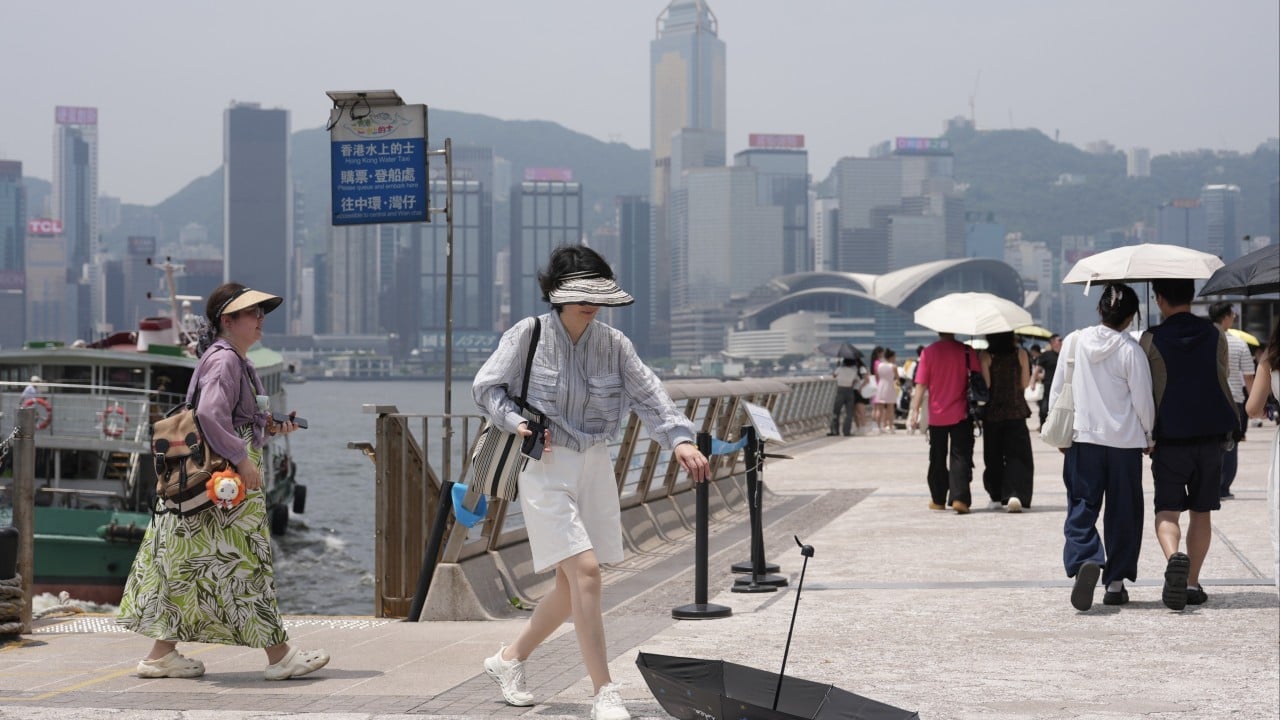
When the Hong Kong Observatory hoists the Strong Wind Signal No. 3, urban infrastructure does not merely react; it undergoes a synchronized operational contraction. The decision to issue the T3 signal at 1:20 PM on a Saturday, coupled with the immediate suspension of classes for specific schools, illustrates the precise threshold management required by densely populated subtropical coastal metropolises. This event exposes the hidden friction points between meteorological monitoring, institutional rigidity, and economic continuity.
Evaluating this administrative pivot requires stripping away sensationalism to examine the mechanical variables that govern meteorological threat levels in financial centers. Meanwhile, you can explore other stories here: Beyond the Handshakes The Strategic Reality of India and US Relations.
The Meteorological Threshold Engine
Typhoon preparedness in Hong Kong operates on a deterministic warning ladder governed by sustained wind speed parameters rather than probabilistic guesswork. The boundary between a Standby Signal No. 1 and a Strong Wind Signal No. 3 is defined by a specific sustained wind velocity range measured at eight reference anemometers distributed across the territory.
When sustained winds reach 41 to 62 kilometers per hour, with gusts potentially exceeding 110 kilometers per hour, the system mandates a shift to T3. The timing of the 1:20 PM issuance reveals an operational vulnerability in urban scheduling. Weekend transitions complicate the administrative response matrix. A Saturday issuance creates a compressed timeline for educational institutions and commercial entities that typically operate on reduced weekend rosters, forcing a reactive posture rather than a preemptive one. To understand the complete picture, check out the excellent article by NPR.
The classification system functions as a binary trigger for downstream protocols:
- Transportation networks adjust headways and secure rolling stock.
- Maritime operations reroute harbor vessels and halt crane activity at container terminals.
- Educational bodies enforce mandatory campus closures to eliminate liability and transit risk.
This institutional machinery leaves little room for ambiguity. Yet, the friction emerges when meteorological models update faster than institutional policy can absorb.
The Cost Function of Educational Suspensions
Suspending classes upon the issuance of a T3 signal on a Saturday afternoon highlights the conservative risk profile embedded in public sector management. From a quantitative standpoint, the decision minimizes tail-end risk—catastrophic injury or entrapment of students and faculty during transit—at the expense of immediate operational efficiency.
The economic cost function of such suspensions can be modeled through three variables: administrative friction, childcare displacement, and institutional schedule disruption. When classes halt mid-day, parents face an abrupt dislocation between workplace demands and domestic care requirements. The system optimizes for life safety while externalizing the coordination costs onto households and private organizations.
Total Risk = (Probability of Severe Weather Impact x Severity) + (Administrative Friction + Household Dislocation)
By prioritizing absolute life safety, the institutional framework treats the cost of disruption as a fixed, necessary expenditure to maintain public trust. However, rigid categorization struggles with temporal nuances. A Saturday afternoon storm profile differs fundamentally from a Monday morning peak-hour direct hit, yet the protocol treats both with uniform administrative weight.
Urban Vulnerability Metrics in High-Density Logistics
Hong Kong functions as a critical node in global supply chains. When the T3 signal activates, the operational dynamics of the Kwai Tsing container terminals and associated logistics hubs shift from throughput maximization to structural fortification.
Heavy winds compromise the structural integrity of high-profile cargo handling equipment. Gantry cranes, which act as vertical sails in sustained winds, must be locked down, powered down, and anchored to storm pins. This initiates a temporary freeze on container throughput. The propagation delay of a single T3 signal ripples through maritime schedules, affecting vessel turnaround times across the Pearl River Delta and extending dwell times for regional cargo.
The vulnerability is compounded by the verticality of the urban form. High-rise canyons create localized wind acceleration effects, known as the venturi effect, where winds funneled between skyscrapers exceed the baseline readings recorded at open-air meteorological stations. Consequently, citizens on the ground experience localized micro-weather that often feels more severe than the baseline T3 classification suggests.
Capital Allocation and Continuity Planning
Urban resilience in the face of tropical cyclones relies on distributed redundancy. Enterprises operating within the jurisdiction maintain tiered business continuity plans triggered automatically by the Hong Kong Observatory's announcements.
The transition from normal operations to T3 protocol requires a rapid reallocation of human capital toward remote configurations. Organizations that fail to modularize their operational dependencies suffer productivity drains during these weather events. The institutional reflex to suspend physical operations must be matched by digital agility.
Urban planners must move beyond static warning scales. The future of metropolitan typhoon management requires dynamic, real-time risk modeling that integrates public transit load data, localized wind sensor arrays within building complexes, and predictive economic impact mapping.
Initiate a comprehensive audit of institutional trigger points to decouple physical transit shutdowns from remote knowledge-work mandates, ensuring that meteorological caution no longer imposes unnecessary friction on economic productivity.