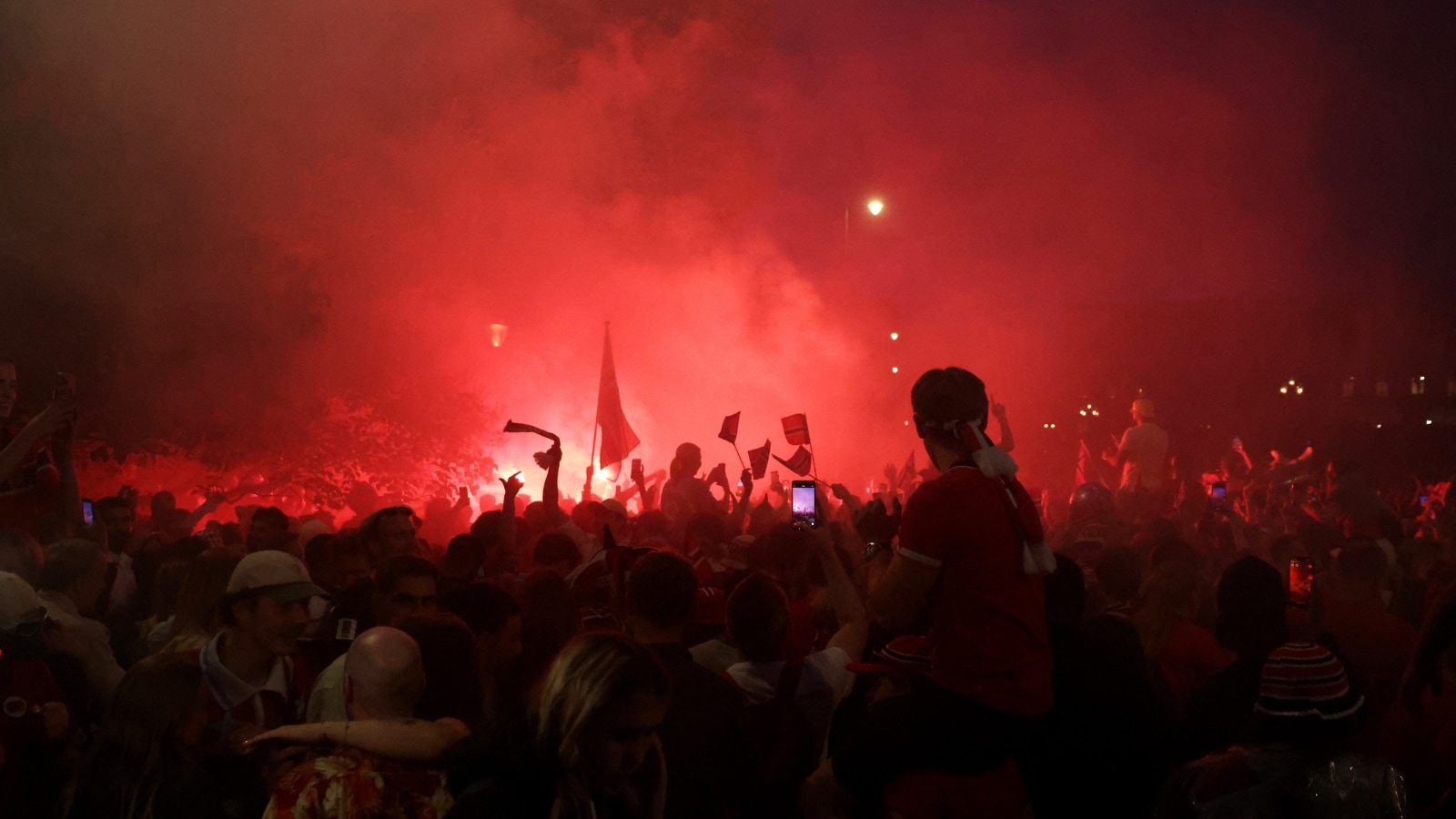
Norway’s recent World Cup exit did not trigger national mourning. Instead, it sparked a massive, 100,000-strong street party in Oslo that looked more like a championship celebration than a post-mortem for a defeated squad. While casual observers view this massive turnout as evidence of a booming, resilient soccer culture, the reality is far more complicated. The street parties mask a systemic failure in the nation’s sporting infrastructure. Norway is failing to convert historic public enthusiasm and unprecedented financial resources into elite, sustained international success, exposing a widening gap between grassroots passion and high-performance execution.
The Comfort of Atmospheric Defeat
Losing gracefully has become a specialized cultural commodity in Scandinavia. When over a hundred thousand fans flooded the center of Oslo, the images broadcast worldwide suggested a country deeply in love with the beautiful game. They drank, they sang, and they draped themselves in the national colors.
But look closer at the metrics that actually matter for a footballing nation's future.
The party in Oslo represents a coping mechanism for a sports culture that has grown comfortable with near-misses. For a country that boasts the highest GDP per capita in the region and an unmatched baseline of athletic participation among youth, merely qualifying or puttering out in the early knockout stages should be viewed as an underachievement. Instead, the narrative is spun into a triumph of community spirit.
This creates a dangerous feedback loop. When federation executives see 100,000 people celebrating a tournament exit, the political pressure to overhaul failing developmental systems evaporates. The public square fills up, the sponsors remain happy, and the status quo gets a free pass. True sporting growth requires a degree of friction and dissatisfaction that the current national mood simply refuses to tolerate.
The Youth Development Bottleneck
The root of the problem lies beneath the celebratory surface, deep within how young talent is nurtured from the ages of six to sixteen. Norway operates on a strictly egalitarian sports model. The Norwegian Olympic and Paralympic Committee and Confederation of Sports mandates that children cannot be ranked, and competitive leagues with official scorekeeping are discouraged until age 13.
On paper, this social democratization of sport is highly admirable. It keeps kids active. It prevents early burnout.
However, the elite global soccer landscape operates on entirely different principles. While young players in France, Spain, and South America are subjected to highly technical, competitive, and pressurized academy environments by age nine, Norwegian prospects are kept in a recreational holding pattern. By the time formal, high-performance coaching begins, a crucial window for technical mastery and tactical instinct has slammed shut.
+-----------------------------------------------------------------+
|              THE DEVELOPMENT GAP: AGE 8 TO 12                   |
+-----------------------------------------------------------------+
|                                                                 |
|  GLOBAL ELITE STANDARD (Spain, France, South America)            |
|  [Technical Focus] -> [Tactical Instincts] -> [High Pressure]   |
|                                                                 |
|  NORWEGIAN MODEL (Egalitarian, Recreational Focus)              |
|  [General Activity] -> [Social Play] -> [Delayed Competition]   |
|                                                                 |
+-----------------------------------------------------------------+
The country relies on rare, generational outliers who bypass the national system entirely by moving abroad at a young age, rather than a reliable pipeline that consistently produces world-class talent. The current system produces excellent physical specimens who lack the tactical sharpness required to break down elite international defenses when the stakes are highest.
The Financial Paradox of Norwegian Football
Norway does not have a money problem. The state-backed lottery system funneling millions into community sports infrastructure ensures that almost every village has a state-of-the-art artificial turf pitch, often heated to withstand the brutal Nordic winters.
Yet, this infrastructure wealth does not translate to elite coaching.
Most of the money is locked up in physical capital—fields, clubhouses, and equipment—while the human capital is neglected. The vast majority of youth coaches in Norway are well-meaning parent volunteers. They lack the tactical education to teach complex positional play. A pristine, million-dollar artificial pitch is useless if the person running the training session is using outdated drills from the 1990s.
To bridge this gap, clubs must professionalize youth coaching. Parent volunteers are excellent for fostering a love of the game, but they cannot teach the subtle body positioning required to play out of a high press. Until the federation shifts its financial focus from building more empty fields to paying full-time, highly qualified youth coaches, the national team will continue to stall on the world stage.
Changing the Cultural Definition of Success
If Norway wants to be more than a feel-good story for international broadcasters, it must confront its aversion to elitism in youth sports. This does not mean abandoning the inclusive values that make Nordic society strong. It means recognizing that elite sports and recreational sports are two entirely different endeavors that require different pathways.
Establishing regional high-performance academies that operate parallel to the community clubs would allow elite prospects to train under professional conditions without dismantling the local club structure that serves the broader public. It requires a difficult, politically sensitive conversation about talent identification and resource allocation.
As long as the streets of Oslo are filled with satisfied fans celebrating honorable defeats, the urgency to make these structural changes will remain nonexistent. True athletic progress begins when the party ends and the hard work of self-correction begins.