Picture a cold November tarmac outside Dublin, Ireland.
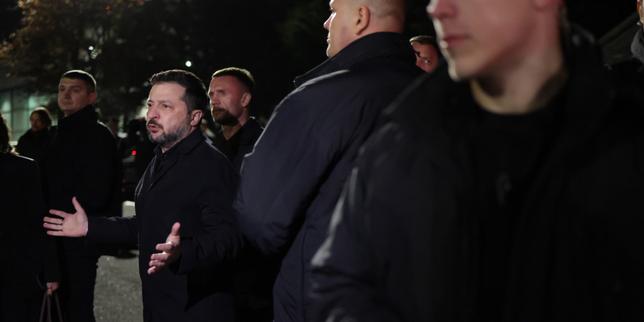
The rain hangs in the air like fine grey dust, smelling of wet asphalt and jet fuel. Inside a quiet briefing room at Baldonnel, far from the shattered concrete of eastern Ukraine, three men sit across a table. On one side are American envoys Jared Kushner and Steve Witkoff. On the other sits Volodymyr Zelensky, wearing the olive-drab fatigues that have become a second skin through nearly five brutal years of war.
Then comes the question that drops the temperature in the room by twenty degrees.
"What if Ukraine joins NATO?" the Americans ask. "Would Ukraine withdraw from Donbas?"
It is a single sentence. Twenty-two words. Yet in the silence that follows, you can almost hear the heavy, grinding weight of history shifting on its axis. For the first time since the full-scale invasion began, Washington has placed the ultimate taboo directly on the negotiating table—linking Ukraine’s long-cherished dream of Western collective defense to the surrender of its own eastern heartland.
Most headlines treat this moment like a high-stakes poker game. They frame it as a cold transaction of square kilometers for treaty articles, a diplomatic chess move calculated in Washington, Brussels, and Moscow.
They miss the point entirely.
When diplomats talk about "territorial concessions," they look at colored lines on a glossy map. When Ukrainians hear those words, they see a kitchen table where a grandmother still drinks tea from a chipped porcelain cup, a graveyard where a twenty-two-year-old son was buried beneath fresh clay, and a coal-blackened horizon that has fed and warmed their nation for generations.
The Architecture of an Unthinkable Bargain
To understand why this proposal hits like a physical blow, we have to look at what is actually being offered—and what is being demanded in return.
In mid-November 2026, speaking to reporters after those discussions in Ireland and parallel rounds of diplomacy stretching from Abu Dhabi to European capitals, Zelensky confirmed what had previously been whispered only in closed corridors. American negotiators had floated a stark hypothetical. If the United States and its allies opened the door to NATO membership—wrapping the rest of Ukraine under the ironclad umbrella of Article 5—would Kyiv order its exhausted soldiers to pack their gear and walk away from the remaining Ukrainian-held portions of the Donbas?
Stop and let that sink in.
Withdraw. Not lose in battle. Not be pushed back by artillery fire. Simply turn around, abandon fortified trenches dug with blood and frozen fingers, and hand over cities that Russian forces have spent years failing to conquer.
Imagine, for a moment, a hypothetical character to ground this abstraction in human reality. Let us call him Mykola—a composite of the tens of thousands of Ukrainian engineers, teachers, and mechanics who traded their civilian lives for combat boots. Suppose Mykola has spent three winters defending a shattered apartment block on the outskirts of Kramatorsk or Sloviansk. His best friend died twenty yards away from him holding that exact street corner. Every brick in that ruined neighborhood carries the memory of someone who refused to yield an inch.
Now imagine telling Mykola to sling his rifle over his shoulder and march west because men in suits in Dublin and Washington decided his street was the price of a signature in Brussels.
"I have no right to make that decision on my own," Zelensky told the press, his voice carrying the unmistakable strain of a leader trapped between an unstoppable force and an immovable moral wall. He reiterated that Kyiv will not simply retreat or sign away its land. Yet he left a narrow, trembling crack in the door: if Ukraine were offered a truly comprehensive security package—not empty promises, but full NATO membership, ironclad security guarantees, a strong and adequately funded army, and massive funds for reconstruction—he would put the question directly to the Ukrainian people in a national referendum.
A referendum. Let the people decide whether to amputate a limb to save the body.
Why a Map Is Never Just a Map
To grasp why this choice is so agonizing, consider an intuitive analogy.
Imagine someone breaks into your house, burns down your living room, and barricades himself in your kitchen. After years of fighting him off in the hallway, the neighborhood watch arrives. They tell you they are finally ready to install an unbreakable steel security door on your front porch and station armed guards outside forever—on one condition. You have to sign over the deed to your kitchen to the arsonist, and you have to promise never to try to take it back.
On paper, your family is finally safe in the bedrooms. In reality, the intruder is still inside your walls, cooking on your stove, waiting for the guards outside to get bored and go home.
That is how millions of Ukrainians view the Donbas question.
The Donbas—comprising the Donetsk and Luhansk regions—is not an empty stretch of wasteland. Before the war, it was the industrial engine of Ukraine, a land of deep coal mines, sprawling steelworks, fertile black soil, and millions of fiercely proud citizens. Much of it has been occupied by Russian forces since 2014 and the wider invasion of 2022, leaving deep scars across every family tree.
More than that, the cities Ukraine still holds in Donetsk are fortress towns. Over more than a decade of grinding trench warfare, Ukrainian engineers have turned this terrain into a deep, layered defensive belt. If Ukraine withdraws from those fortified positions, it does not just lose territory; it hands Russia the high ground and opens a flat, unobstructed highway straight toward central Ukraine and the Dnipro River.
History has taught Ukrainians to be deeply suspicious of paper promises. In 1994, Kyiv gave up the world’s third-largest nuclear arsenal under the Budapest Memorandum in exchange for "security assurances" from the United States, the United Kingdom, and Russia. Everyone saw how much that ink was worth when the tanks rolled across the border.
So when Americans ask whether Ukraine would trade Donbas for NATO, the immediate, gut-level question from Kyiv is painfully simple: Is NATO membership actually real, or is it another mirage?
The Mirage of Consensus
Here is where the story gets even darker, and where cold geopolitical reality collides with human hope.
Even if Zelensky wanted to take that deal tomorrow, and even if a heartbroken Ukrainian public voted yes in a referendum, the American negotiators are offering something they do not unilaterally own.
NATO does not expand by American decree. It expands by unanimous consensus. Every single one of the thirty-two member nations must ratify a new member's entry. Right now, that consensus does not exist. While countries like France have signaled openness to discussing membership, major powers like Germany remain firmly opposed to bringing a country at war—or one with unresolved territorial disputes—into the alliance. Other members fear that admitting Ukraine means signing up for a direct nuclear confrontation with Moscow.
And what about Moscow itself?
Russia’s position is not a secret; it is a brick wall. Russian negotiators have laid out non-negotiable demands that run in the exact opposite direction. The Kremlin does not want Ukraine in NATO under any circumstances—not without Donbas, not without Crimea, not even if Ukraine were reduced to a single city block. Moscow has demanded that Kyiv drop its NATO aspirations entirely and has even pushed for NATO to roll back its military presence in Eastern Europe to 1997 levels.
Look at the absurdity of that triangle.
Washington floats a trial balloon asking Ukraine to give up its land for a NATO seat. Berlin and several European allies quietly balk at the NATO seat. And Moscow says it will keep firing missiles until both the land and the NATO seat are dead and buried.
It is a diplomacy of ghosts. Everyone is negotiating over pieces that nobody has agreed to move.
The Exhaustion You Cannot Measure in Statistics
Why, then, is this conversation happening right now? Why in November 2026, as Ukraine braces for its fifth brutal winter of full-scale war, has the unthinkable suddenly become speakable?
Because exhaustion is a physical weight, and it does not show up on satellite imagery.
If you walk through Kyiv or Lviv or Kharkiv today, you do not just see damaged buildings; you see a bone-deep weariness etched into the faces of people who have spent nearly five years sleeping with one ear tuned to air-raid sirens. You see mothers checking phone apps every twenty minutes to see if a ballistic missile is heading toward their child's school. You see power grids patched together with ingenuity and desperation, humming through sub-zero nights while millions sit in the dark, wrapped in coats inside their own apartments.
The numbers tell one story—hundreds of thousands of casualties, millions displaced, entire towns erased from the earth like chalk wiped off a blackboard. The human nervous system tells another. A human being can endure terror for a month. They can endure grief for a year. When terror and grief stretch toward half a decade, something inside the soul begins to fray.
In Washington, a new political calculation has taken hold. Envoys like Kushner and Witkoff are operating from a transactional worldview: every conflict is a real estate dispute waiting for a price tag, every impasse a problem of finding the right leverage to force both sides to a close. From an American vantage point, the war is draining billions of dollars, straining weapons stockpiles, and distracting from other global crises. Washington wants an exit ramp.
If trading the Donbas for NATO membership—or alternatively, freezing the front lines where they stand—can stop the bleeding and let the West claim a strategic victory, American officials are willing to test the waters.
I admit, looking at this from the outside, it is terrifyingly hard to judge who is right. When you have never had to choose between burying your neighbor's children and surrendering your own hometown, moral certainty comes cheap. From a comfortable desk thousands of miles away, it is easy to demand that Ukrainians fight forever for every square inch of international law. It is equally easy to demand that they surrender someone else's home so that gas prices stabilize and headlines move on.
Both positions carry an unbearable arrogance when you aren't the one paying the bill in blood.
The Question That Haunts Every Kitchen Table
Let us return to our hypothetical soldier, Mykola, and his family.
Suppose the ballot actually gets printed. Suppose the power stays on long enough for millions of Ukrainians—those huddled in basements in Kharkiv, those living as refugees in Warsaw and Berlin, those still holding rifles in the frozen mud of Donetsk—to cast a vote.
What does that ballot actually ask?
It does not ask, "Do you want peace?" Everyone wants peace. Even the soldiers in the trenches want nothing more than to go home, wash the mud out of their hair, and never hear the whistle of a mortar again.
The ballot asks something far crueler: Who do you leave behind?
Because territory is not empty dirt. Inside the Russian-occupied parts of Donbas, and inside the towns Ukraine would be forced to vacate, live hundreds of thousands of Ukrainian citizens. Some are too old or too sick to flee. Others stayed behind to care for dying parents or guard the graves of their ancestors.
If Ukraine signs a piece of paper ceding the Donbas, those people wake up the next morning legally abandoned by their own government. Their children will be forced into classrooms that teach them their language is a dialect of an empire that tried to erase them. Their property will be confiscated. Those who worked as teachers, local officials, or volunteers for the Ukrainian state will face interrogation cells and filtration camps.
Can a nation save its future by signing away its own citizens? Or, conversely, can a nation save its citizens if it bleeds itself to death trying to rescue them?
There is no textbook answer to that. Political science offers formulas for deterrence, balance of power, and conflict resolution, yet none of them can weigh the value of one human life against the sovereignty of a patch of earth.
A Cold Wind Over Baldonnel
Zelensky knows this trap better than anyone alive. By refusing to reject the American question outright, he avoided giving Washington an excuse to paint him as the obstacle to peace. By insisting that only a national referendum—backed by real, ironclad security guarantees and full reconstruction funding—could ever authorize such a move, he handed the moral burden right back to the West.
In effect, he called their bluff.
He looked across the table in Ireland and said: If you want my people to make the most painful sacrifice in modern European history, show us the treaty first. Show us the signatures of all thirty-two NATO allies. Show us the money to rebuild our ruined cities and arm our soldiers so that Russia can never come back for the rest of the country. Put real steel on the table, and then I will ask my people if they are willing to break their own hearts to survive.
Until that steel appears, the American proposal remains what it was on that damp November day outside Dublin: a haunting hypothesis suspended in cold air.
Far to the east, as night falls over the steppe and the first frost hardens the mud in the trenches of Donetsk, a young soldier checks the magazine of his rifle, blows warm breath into his numb hands, and stares across a ruined field toward a tree line he has been ordered to hold until morning.