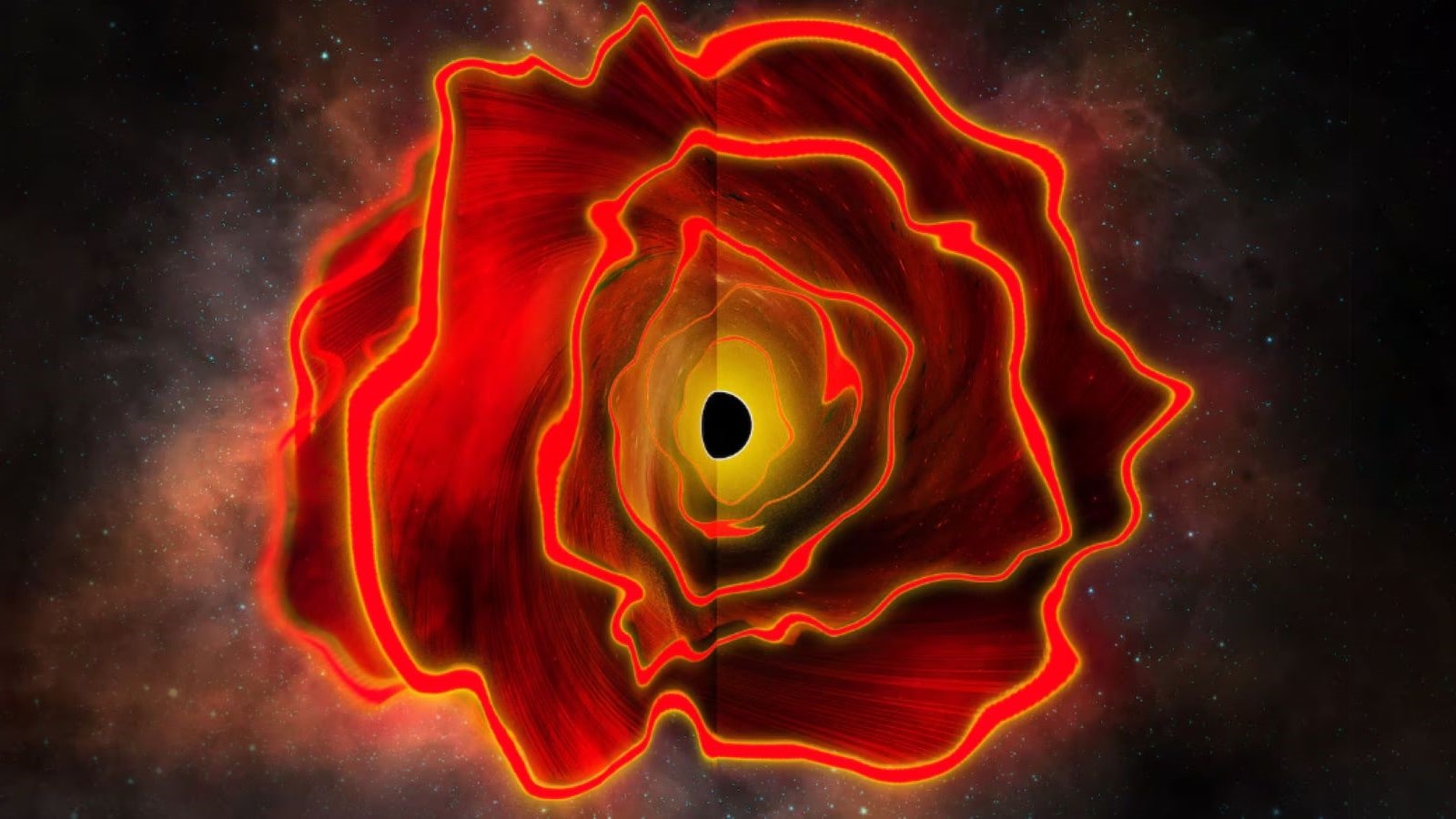
Astronomers found something that mathematically should not exist. Deep in the cosmos, an ultra-luminous object shines with the brilliance of a million suns while hiding behind the gravitational signature of a stellar-mass black hole.
Mainstream astrophysics teaches a strict boundary. Objects governed by extreme gravity consume matter at a measured pace. They respect the Eddington limit. This natural barrier prevents a gravitational well from devouring material too quickly. When gas falls inward too fast, outward radiation pressure pushes the remaining fuel away. It is a universal check on cosmic growth.
Yet this newly scrutinized anomaly shatters that threshold by a factor of one hundred.
The Anatomy of an Impossibility
For decades, researchers operated on clean classifications. Stars burn brightly through nuclear fusion. Black holes remain dark, betraying their presence only through the violent friction of accretion disks or gravitational waves. When an object blurs these categories, standard models break down.
The anomaly sits in a neighboring galaxy, pumping out radiation at levels that dwarf normal stellar output. Traditional theory dictates that any accumulation of mass drawing in matter this aggressively should blow itself apart. The radiation pressure ought to choke off the supply line instantly.
Instead, the system remains stable. It feeds at a frenzied pace without scattering its own accretion disk into the void.
To understand why this breaks conventional thought, consider how mass accumulation normally works. Picture water circling a drain. If you pour a cup into the basin, it spirals down smoothly. If you dump an entire swimming pool into a domestic sink, the water backs up, overflows, and creates chaotic backpressure. The Eddington limit is that sink. It dictates how much cosmic material a gravitational anchor can swallow per second before the backpressure of escaping heat halts the process.
This object takes the swimming pool and swallows it instantly.
Bending the Rules of Accretion
How does an entity bypass a fundamental law of astrophysics?
The leading hypothesis points toward extreme magnetic geometry. Powerful magnetic fields can trap photons and redirect radiation away from the central funnel. If the energy escapes through narrow beams or structured channels rather than radiating uniformly in all directions, the outward pressure drops. The mass trap can continue feeding unchecked.
Another possibility involves photon-trapping effects in super-dense environments. When matter becomes thick enough, light gets dragged along with the falling gas rather than escaping outward. Photons fall inward alongside the matter, effectively hiding their luminosity from the external universe.
Both explanations require conditions so extreme that laboratory replication is impossible. Researchers are forced to work backward from distant photons, piecing together a puzzle using faint signals that traveled millions of years to reach our sensors.
The Shift in Modern Cosmology
Discoveries like this expose the fragility of human models. Physics textbooks often present the universe as a tidy collection of settled rules. Gravity works this way. Fusion works that way. Mass limits are absolute.
Every few years, nature reminds us that our equations are merely approximations.
When a black hole shines like a giant star, it forces a complete recalculation of how early galaxies formed. If super-massive objects can grow a hundred times faster than previously thought, standard timelines for galaxy maturation fall apart. We might need to rewrite how the first generation of cosmic structures assembled in the early universe.
The data refuses to fit the neat boxes designed for it. That tension drives real science forward.
We are standing at the edge of a fundamental shift in observational astronomy. Next-generation orbital telescopes and gravitational wave detectors will soon peer deeper into these hyper-luminous zones. They will test whether this anomaly is a singular freak of nature or a common blueprint hiding in plain sight across the dark expanse.