The operational reality of border conflict in Southern Lebanon has shifted beyond kinetic exchanges between combatants to encompass a secondary, systemic crisis: the widespread destruction of agricultural and ecological infrastructure via fire. When high-explosive munitions interact with dry, cultivated terrain during the summer months, the resulting environmental degradation functions as a deliberate, albeit often collateral, economic weapon. Understanding this crisis requires moving past anecdotal accounts of fear to quantify the relationship between munitions trajectory, terrain flammability, and long-term socio-economic viability.
The Mechanism of Ecological Attrition
The primary driver of the current crisis is the intersection of high-velocity ordnance and local land use. Southern Lebanon remains a predominantly agrarian economy, reliant on olive groves, tobacco crops, and seasonal grazing. The fundamental problem lies in the volatility of these assets. Olive trees, which can produce for centuries, are particularly vulnerable to thermal damage. Unlike crops that perish and regrow on an annual cycle, the destruction of an olive orchard represents a generational loss of capital. Recently making headlines recently: Why Trump Just Threatened Oman and Told Iran to Surrender.
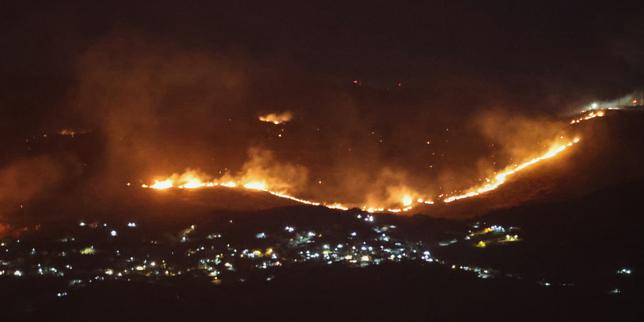
When munitions—whether mortars, artillery rounds, or incendiary payloads—impact arid, sun-scorched vegetation, they initiate uncontrolled combustion. The lack of standardized fire-suppression infrastructure in rural border zones exacerbates this. Local municipalities lack the heavy-lift aerial firefighting capabilities required to contain fires in high-gradient, inaccessible terrain. The fires, therefore, burn until they exhaust available fuel or reach a geographic break. This creates a cascade effect where the destruction of ground cover leads to rapid soil erosion during the winter rainy season, permanently reducing the land’s future yield capacity.
Economic Impact Modeling
To quantify the cost of this conflict, analysts must categorize losses into three specific tiers: direct, indirect, and systemic. Additional information regarding the matter are covered by BBC News.
- Direct Losses: These encompass the immediate destruction of physical capital—standing crops, irrigation piping, and stored harvests. Because these items are destroyed in situ, the loss is total. The speed of fire spread makes the salvage of these assets impossible, resulting in a binary loss of household wealth.
- Indirect Losses: These involve the degradation of land productivity. Fire damages the topsoil microbiome and the root systems of perennial crops. Even if the immediate threat of fire subsides, the land requires years of intervention to recover its pre-fire productive capacity. The cost of labor to clear charred remains and replant is prohibitive for small-scale agrarian operators.
- Systemic Erosion: The cumulative effect of these losses forces migration. When farmers can no longer secure a return on their labor or capital, they abandon the land. This depopulation of border regions shifts the economic burden to urban centers, creating a humanitarian supply chain constraint.
Strategic Infrastructure Deficiencies
The fear experienced by inhabitants is a rational response to the total collapse of risk-mitigation systems. In any stable region, fire risk is managed through fuel-load reduction, firebreak maintenance, and rapid response deployment. In the border zone, none of these are currently viable.
Traditional firebreak strategies, which involve clearing vegetation to starve a fire of fuel, are impossible to implement when the terrain is monitored by adversarial observation or littered with unexploded ordnance. The inability to manage fuel loads transforms the landscape into a tinderbox. Every strike becomes a force multiplier for destruction; the fire spreads with a velocity that renders traditional civil defense efforts moot. The absence of a formalized early-warning and suppression framework means that the fire itself—not just the strike—dictates the movement and survival of the civilian population.
The Intersection of Kinetic and Non-Kinetic Warfare
It is a mistake to categorize the fires purely as accidental consequences of kinetic warfare. In strategic terms, these events function as a denial of area. By degrading the agricultural utility of the land, the capacity for local populations to remain self-sufficient is severed.
This creates a self-reinforcing cycle of dependency. As agrarian income collapses, households lose the ability to fund their own resilience, forcing reliance on external aid or internal relocation. The loss of agricultural output also weakens local food security, as the region’s primary source of non-imported calories is incinerated. Over time, this shifts the conflict from one fought between combatants to one that erodes the very structure of the society residing within the contested zone.
Tactical Reconfiguration of Risk
The long-term viability of agriculture in Southern Lebanon under current conditions hinges on radical shifts in land management and economic mitigation. Conventional approaches to farming have become liabilities.
The primary strategic move for agrarian operators in high-risk sectors involves a transition toward high-density, low-fuel crops that require less labor in open, vulnerable fields. However, this is largely impractical for olive producers. The secondary move is the creation of localized, decentralized water storage systems that can be tapped for defensive fire suppression. Current irrigation networks are fragile and susceptible to pressure failure if damaged by a strike. Hardened, underground reservoirs that do not rely on centralized power grids provide a buffer for rapid, localized response to early-stage fire ignition.
Finally, the economic logic of the region must be re-evaluated by policy planners. If the border cannot be secured against incendiary risk, the investment model must transition from perpetual production to disaster-contingent insurance schemes. Without the ability to guarantee the survival of assets, the cost of agricultural participation will continue to exceed the value of the yield. The strategic reality dictates that the land will remain a theater of attrition until fire-suppression capacity is elevated to match the frequency of kinetic activity, or until economic activity is decoupled from the immediate exposure to the border.