Everyone loves a big round number. When political leaders throw out a phrase like 100 billion dollars by 2030, it's easy to dismiss it as standard diplomatic hype. You've heard it before. Two prime ministers shake hands, smile for cameras, and promise a golden future of economic cooperation.
But something different is happening between India and Australia right now. In related news, take a look at: The Weight of a Single Signature in a Room Full of Rivals.
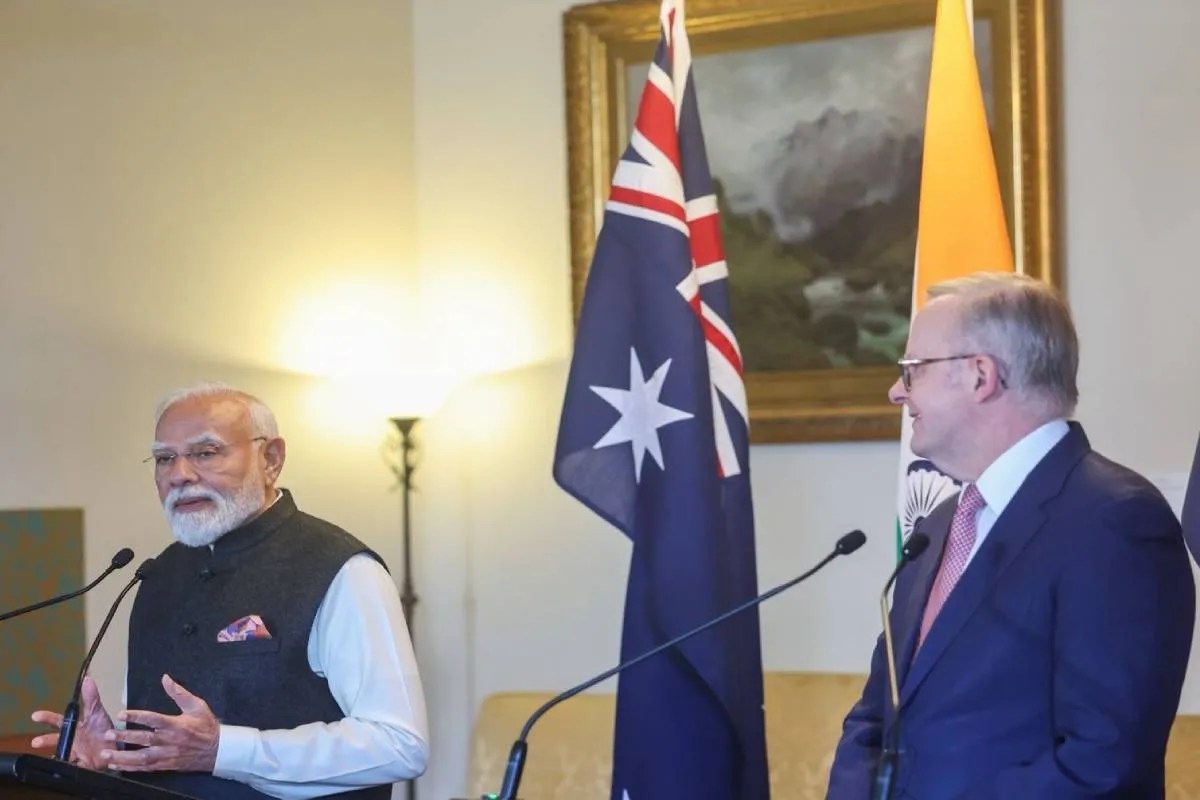
During his latest visit to Melbourne, Prime Minister Narendra Modi laid out an aggressive blueprint alongside Australian Prime Minister Anthony Albanese. They aren't just trying to sell more traditional goods to each other. They're rewiring how the two nations interact commercially. If you think this is just about coal, wine, and cricket, you're missing the entire picture.
The baseline is already moving fast. Since the Economic Cooperation and Trade Agreement, or ECTA, took effect in 2022, India's exports to Australia doubled. That isn't a minor bump. It's an explosion. Now, the push is on to finalise the Comprehensive Economic Cooperation Agreement, known as CECA, to open up the remaining sectors of the economy. Investopedia has provided coverage on this important issue in extensive detail.
Bypassing Capital Cities for Direct Deals
Most trade agreements get bogged down in federal bureaucracies. Modi pitched a radical shift in how economic diplomacy works by telling business leaders to stop focusing exclusively on New Delhi and Canberra. Instead, the real action needs to happen at the state and provincial level.
Think about it like matching hyper-local needs with regional strengths. Western Australia has the lithium and cobalt that India's tech sector desperately lacks. Gujarat has the massive manufacturing setups to turn those raw materials into electric vehicle batteries. Victoria houses brilliant innovation hubs, while Karnataka, specifically Bengaluru, holds the software muscle to write the code for those innovations.
Connecting these regions directly bypasses federal red tape. It lets businesses move at market speed rather than diplomatic speed.
The Energy Transition Blueprint
India wants 500 gigawatts of renewable energy capacity by 2030. It also wants a massive 100 gigawatts of nuclear power capacity by 2047. Those are absurdly large targets for a developing nation.
You can't build that kind of infrastructure without raw materials and immense capital. Australia happens to sit on some of the largest uranium and critical mineral reserves on the planet. The recent opening of India's private nuclear sector under the SHANTI Act means private players can now buy Australian uranium directly to power Indian reactors.
On the clean energy side, India is constructing a local manufacturing ecosystem for solar modules, wind turbines, and green hydrogen systems. Australia brings the advanced technological expertise and deep-pocketed pension funds to finance these projects. It's a clean trade. Australia provides the capital and raw resources, and India scales the manufacturing.
Big Capital Is Already Moving
Talk is cheap, but actual money talks. AustralianSuper, the biggest pension fund in Australia managing around 410 billion Australian dollars, just committed an extra 500 million Australian dollars to India's National Investment and Infrastructure Fund.
AustralianSuper Total Investment Track:
- Initial Commitment (7 years ago): AU$240 million
- New 2026 Commitment: AU$500 million
- Total Cumulative Investment: AU$3.3 billion
Pension funds are notoriously risk-averse. They don't invest millions based on political speeches. They invest because the returns are real. Chief Executive Paul Schroder noted that their original Indian infrastructure investment has been one of their top performers.
India is building 34 kilometres of national highways and laying more than a kilometre of railway tracks every single day. That kind of relentless physical expansion needs steady, long-term funding. Australian pension funds need stable, yield-generating assets to pay out their retirees. It fits perfectly.
Tech Alliances Over Raw Shipping
The old way of trading was simple. One country digs stuff out of the ground, ships it, and the other country consumes it. That won't get both nations to 100 billion dollars.
The focus has shifted toward high-tech co-development. India has set aside over 10 billion US dollars in government incentives for artificial intelligence, quantum computing, and semiconductor manufacturing. The goal now is to combine Australian research with Indian tech talent to build global products.
Look at the steel sector. India is the second-largest crude steel producer globally. The new frontier isn't just shipping raw iron ore. It's co-developing low-carbon aluminium and green iron to build supply chains that won't get penalized by global carbon taxes.
Moving From Student Visas to Real Talent Partnerships
For decades, the educational relationship was transactional. Indian students went to Australia, paid high tuition fees, and stayed to work or came back.
That model is evolving. Australian universities are setting up actual physical campuses inside India's GIFT City in Gujarat. Deakin University and the University of Wollongong already broke the ice. The next step involves corporate leaders linking up with these campuses to turn student mobility into direct corporate pipelines. You study at an Australian university on Indian soil, and you step directly into a global workforce aligned with both economies.
Achieving the 100 billion dollar trade target won't happen through bureaucratic paperwork. It requires businesses to actively exploit the room provided by ECTA and the upcoming CECA. If you run a business in logistics, clean energy components, tech, or higher education, the runway is clear. Your immediate next step is to look beyond national capitals and start exploring direct partnerships with regional provincial trade bodies to see where your supply chain fits.
The India Australia CEO Forum broadcast covers the complete details of the economic agreements, infrastructure targets, and specific business investments discussed by both prime ministers.