India wants to be the world's factory floor. The factories are built, billions of rupees have been poured into capacity, and the government keeps pushing the self-reliance narrative. Yet, if you look under the hood of the industrial machine, something is broken. Domestic factories are running half-empty while ports are flooded with cheap foreign goods.
A fresh batch of reports from the Centre for Digital Economy Policy Research (C-DEP) and the Centre for WTO Studies has exposed a messy reality. India's manufacturing push is getting choked out by a double whammy of dumped foreign imports and broken tax structures. It is not just about losing market share. It is about domestic manufacturers getting punished for trying to build things at home. If you found value in this post, you should read: this related article.
If you are tracking why the big industrial push feels uneven, the answer lies in the weird world of trade remedies and inverted duties. Let's look at what is actually going on on the factory floor.
The Anti Dumping Collapse Sabotaging Domestic Plants
When a foreign competitor floods the market with goods priced below their actual production cost, the standard defense is an anti-dumping duty. India has a dedicated body for this, the Directorate General of Trade Remedies (DGTR). They investigate the data, establish that domestic players are getting hurt, and recommend a protective tariff. For another look on this event, check out the recent coverage from Business Insider.
The system should work smoothly. Instead, it is stuck in an administrative bottleneck.
The numbers from recent trade studies are alarming. There is an absolute collapse in the implementation rate of recommended anti-dumping duties. The DGTR does the legwork, proves the damage, and sends the recommendation to the Ministry of Finance. Then, nothing happens. The finance ministry has been sitting on these recommendations or rejecting them outright. Between November and December 2025, the rejection rate of these trade-remedy recommendations shot up to 81%. For context, that rejection rate averaged just 0.5% over the previous three decades.
This policy freeze leaves domestic industries completely exposed. Estimates show that the non-implementation of pending anti-dumping duties drains around ₹28,540 crore every single year in forgone foreign exchange savings. The current total economic loss from these dumped imports sits at a massive ₹1.54 lakh crore. If the ministry keeps ignoring these recommendations, that damage is projected to rocket to nearly ₹2.70 lakh crore by 2030.
The standard excuse for skipping these duties is a fear of inflation. Policymakers worry that taxing intermediate imports will make consumer goods too expensive. It sounds logical on paper. In practice, it is flat-out wrong. An analysis of 56 cases where recommended duties were buried showed that the median impact on final consumer prices would have been a tiny 0.023%. These are industrial inputs, not retail groceries.
The Disastrous Math of Inverted Duty Structures
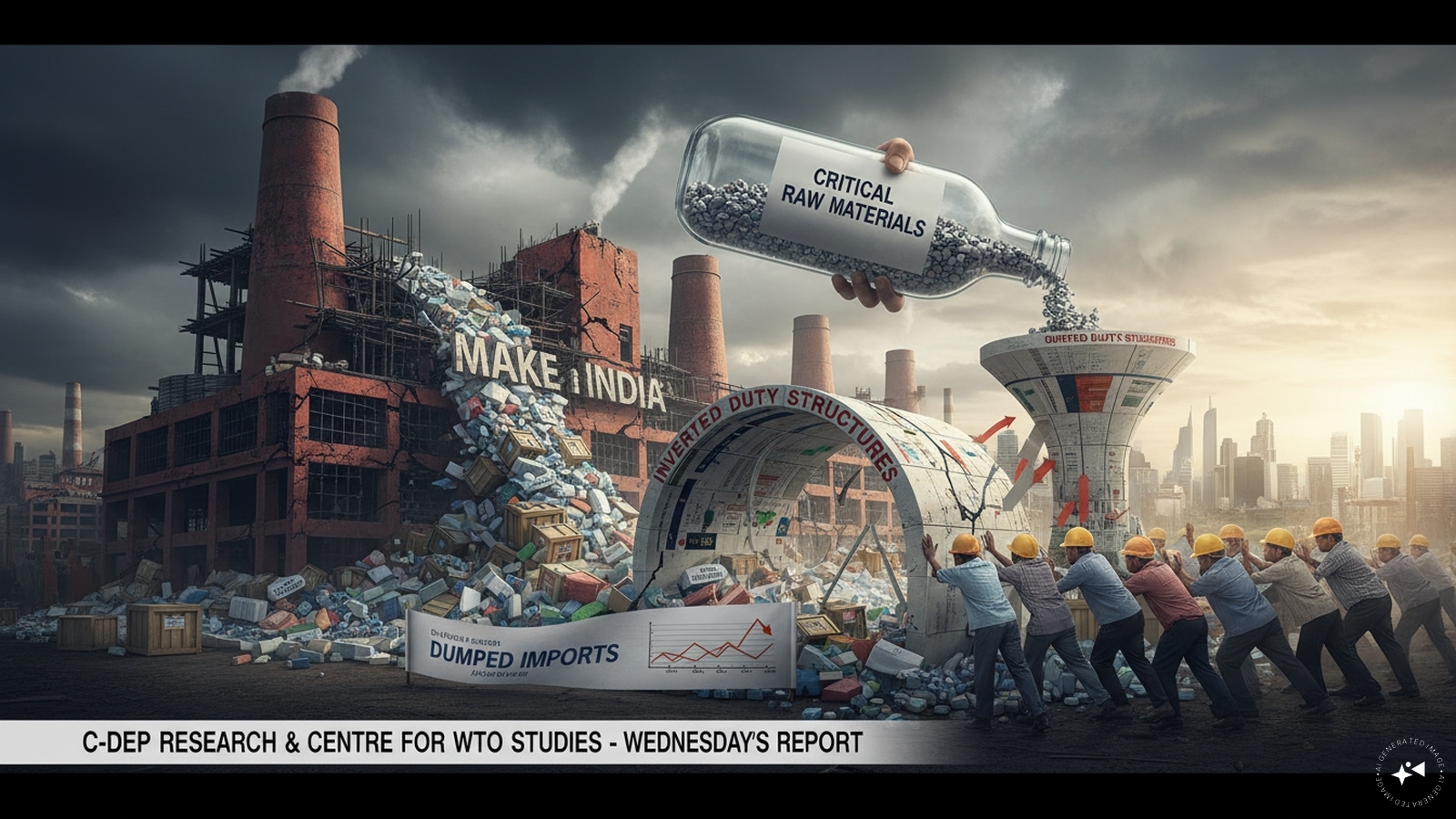
The second structural flaw killing domestic factories is the inverted duty structure. It is a simple tax mistake with catastrophic consequences. An inverted structure happens when the import tariff or domestic tax on raw materials is higher than the tax on the finished product.
Think about the math for a second. If you import a finished piece of gear, you pay a tiny duty. If you import the raw plastic or chemical blocks to build that exact same gear in Chennai or Pune, you pay a massive duty. You are essentially paying a tax penalty just for assembling the product locally.
This issue plays out across two distinct fronts: customs duties at the border and the internal Goods and Services Tax (GST).
The internal tax system went through a major overhaul with the GST 2.0 reforms. The changes aimed to simplify things by slashing rates to stimulate consumer demand. They knocked a ton of finished goods down to the 5% bracket. But they left the raw materials and input services sitting at 18%.
Take the electric vehicle market. An EV manufacturer pays an 18% GST on auto parts and components. When they sell the finished electric car, they only collect 5% GST from the consumer. That leaves a massive 13% tax gap.
Where does that extra money go? It gets permanently trapped in the manufacturer's Electronic Credit Ledger as blocked Input Tax Credit. It is cash that belongs to the business, but it is locked up by the government. While Section 54(3) of the CGST Act allows companies to claim a refund, the administrative process is a nightmare. Smaller players find their vital working capital frozen for months. If your input costs make up more than 27.8% of your total turnover, your cash flow is actively bleeding out under this tax system. For most factories, inputs comprise 60% to 80% of costs.
Four Key Sectors Right in the Line of Fire
The C-DEP industrial supply chain resilience reports highlighted four critical sectors where these distortions are doing the most damage. These are not niche products. They are core building blocks of the broader economy.
Nylon Filament Yarn
India has spent years building enough domestic capacity to satisfy its entire internal demand for Nylon Filament Yarn, a core input for textiles. Yet, the plants are idling. Massive surplus production from China—which sits at 15 to 17 times the entire size of the Indian market—is being dumped into the country. Dumping margins have been recognized at up to 55% for China and a staggering 150% for Vietnam.
Because of this influx, ten domestic manufacturers have already put locks on their gates and shut down operations entirely. Industry projections show that capacity utilization for the remaining plants will plummet to just 45% by the end of FY2027-28.
PET Resin
The material used to make everything from plastic bottles to food packaging is facing a literal tidal wave of imports. Chinese shipments of PET resin into India surged by 763% over a three-year period, jumping from 23,142 metric tonnes to 199,704 metric tonnes. China holds roughly 87% of the global surplus capacity for this material. Their idle, unused capacity alone is three times larger than India's entire domestic demand. To make things worse, foreign exporters are using origin manipulation and third-country routing to sneak products past existing trade barriers.
Viscose Staple Fibre
This sector is the poster child for the broken customs duty framework. To make Viscose Staple Fibre for the apparel industry, you need rayon-grade wood pulp. India does not produce enough of it, so manufacturers have to import it. The government slaps a steep import duty on this raw pulp.
Meanwhile, under existing Free Trade Agreements, finished Viscose Staple Fibre from ASEAN nations enters Indian ports completely duty-free. Indian fiber producers are operating at an immediate 7% to 8% cost disadvantage compared to global rivals before they even turn on their machinery.
Optical Fibre Cable
India is currently laying down massive telecom networks for 5G, BharatNet, and AI data centers. The country has built an impressive production capacity of 100 million fiber-kilometers to manufacture Optical Fibre Cables. But there is an Achilles' heel. Domestic plants are almost entirely dependent on foreign imports for critical upstream chemical inputs like Germanium Tetrachloride, Silicon Tetrachloride, helium, and specialized UV resins. Without a strategy to secure these base materials or correct the duties on them, the entire digital infrastructure push is built on shaky ground.
How Free Trade Agreements Widened the Gap
The deeper issue is that India's trade strategy has historically miscalculated how Free Trade Agreements play out in the real world. Data from the Global Trade Research Initiative (GTRI) paints a sobering picture of India's long-standing trade pacts.
Between the pre-FTA period and the mid-2020s, India's trade deficit with ASEAN countries ballooned by 381%. The deficit with South Korea climbed 268%, and the gap with Japan shot up 318%. For comparison, India's trade deficit with countries where it does not have an FTA grew by a much lower 142%.
The root cause of this imbalance is tariff asymmetry. Most of India's FTA partners were already ultra-open, low-tariff economies before any deals were signed. Singapore's standard tariffs are essentially zero. Japan, Australia, and the UAE keep theirs below 4%. India, on the other hand, maintains a trade-weighted average tariff of around 12.6%.
When India signs an FTA and slashes its tariffs, foreign exporters get a massive, wide-open doorway into the Indian market. But when an Indian exporter tries to go the other way, they get almost no new advantage because the foreign tariffs were already close to zero anyway. It is a one-way street that incentivizes companies to shift actual manufacturing operations outside of India into partner countries, only to ship the finished goods back into India duty-free.
Sourcing Shocks and the China Problem
You cannot talk about Indian manufacturing without looking at the massive bilateral trade deficit with China, which has climbed past the $100 billion mark. The dependency is not just about cheap consumer gadgets. It runs deep into industrial intermediates.
Recent geopolitical friction and shipping choke points in West Asia have made matters worse. For decades, hubs like Saudi Arabia and the UAE were the primary suppliers of raw chemical blocks to India. As those Gulf supply lines faced logistical bottlenecks, Indian importers were forced to pivot. China was more than happy to fill the void, further cementing its grip on the industrial supply chain.
When a domestic industry attempts to push back, they face an uphill battle. The slow pace of trade-remedy notifications means that by the time an anti-dumping duty is actually cleared and implemented, the domestic target has often already gone bankrupt. The average duration of an anti-dumping duty in India is just under seven years, while the global average sits closer to eleven years. Indian duties are also notoriously low, usually hovering between 5% and 12%, which barely makes a dent against heavily subsidized state-backed foreign exporters.
Real Fixes Needed on the Factory Floor
Fixing this trend requires moving away from reactive policy tweaks and focus on structural repair. If the goal is a genuine manufacturing hub, the policy blueprint needs an immediate overhaul.
First, the Ministry of Finance needs to stop blocking the trade-remedy recommendations cleared by the DGTR. When an independent body spends months analyzing data and proves that domestic plants are suffering material injury from subsidized dumping, those duties must be notified immediately. If the government decides to reject a recommendation, that process needs to be completely transparent and publicly documented so businesses can plan their investments accordingly.
Second, customs tariffs must be dynamically calibrated to eliminate the inverted duty layout. Raw industrial inputs and foundational chemicals should never carry a higher import duty than the finished items made from them.
Third, the GST Council needs to address the internal cash flow trap created by GST 2.0. While recent updates like CGST Instruction 6/2025 have helpful intentions—allowing a 90% provisional refund credit within seven days for clean-filing manufacturers—the underlying rate mismatches still need alignment. The tax design must ensure that industrial inputs are not stuck in a permanently higher tier than final outputs.
Finally, India needs a specialized FTA Impact Monitoring Authority. This body should track import surges, monitor utilization rates, and flag instances where trade agreements are being used to bypass local manufacturing. Relying on generic trade data is too slow. The policy response needs to match the speed of the global market. Domestically, the immediate priority for manufacturers is auditing their supply chains to identify key input tax blockages and filing for timely inverted duty structure refunds before the strict two-year legal window shuts down their capital permanently.