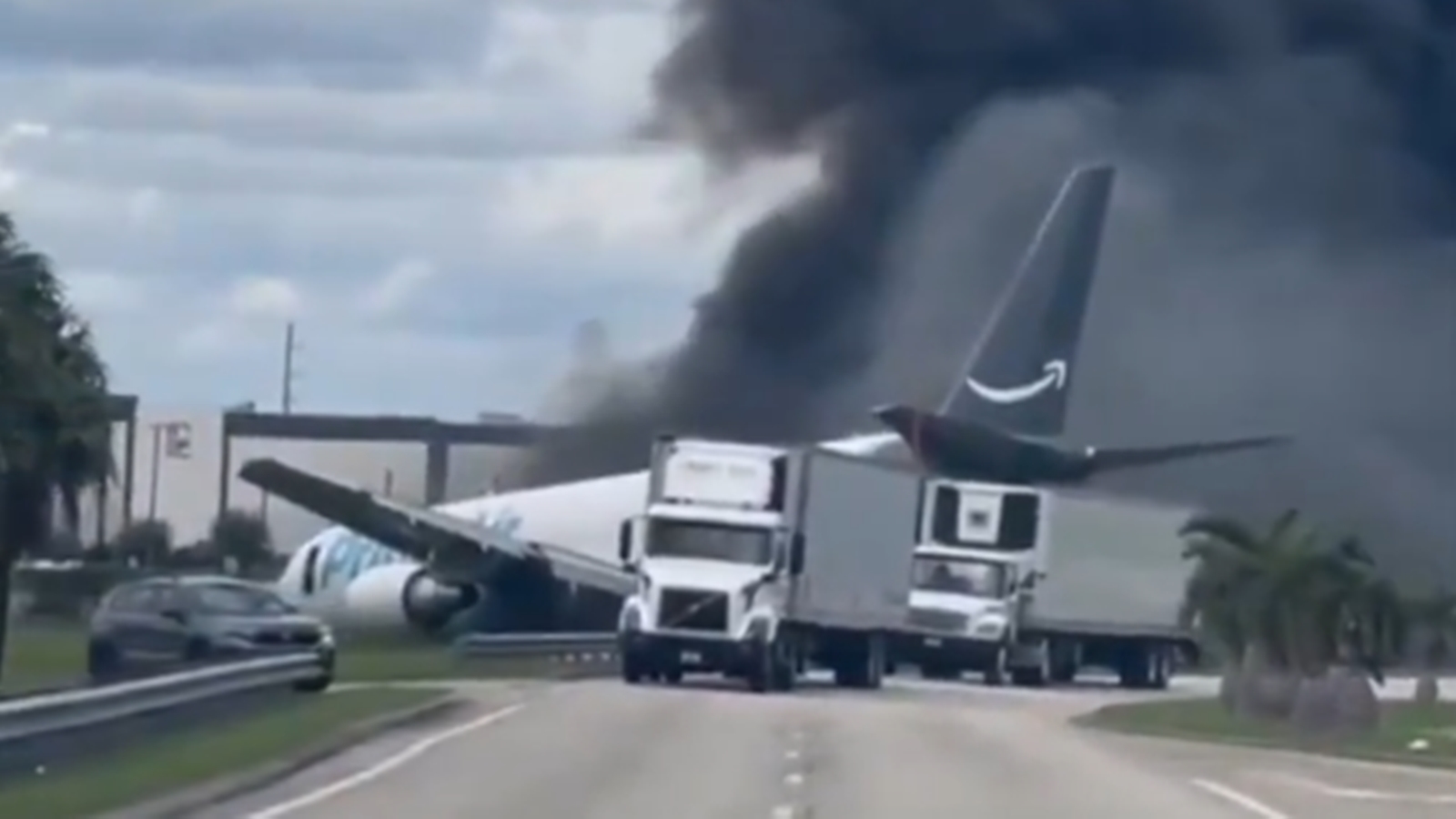
A 32-year-old Boeing 767 freighter operating for Amazon Prime Air barreled past the end of a runway at Miami International Airport, slamming into vehicles on an adjacent perimeter road and erupting into flames. Five people lost their lives in the disaster, with several others sustaining critical injuries. The aircraft, flying in from San Juan, Puerto Rico, and operated by the regional cargo carrier 21 Air, failed to decelerate within the paved confines of the airfield. Thick black smoke quickly choked the South Florida sky, grounding hundreds of flights and thrusting the logistics giant's heavily outsourced aviation model under intense public scrutiny.
The Anatomy of a Runway Excursion
A heavy commercial jet does not simply slide off a dry runway without a cascading failure of multiple safety layers. When flight 7598 touched down on the tarmac, a complex physics equation began ticking against the pilots. Weather conditions, braking friction coefficients, payload weight distribution, and thrust-reverser deployment efficiency all dictate whether a multi-ton aircraft stops safely.
The airframe involved was ancient by commercial aviation standards. Built over three decades ago, the Boeing 767 had spent the initial portion of its operational life carrying passengers before undergoing a freighter conversion. While older airframes remain structurally sound if maintained under strict regulatory oversight, the mechanical demands placed on cargo operators often differ vastly from major passenger airlines.
Runway overruns, known in aviation safety circles as runway excursions, typically happen when an aircraft lands long, suffers from hydroplaning due to standing water, or experiences mechanical anomalies with its braking systems. Investigators from the National Transportation Safety Board and the Federal Aviation Administration face the arduous task of piecing together cockpit voice recorders, flight data parameters, and maintenance logs to determine why this particular widebody jet refused to stop.
The Hidden Cost of the Outsourced Skies
Amazon does not fly its own planes. Instead, the trillion-dollar retailer relies on a fragmented network of third-party carriers like 21 Air, ATSG, and Atlas Air to fly aircraft painted in the distinctive blue-and-white Prime livery. This structural separation creates a distinct buffer between corporate headquarters and the physical realities of the tarmac.
The explosive growth of e-commerce delivery expectations places immense temporal pressure on regional supply chains. Pilots and logistics analysts have repeatedly warned that the relentless push for two-day, next-day, and same-day shipping trickles down into operational environments characterized by tight turnarounds and high-tempo schedules. While investigators have not yet assigned fault or pointed to scheduling pressures in this specific incident, the systemic reliance on outsourced wet-leases and smaller charter operators remains a persistent focal point in aviation safety debates.
Outsourced cargo networks often operate under different economic margins than legacy passenger airlines. Margins are tight, competition for qualified flight deck crew is fierce, and the sheer volume of nightly package sorting leaves little room for operational hesitation. When a major incident occurs, the parent company's brand is emblazoned across the burning fuselage, yet the operational controls are diffused across subcontractors.
Perimeter Vulnerabilities and Airfield Safety
The tragedy at Miami International Airport extends beyond the mechanics of flight operations and into the vulnerability of airport perimeter geography. Modern airports are bounded by dense urban environments, major highways, and perimeter service roads. When an aircraft fails to stop within the designated safety areas, the margin between a localized mishap and a community catastrophe vanishes instantly.
Runway Safety Areas are engineered specifically to absorb overrunning aircraft, utilizing graded earth beds or engineered materials arresting systems designed to crush under the weight of an airframe and bleed off kinetic energy. When an aircraft clears these zones entirely and strikes moving traffic on a public roadway, it highlights the terrifying proximity of high-density civilian infrastructure to major commercial flight paths.
Federal regulators and airport authorities have spent decades retrofitting airports with enhanced safety geometries, but space constraints at dense urban hubs like Miami make total isolation nearly impossible. Perimeter roads that handle service vehicles, delivery trucks, and local traffic sit directly in the shadow of final approach and departure corridors.
The investigation unfolding in South Florida will inevitably move past initial shock and focus on hard, uncomfortable questions. Flight data recorders will reveal whether mechanical failure, pilot input, or environmental conditions sealed the fate of those on board and on the ground. Until those answers emerge from the wreckage, the smoking remnants of the Prime Air freighter stand as a grim reminder of the physical human toll exacted by the modern global delivery machine.