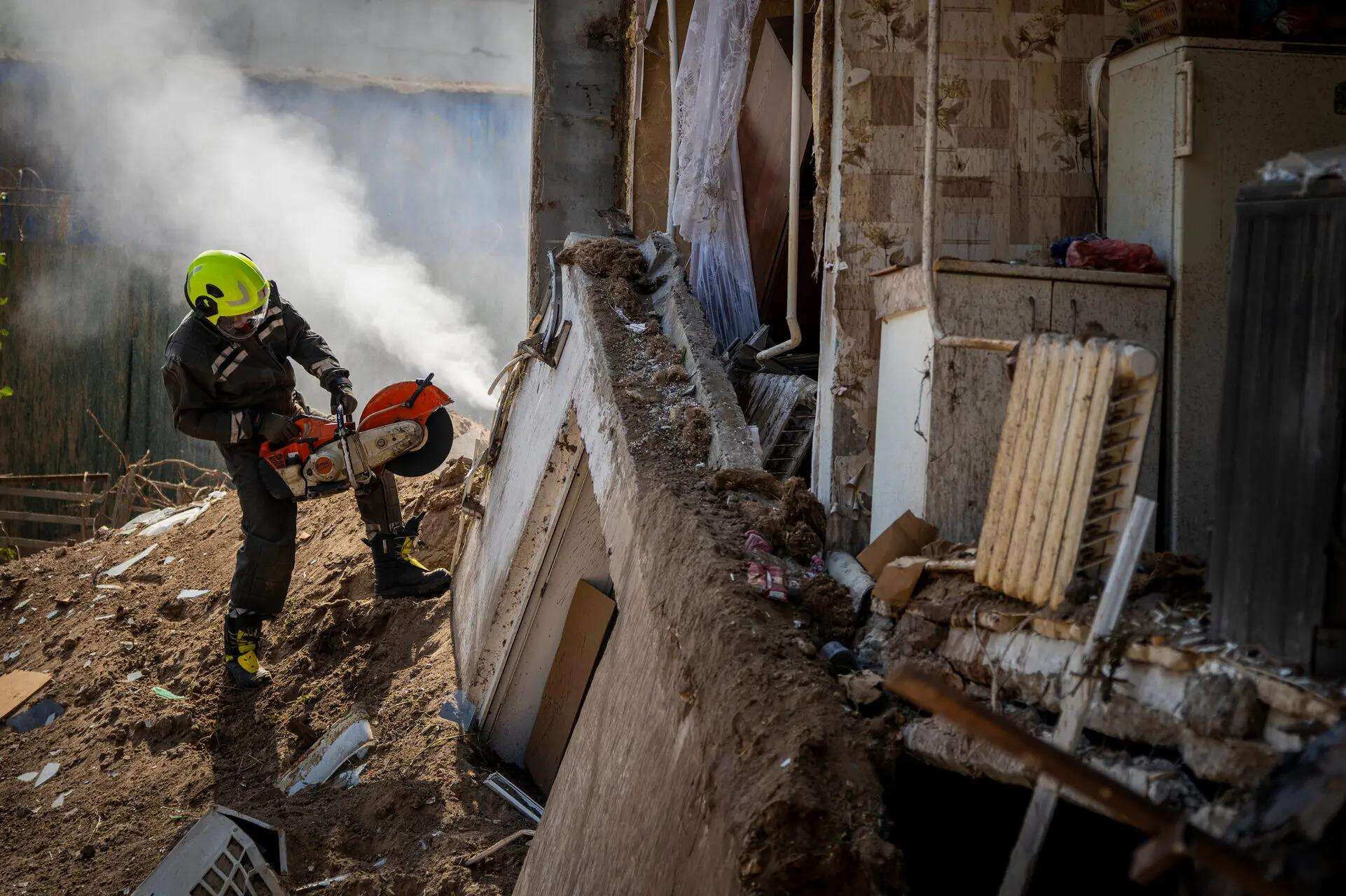
The smoke clearing over Kyiv carries a brutal geopolitical reality that far outlasts the body count. Hours before Ukrainian President Volodymyr Zelenskyy stepped onto a transport plane to meet U.S. President Donald Trump at the high-stakes NATO summit in Ankara, Turkey, a massive barrage of 68 Russian missiles and 351 drones tore through the Ukrainian capital, killing at least 22 people and collapsing residential blocks.
This was not a random act of wartime cruelty. It was a calculated, synchronized veto sent directly from the Kremlin. By unleashing one of the most intense aerial assaults of the entire war on the immediate eve of direct bilateral talks, Russian President Vladimir Putin signaled his true intent to the incoming Western order. He does not want a negotiated settlement; he wants total capitulation.
The tragedy of the civilian deaths exposes a severe tactical crisis. Kyiv’s air defense grid, once considered an impenetrable shield backed by Western hardware, is running dangerously low on interceptors. While Ukraine remains highly effective at downing low-altitude drones, it is now functionally defenseless against heavy ballistic missiles.
This structural vulnerability forms the grim backdrop for the Ankara meeting. Trump has consistently maintained that he can halt the conflict through direct, hard-nosed diplomacy, a claim bolstered by a flurry of recent phone calls to both Moscow and Kyiv. But the kinetic reality on the ground shows that the Kremlin is weaponizing Trump's push for an immediate ceasefire to force Ukraine into a position of absolute weakness.
The Mirage of a Twenty Point Plan
Negotiators behind the scenes have spent weeks trading a draft peace proposal that officials claimed was nearly 90 percent ready. The framework outlines deep concessions, including a potential pause on Ukraine’s formal NATO bid in exchange for legally binding, alliance-style security guarantees.
But a draft treaty is only as strong as the willingness to enforce it. Putin understands that the current American political administration is eager for a swift diplomatic victory to fulfill campaign promises. By striking Kyiv now, Moscow is testing exactly how much violence the White House will tolerate before walking away from the negotiating table.
The diplomatic math simply does not add up. Ukraine has indicated it might consider creating free economic zones in its occupied eastern regions or adjusting troop deployments, but it requires ironclad guarantees that Russia will not use a ceasefire to rearm and strike again. Russia’s actions over the weekend show that any pause in hostilities would merely be a tactical intermission.
The Interceptor Famine
The military mechanism behind the recent tragedy reveals a deeper supply chain crisis. Foreign Minister Andrii Sybiha has spent months warning that domestic factories, while now producing up to 75 percent of basic infantry equipment, cannot manufacture advanced air defense systems.
The defense of major cities relies entirely on foreign stockpiles. NATO Secretary General Mark Rutte recently defended the alliance's current defense distribution pipelines, but the raw numbers tell a different story. When Russia coordinates saturation strikes using hundreds of cheap drones alongside high-speed ballistic missiles, it forces Ukrainian commanders to make impossible choices. Do they expend their last remaining multimillion-dollar Patriot missiles on a decoy drone, or do they save them and allow residential neighborhoods to be exposed to ballistic impacts?
The result is what occurred in the Darnytskyi and Desnianskyi districts of Kyiv. Entire apartment blocks collapsed because there were simply no interceptors left in the local battery to stop the incoming warheads.
Leveraging the Firepower asymmetry
The timing of the bombardment was designed to alter the psychological leverage inside the Ankara summit room. Russia is currently facing its own internal pressures, including a severe domestic fuel crisis driven by months of relentless Ukrainian drone strikes on major oil refineries from Volgograd to the Black Sea peninsula.
Putin’s response to economic pain is always an escalation of violence. By demonstrating that he can still paralyze the Ukrainian capital at will, he is trying to convince Donald Trump that supporting Ukraine is a sunk cost. The strategic goal is to pressure the U.S. delegation into forcing territorial concessions from Zelenskyy as a prerequisite for any peace deal.
This puts the Ukrainian delegation in an extraordinarily precarious position. If Zelenskyy agrees to a ceasefire under the current conditions, he risks locking in the loss of critical eastern settlements like Rozkishne and Okhrimivka, which Russian forces recently captured during grinding ground offensives. If he rejects the terms, he faces the prospect of an unmitigated aerial campaign against an unprotected civilian population.
The coming days in Ankara will reveal whether international diplomacy can withstand brutal kinetic pressure. The Russian missiles that struck Kyiv were intended to shatter the framework of the upcoming talks before the leaders even shook hands. If the Western alliance mistakes this blatant show of force for a willingness to negotiate, they will sign an agreement that isn't a peace treaty at all, but a roadmap for the next invasion.


