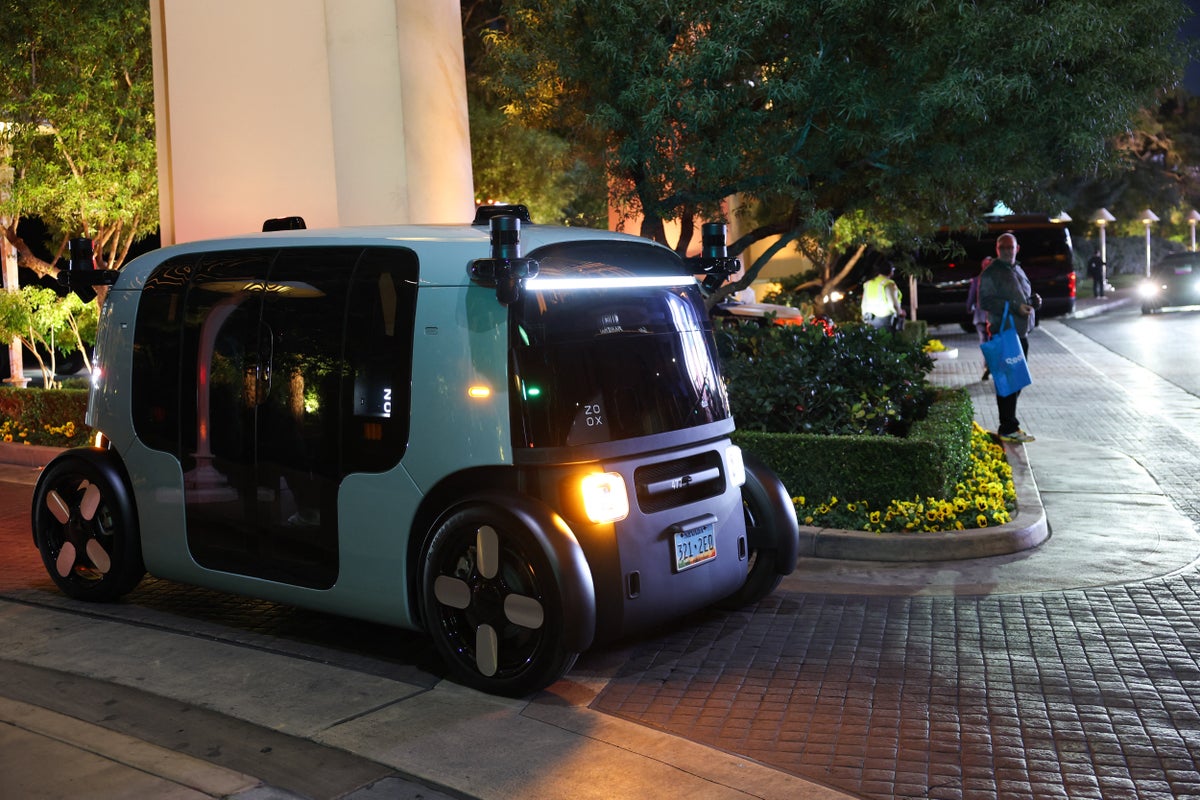
Amazon-owned Zoox issued a voluntary software recall across its fleet of 105 custom robotaxis after a vehicle rolled straight into dense smoke at an active Las Vegas fire scene. The June 202026 incident required a human operator to remotely steer the vehicle in reverse out of danger before emergency personnel could cordon off the roadway with traffic cones. While autonomous driving systems handle structured highway miles and predictable city grid traffic with high precision, unscripted emergency environments expose critical sensor limitations.
The Las Vegas event highlights a systemic engineering problem across the entire self-driving sector. Autonomous perception systems rely on a combination of lidar, radar, and optical cameras to construct a real-time three-dimensional map of their surroundings. Heavy, opaque smoke scrambles these systems in distinct ways. Lidar sensors fire thousands of laser pulses per second; when those photons strike dense airborne particulates, they scatter prematurely, producing phantom obstacles or obscuring the physical road surface entirely. Optical cameras struggle with low contrast and sudden light diffusion, while radar, though able to penetrate fog and smoke, lacks the spatial resolution required to identify active fire hoses, unmonitored hazards, or subtle hand signals from emergency personnel.
The Sensor Blindspot at Emergency Scenes
When the Zoox vehicle encountered the un-shielded fire scene, its software failed to recognize airborne smoke as a hazard requiring an immediate route halt prior to entering the perimeter. Instead, the vehicle entered the plume, registered an anomaly, and executed a hard brake inside the hazardous zone.
NHTSA Administrator Jonathan Morrison issued a direct call to action to autonomous developers, pointing out that emergency scenes can no longer be dismissed as rare edge cases. Emergency environments are chaotic, dynamic, and defined by non-standard human behaviors. Firefighters step into active lanes, police vehicles park diagonally across marked intersections, and smoke patterns shift with unpredictable wind gusts.
A traditional driver relies on contextual reasoning to interpret these cues. A driver sees distant smoke, hears distant sirens, notices pedestrians turning their heads, and decelerates long before reaching an official police barricade or traffic cone boundary. A machine learning model trained primarily on standard traffic flows lacks this broad contextual chain. If the specific pattern of thick particulate smoke isn't explicitly classified as an impassable barrier within the perception architecture, the system defaults to driving forward until a solid physical object triggers its collision avoidance thresholds.
Over the Air Patches Versus Physical Reality
Zoox responded to the Las Vegas incident by deploying a remote software update to update its fleet's perception algorithms. The updated code improves how the vehicle's sensor fusion engine processes heavy smoke and flags fire emergency zones.
- Sensor Fusion Overload: High-density smoke creates conflicting data streams between optical cameras, which see zero visibility, and radar, which sees an open road ahead.
- Remote Teleoperation Latency: When autonomous vehicles halt in uncertain conditions, they rely on human remote operators to plot a safe path out. In rapidly evolving fire or hazardous material scenes, even a few seconds of teleoperation delay poses risks to first responders.
- The Regulatory Push: Regulators are increasingly scrutinizing "software recalls" that allow companies to fix critical safety vulnerabilities wirelessly without pulling physical hardware from service.
Fixing software algorithms solves only part of the puzzle. The deeper issue lies in how autonomous fleets interact with dynamic emergency operations where standard rules of the road are suspended. First responders require instant, predictable compliance from every vehicle on the road. When a robotaxi stalls, executes an unexpected hard brake, or requires remote intervention, it diverts vital human attention away from the emergency at hand.
Solving the emergency blindspot requires move-beyond-vision approaches. Engineers must build models capable of contextual inference, recognizing early warning signals well before a vehicle physically reaches an active scene. Until autonomous fleets demonstrate reliable safety when encountering smoke, flares, and changing traffic controls, regulatory oversight will continue to intensify.