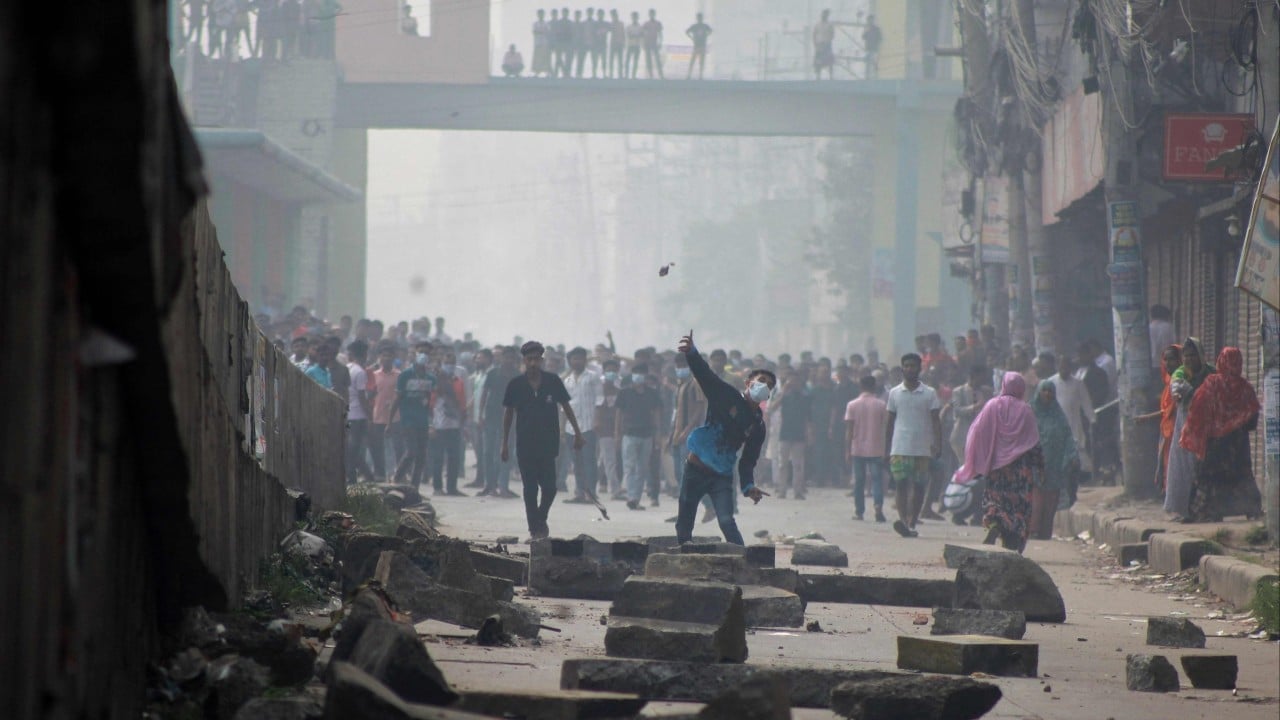
Bangladesh garment workers are once again clashing with police in the industrial belts of Gazipur, Ashulia, and Savar because the baseline wages governing the world’s second-largest apparel exporter no longer cover basic survival. Tear gas and rubber bullets have become routine responses to labor unrest in Dhaka’s periphery, yet treating these demonstrations as isolated law-and-order incidents misses the structural reality. The violence on the streets is the direct result of a global supply chain pricing model that squeezes factory margins until worker pay collapses beneath the weight of persistent inflation.
To understand why four million workers repeatedly risk arrest, blacklisting, and physical harm, you have to look past the police barricades and examine the ledger books of Western retail brands and local factory owners. Every t-shirt hanging on a rack in New York, London, or Berlin carries an invisible subsidy paid out of the caloric intake and living conditions of Bangladeshi sewing machine operators.
The Arithmetic of Survival in Gazipur
Walk through the narrow, unpaved lanes of Gazipur at six in the morning, and the human cost of global fashion becomes immediately obvious. Workers live in tin-roofed, single-room tenements where a dozen families often share two concrete toilets and a single water tap. Rent for these cramped spaces consumes up to forty percent of a junior operator's monthly paycheck.
When the government's Minimum Wage Board revises pay structures—historically occurring once every five years—the resulting numbers routinely trail behind reality before the ink dries. In late 2023, following weeks of deadly protests, the monthly minimum wage was raised from 8,000 taka to 12,500 taka, roughly equivalent to $113 at the time. Unions had demanded 23,000 taka based on basic nutritional and housing baskets. Even that compromise figure was rapidly eroded by double-digit food inflation and the steady depreciation of the Bangladeshi taka against the US dollar.
Consider the actual monthly math for a typical garment worker supporting a family of four. A hypothetical budget built on current market prices in Dhaka's industrial suburbs tells a stark story:
- Housing and Utilities: A single room with erratic electricity and shared sanitation costs roughly 4,500 to 5,500 taka.
- Staple Foods: Rice, lentils, cooking oil, eggs, and basic vegetables easily exceed 6,000 taka, leaving almost nothing for meat, fish, or dairy.
- Healthcare and Transport: Over-the-counter medicine, clinic visits, and local transit absorb another 1,500 to 2,000 taka.
The ledger does not balance. Workers survive only through mandatory overtime—often pushing shifts to ten or twelve hours a day, six days a week—and by taking high-interest loans from local moneylenders when a child falls sick or a monsoon floods their ground-floor room. When factories cut overtime hours due to fluctuating international orders, household budgets snap overnight. That is the precise moment when factory floor frustration spills onto the highways.
How Global Brands Dictate Factory Floor Reality
Factory owners in Dhaka are often cast as the sole villains in labor disputes, and many certainly bear responsibility for union-busting and delayed wage payments. Yet anyone who has spent time negotiating sourcing contracts knows that local manufacturers operate inside a financial vise designed in Western corporate headquarters.
For two decades, the price paid by major apparel brands for basic cotton garments—known in the trade as Free on Board (FOB) pricing—has remained stagnant or actually declined in real terms. While the cost of raw cotton, shipping containers, industrial electricity, and diesel generators has climbed steadily, multinational retailers continue to demand lower unit prices and faster turnaround times.
A factory owner running a mid-sized facility with two thousand sewing machines operates on razor-thin margins, frequently between two and four percent. If a supplier raises prices by fifty cents per garment to fund higher wages, the buyer simply shifts the order to a competing factory down the road, or moves production to Vietnam, Cambodia, or Ethiopia.
This dynamic creates a race to the bottom disguised as free-market efficiency. Brands publish glossy sustainability reports praising their commitment to ethical sourcing while their procurement departments aggressively penalize suppliers for any cost increase. The compliance auditors sent by Western corporations check whether fire exits are unlocked and whether workers wear protective masks, yet those same auditors rarely ask whether the factory's contract price actually allows the owner to pay a living wage.
The Anatomy of an Industrial Crackdown
When protests erupt in hubs like Ashulia or Mirpur, the escalation follows a predictable, brutal script. It rarely begins with an organized national strike. Instead, unrest usually sparks at a single factory where management has delayed attendance bonuses, altered piece-rate targets, or fired workers suspected of organizing.
Workers walk out and march toward neighboring plants, calling on peers to join them. Within hours, tens of thousands of people block the Dhaka-Mymensingh highway, the economic artery connecting the industrial zones to the capital and the port of Chattogram.
The state's response is swift because the government views uninterrupted garment exports as an existential necessity. Ready-made garments account for more than eighty percent of Bangladesh's total export earnings and employ millions of citizens, predominantly women from rural districts. Any prolonged shutdown threatens foreign currency reserves and macroeconomic stability.
Consequently, the Industrial Police—a specialized paramilitary force created specifically to police export zones—deploy alongside border guards and rapid action battalions. Streets fill with acrid smoke. Workers throw bricks; security forces respond with sound grenades, tear gas, and shotgun pellets.
After the streets are cleared, the quieter repression begins. Factory managers review CCTV footage to identify protest leaders. Thousands of workers are named in sweeping, "unnamed" police complaints—a legal tactic used across South Asia that allows authorities to arrest almost anyone in the vicinity weeks after a demonstration ends. Blacklisted workers find their national ID numbers flagged in industry databases, permanently barring them from formal employment across the entire sector.
Why Conventional Labor Unions Struggle to Gain Footing
In most industrialized economies, collective bargaining provides a release valve that prevents strikes from turning into street battles. In Bangladesh, that mechanism is broken by design.
Less than ten percent of the country's roughly four thousand export-oriented garment factories have registered trade unions. Even where unions exist on paper, many are "yellow unions" controlled directly by factory management to satisfy international compliance checklists.
Independent organizers face relentless obstacles:
- Bureaucratic Hurdles: Registering a union requires signatures from twenty percent of a factory's workforce—a threshold nearly impossible to meet secretly in a facility of five thousand workers. Once the list is submitted to labor authorities, names frequently leak to factory owners, resulting in immediate dismissals and physical intimidation before registration is ever approved.
- Political Co-optation: Major labor federations are often tied to rival political parties, meaning worker grievances get subordinated to national political agendas rather than shop-floor realities.
- Lack of Legal Recourse: Labor courts in Dhaka are severely backlogged, with wrongful termination cases dragging on for years while the fired worker has no income.
Without legitimate representation inside the factory walls, workers have no institutional channel to negotiate grievances. Blocking a highway becomes the only way to force the government, factory associations, and international buyers to acknowledge their existence.
The Automation Threat and the Shifting Global Map
The tragedy of the current wage crisis is that workers are fighting for survival just as the economic foundations of Bangladesh's garment miracle are shifting beneath their feet.
For forty years, Bangladesh held an unbeatable competitive advantage: the lowest labor costs in the world paired with massive production scale. That advantage is narrowing. As wages slowly inch upward under inflationary pressure, manufacturers are aggressively investing in automated cutting machines, computerized knitting systems, and robotic material handlers.
A single automated flat-knitting machine can replace up to a dozen manual operators while running twenty-four hours a day with zero defects. Factory owners openly admit that every major wage hike accelerates their capital expenditure on machinery. For low-skilled helpers—traditionally the entry-level tier for young women arriving from rural villages—those jobs are disappearing permanently.
At the same time, Bangladesh is scheduled to graduate from the United Nations' Least Developed Country (LDC) status. Graduation brings prestige, but it also means losing automatic duty-free access to key European and North American markets unless new trade agreements are secured. Facing potential tariffs of ten to twelve percent on exports to the European Union, Bangladeshi manufacturers will face even fiercer pressure from buyers to keep production costs artificially depressed.
Beyond Charity and Compliance Audits
If meaningful reform is ever going to reach the factory floors of Gazipur and Narayanganj, it cannot come from another round of corporate social responsibility pledges or voluntary codes of conduct. Decades of self-regulation have proven that brands will not police their own purchasing practices when quarterly profit margins are on the line.
Real change requires binding structural shifts at both ends of the supply chain:
- Purchasing Practice Accountability: Emerging legislation in the European Union, such as the Corporate Sustainability Due Diligence Directive, marks a critical turning point by making brands legally liable for human rights and wage violations in their supply chains. Crucially, these frameworks must scrutinize whether a buyer's pricing and lead times make compliance mathematically possible.
- Ring-Fenced Labor Costs: Industry advocates have long proposed isolating labor costs from price negotiations. Under a ring-fenced model, brands agree to pay a fixed, transparent labor premium per garment that goes directly into audited payroll accounts, preventing suppliers from undercutting each other by squeezing worker pay.
- Index-Linked Minimum Wages: Waiting five years between wage reviews guarantees periodic explosions of unrest. Tying minimum wages to an annual inflation index would remove the political brinkmanship from wage boards and prevent purchasing power from collapsing between cycles.
None of these solutions are painless. Ring-fenced pricing requires intrusive financial transparency that both buyers and suppliers resist. Binding due diligence laws face fierce lobbying from retail associations warning of higher consumer prices in Western shopping malls. Yet the alternative is already playing out on the asphalt outside Dhaka. Until the price of a garment reflects the true cost of keeping the person who stitched it fed and housed, the tear gas in Gazipur will never fully clear.

