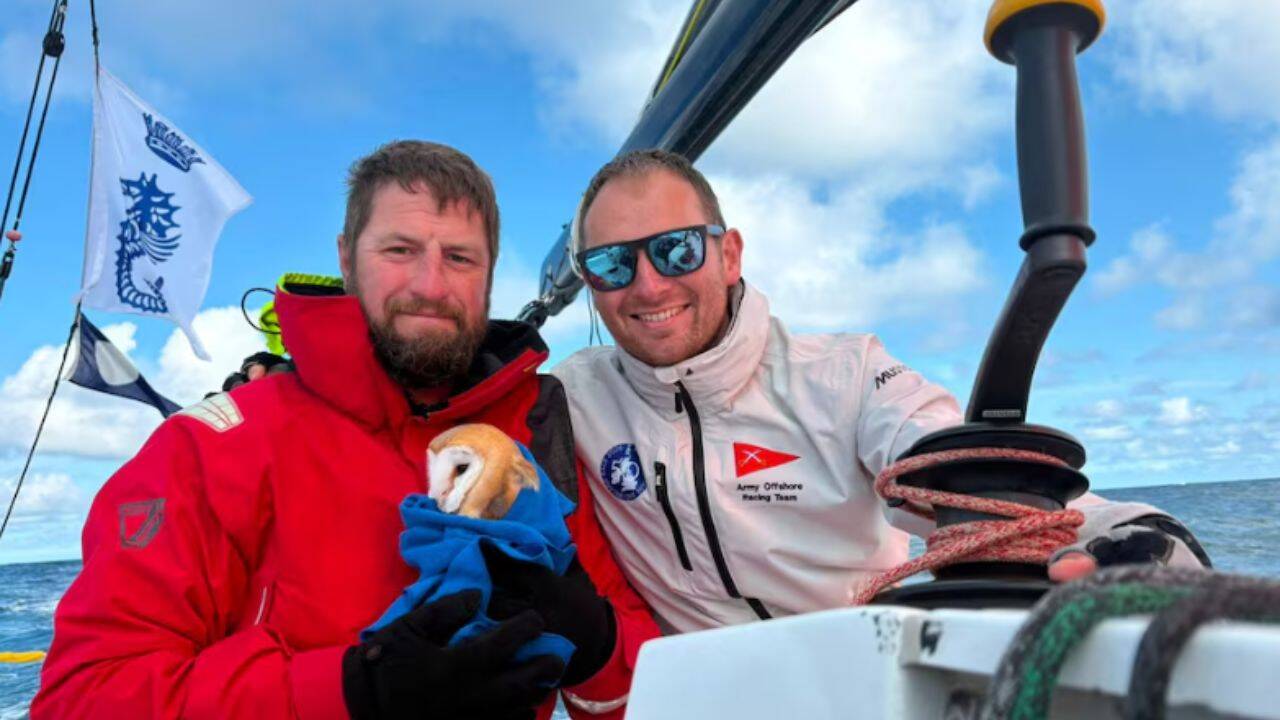
An exhausted barn owl found itself stranded seventy nautical miles off the coast of Newcastle, fighting for survival in the swells of the North Sea before finding refuge aboard a British Army racing yacht.
Most people assume seabirds own the horizon. They do not expect a terrestrial raptor, completely devoid of natural waterproofing, to drop out of a salt-laden sky onto the deck of a military sailing crew competing in the rigorous Round Britain and Ireland Race. Yet that is precisely what happened when the crew of the Sun Fast 3600 Fujitsu British Soldier—campaigning under the Army Sailing Association banner—stumbled upon an anomaly of navigation.
The bird did not merely glide onto the vessel for a casual rest. Witnesses from the 2nd Battalion, The Parachute Regiment, reported watching the animal tumble into the water three separate times, fighting an exhausting upward battle against the heavy wake and its own waterlogged feathers. It attempted to land on a crew member's head, missed, slammed against the mast, and finally collapsed onto the side deck where quick-thinking sailors threw a towel over its trembling frame.
They named her Little Reg, later amended to Little Regina once a veterinary evaluation corrected initial assumptions. But nomenclature aside, the pressing question remains entirely unanswered by standard maritime reporting. How does a creature built exclusively for silent predation over dry fields end up seventy miles deep into a watery void?
The Mechanics of an Impossible Misplacement
Barn owls do not migrate across oceans. Their physiological design is optimized for low-altitude quartering flights over meadows, hedgerows, and farmland, hunting small mammals by sound and low-light vision. They possess zero oil gland output comparable to true seabirds like gulls or petrels, meaning their feathers saturate rapidly when exposed to persistent sea spray or rain.
Wildlife specialists point to a terrifyingly mundane logistical chain for how terrestrial birds cross vast oceanic gaps. A favored theory involves nocturnal roosting aboard commercial or fishing vessels while docked in harbor. If a cargo ship or trawler slips its moorings under the cover of darkness while a nocturnal hunter is sleeping soundly in the rigging, the animal can wake up miles out to sea with no visual reference points for land.
Once airborne over open water, panic sets in. The bird flies until its metabolic reserves hit absolute zero. Without thermals rising off sun-warmed landmasses, maintaining altitude requires relentless, frantic wingbeats. By the time Little Regina spotted the white hull of the Army yacht, she was operating on pure neurological reflex.
The Logistics of a Mid-Ocean Rescue
Racing yachts do not possess brakes. When you are deep into a punishing 1,805-nautical-mile non-stop circuit around the British Isles, stopping for a stray animal violates every tenet of competitive urgency. Yet the military crew adjusted their priorities immediately.
They tucked the bedraggled raptor below deck into a secure container, offering rehydration fluids and shelter while continuing their tactical trajectory toward the finish line in Cowes. What followed was an intricate relay operation spanning multiple independent maritime and wildlife agencies.
Coordinating across hundreds of miles of open water, the Devon-based Barn Owl Trust, Marine and Wildlife Rescue, and the Caister Independent Lifeboat engineered an intercept off the Norfolk coast. The lifeboat crew met the racing yacht at sea, extracted the fragile passenger, and transferred her ashore for a sixty-mile transit to the RSPCA East Winch Wildlife Centre.
Veterinary checks confirmed the harsh reality of her ordeal. The bird was profoundly emaciated, weighing well below normal baseline thresholds, and suffering from extreme dehydration. Yet her defensive instincts remained entirely intact, snapping up rehydration fluids and whole mice with fierce territorial pride as she began the long recovery process behind closed doors.
The Vulnerability Hidden in Plain Sight
Stories of animals saved from impossible odds routinely capture the public imagination because they offer a neat narrative of redemption. A group of tough soldiers pauses a high-stakes race to save a helpless creature. Everyone wins.
Strip away the heartwarming optics, however, and a starker ecological picture emerges. Industrial shipping lanes, expanding coastal light pollution, and shifting weather patterns increasingly disrupt the micro-navigation of localized wildlife. When an apex predator of the agricultural landscape ends up drifting seventy miles off Newcastle, it serves as a bizarre indicator species for how easily natural instincts break down when confronted with human infrastructure and maritime transit corridors.
Little Regina survived because a carbon-fiber hull happened to intersect her final, desperate descent into the grey waves. Millions of other displaced creatures do not find a floating safety net when their internal compasses fail them in the dark.
The yacht crossed the finish line bearing the memory of an unprecedented extra crew member, and the wildlife center continues its quiet work of restoring weight to hollow bones. The ocean remains vast, indifferent, and entirely unsuited for creatures of the earth.


