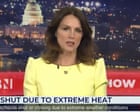
When the thermometer shatters historical ceilings, the immediate instinct of traditional journalism is measurement. Meteorologists track atmospheric pressure; public health officials count excess mortality. But across the studios of Britain's alternative broadcast channels, record-breaking summer heatwaves triggered a very different kind of meteorological response. It was an ideological panic disguised as common sense.
During the searing summer months, anchors and guest commentators on networks like GB News and TalkTV turned their fire away from the rising temperatures and squarely toward the messengers. They dismissed meteorological warnings as psychological operations, mocked public safety alerts as snowflakes panicking over a nice day, and framed basic climate physics as a gateway to communism. If you found value in this article, you should read: this related article.
Behind this on-air defiance lies a deeper institutional anxiety. The modern challenger broadcast model depends entirely on permanent grievance and institutional skepticism. When physical reality—such as a multi-week heatwave resulting in nearly 3,000 excess deaths in England and Wales—collides with a political narrative built on contrarianism, the resulting cognitive dissonance is spectacular to watch.
The Mechanics of Broadcast Contempt
To understand why prime-time hosts responded to extreme weather with open hostility, one must examine the economic engine of anti-establishment television. Outrage is not merely a byproduct of these platforms; it is the currency. Every broadcast cycle requires an enemy. When the enemy happens to be a persistent high-pressure weather system, the standard playbook of cultural warfare breaks down, forcing hosts into absurd rhetorical gymnastics. For another angle on this story, refer to the recent coverage from NPR.
Consider the treatment of numerical data. When early summer heat advisories were published, presenters brushed them aside as trivial inconveniences. One GB News host suggested that people simply drink less rosé, while another downplayed fatalities by comparing them to everyday accidents or arguing that vulnerable victims were close to the end of their natural lives anyway.
This casual dismissal reveals a chilling calculus. When ideological consistency requires denying systemic threats, individual human costs are categorized as statistical noise.
When Weather Maps Become Conspiracies
As the temperatures climbed higher, the commentary shifted from casual minimization into full-scale conspiracy theory. Weather forecasts themselves became targets of state-control paranoia. Traditional meteorological graphics—long standardized to show temperature gradients—were re-imagined by presenters as psychological warfare tools designed to manipulate the public.
One TalkTV host claimed that color thresholds on weather maps had been deliberately altered to manufacture panic, declaring it an explicit psychological operation. Another asserted that maps had turned black to mimic a nuclear holocaust, driven by climate fanatics.
This transition from political disagreement to cartographic paranoia highlights a structural trap. Once a media outlet convinces its audience that mainstream institutions—from weather bureaus to scientific academies—are part of a coordinated deception, every standard public service announcement becomes suspect. A heat health warning cannot simply be an effort to keep elderly citizens hydrated; it must be framed as a precursor to totalitarian lockdowns.
The Cost of Manufactured Denial
The disconnect between studio bravado and epidemiological reality ultimately leaves audiences poorly served. While hosts rail against net-zero policies as socialist control mechanisms, the structural realities of global heating continue to alter the physical environment.
The defense mechanism deployed by these networks is ultimately fragile. Shouting down a thermometer does not lower the mercury. By treating basic atmospheric physics as an optional political opinion, alternative broadcasters have painted themselves into a corner where reality itself is treated as a hostile actor.
The studio lights remain bright, and the rhetoric grows louder with every passing meteorological milestone. But the heat outside refuses to take calls from the production desk.