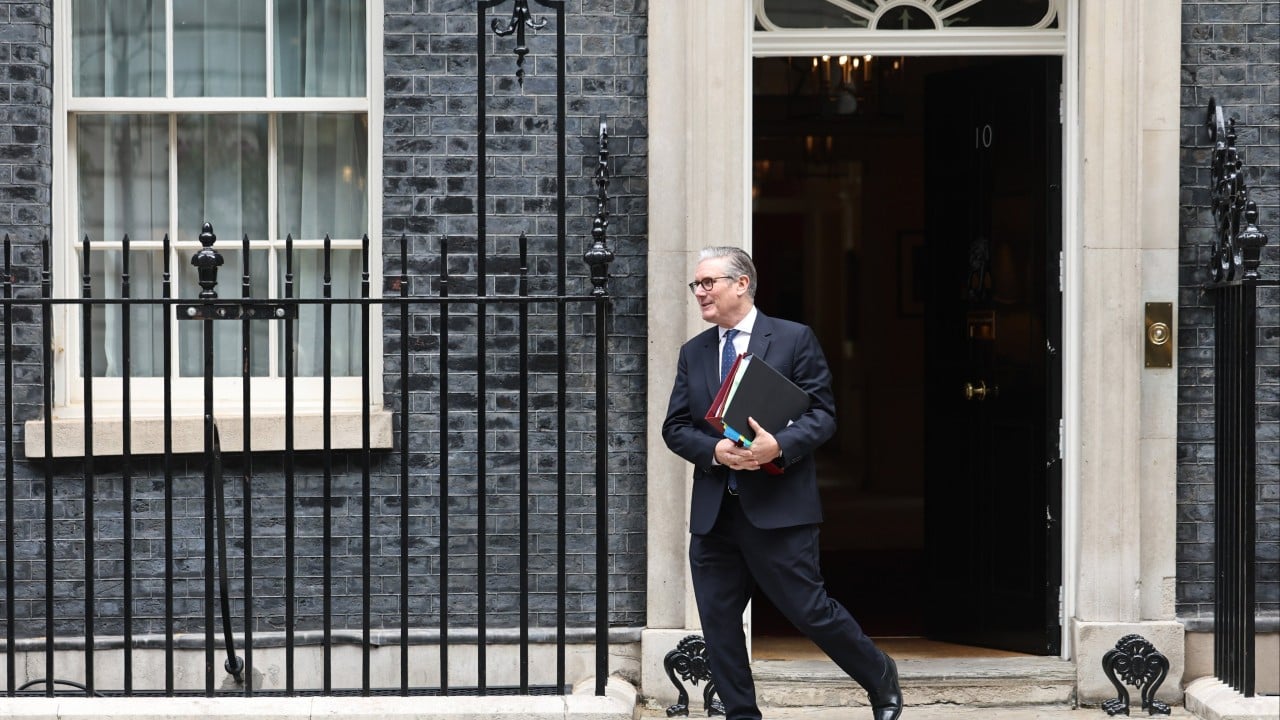
Keir Starmer is facing the most acute political test of his premiership following the abrupt resignation of Defense Secretary John Healey. While the Prime Minister has publicly vowed that he will not walk away or allow his administration to be blown off course, the departure of a foundational cabinet heavyweight exposes deep, structural fractures within the government. This is not a standard mid-term reshuffle or a minor disagreement over policy. It is a fundamental fracture over the funding, direction, and strategic readiness of the nation at a time of heightened global instability.
The official narrative framed the exit as a personal decision. Downing Street operatives worked overtime to brief journalists that Healey’s departure was amicable, a natural moment for a veteran politician to step aside.
That narrative is fiction.
Behind closed doors, a bitter war has been raging between the Ministry of Defence and the Treasury. Healey’s resignation is the direct result of a multi-billion-pound budgetary shortfall that left the defense chief feeling entirely exposed. He refused to preside over a hollowed-out military while the rhetoric from Number 10 continued to promise global leadership. Starmer’s insistence that he will stand firm is an attempt to project strength, but the reality is an administration scrambling to contain a contagion that threatens to infect other major departments.
The Breaking Point at Whitehall
To understand why Healey walked, one has to look at the cold numbers that the Treasury tried to hide behind creative accounting. For months, the government has attempted to balance its ambitious domestic spending commitments against the reality of a shrinking tax base. Defense was viewed by the Chancellor as a piggy bank that could be repeatedly raided.
The breaking point arrived during the finalization of the strategic defense review. Healey demanded a binding commitment to raise defense spending to 2.5% of GDP immediately, pointing to deteriorating security situations in Eastern Europe and the Indo-Pacific. The Treasury countered with a vague promise to reach that target when economic conditions allow.
In politics, "when conditions allow" means never.
Healey recognized that he was being set up to fail. The military is currently facing severe recruitment shortfalls, critical ammunition depletions, and procurement programs that are years behind schedule. By refusing to sign off on a defense review that he believed was fundamentally underfunded, Healey chose to sacrifice his career rather than validate a strategy he knew to be a dangerous bluff.
Starmer now finds himself in a precarious position. By doubling down and stating he will not walk away, he is trying to signal to international allies that British foreign policy remains steady. But foreign allies do not read press releases; they look at capability. The resignation sends a clear signal to NATO that the UK's financial commitments are on shaky ground.
A Pattern of Centralized Control
This crisis highlights a broader problem with Starmer’s management style. Power within the current administration is concentrated within an incredibly tight circle of advisers in Downing Street. Cabinet ministers are increasingly treated as regional managers rather than policymakers, expected to implement directives handed down from the center without complaint or modification.
This centralized grip has created a culture of resentment across Whitehall. Healey, a politician with decades of experience and a deep network of loyalty within the parliamentary party, was one of the few figures willing to push back against the center. His departure removes a vital counterweight to the influence of unelected advisers who view policy primarily through the lens of daily media cycles.
Other senior ministers are watching this development with growing alarm. The Home Office and the Department of Health are facing similar budgetary squeezes, with ministers reportedly being told that their pre-election promises must be scaled back to appease the bond markets. Healey’s resignation provides a blueprint for how other disgruntled cabinet members might choose to exit if they feel they are being pushed too far.
The Treasury vs The World
The conflict between spending departments and the Treasury is as old as Whitehall itself, but the current iteration is exceptionally brutal. The Chancellor is operating under self-imposed fiscal rules that leave almost no room for maneuver.
- Fixed Spending Caps: Strict limits on departmental borrowing that prevent long-term infrastructure investment.
- The Growth Myth: An over-reliance on projected economic growth to fund future public services, ignoring immediate inflationary pressures.
- Efficiency Scrutiny: A demanding oversight regime that treats essential operational readiness as bureaucratic waste.
When these fiscal rules collided with the harsh realities of global defense requirements, something had to give. Healey refused to let it be the safety of the realm.
The Problem With Staying the Course
Starmer’s public response—the defiant assertion that he will press on—is the standard playbook for a leader under siege. It is designed to project stability to the markets and discipline to his backbenchers. However, this stubbornness carries significant political risks.
By refusing to acknowledge the legitimate concerns that drove Healey out, Starmer risks appearing disconnected from the realities facing his own government. The problems plaguing the defense sector will not vanish with a change of personnel. The incoming Defense Secretary will inherit the exact same structural deficits, the same aggressive Treasury targets, and an increasingly skeptical military leadership.
Furthermore, this defiance could alienate the center-right faction of the parliamentary party, which views national security as a non-negotiable priority. If Starmer cannot reassure his MPs that the government remains committed to a strong defense posture, he could face a coordinated backbench rebellion during the upcoming budget votes.
The Illusion of Stability
Governments rarely fall because of a single resignation. They erode. The departure of a figure like Healey acts as an accelerant, shifting the public perception of the administration from one of competent technocracy to one of chaotic firefighting.
The Prime Minister’s allies argue that the public cares little for the internal mechanics of cabinet disputes, focusing instead on tangible outcomes like NHS waiting lists and economic stability. This view is short-sighted. A government that appears incapable of managing its own internal affairs quickly loses the authority required to implement difficult reforms across the wider economy.
The Real Cost of the Funding Gap
To grasp the magnitude of the crisis Healey left behind, consider the state of the armed forces. This is not about abstract geopolitical grandstanding; it is about operational survival. The Royal Navy currently lacks the personnel to man its existing fleet, let alone the new vessels currently under construction. The Army has shrunk to its smallest size since the Napoleonic era, and the Royal Air Force is struggling with a chronic shortage of pilot training slots.
The Treasury’s proposed solution was to rely more heavily on technological innovation and cyber capabilities, arguing that traditional hardware is becoming obsolete. While cyber defense is undeniably critical, it cannot hold territory or deter conventional military aggression. Healey understood that you cannot fight a modern conflict purely with algorithms and press releases.
The hypothetical scenario of a major security crisis occurring while the UK’s armed forces are in this state of transition is what kept senior defense officials awake at night. By walking away, Healey forced this debate into the open, ensuring that the government can no longer hide its lack of investment behind a wall of classification.
The Path to Contagion
The danger for Downing Street is that the defense crisis is a harbinger of what is to come in other sectors. The underlying issue—an insistence on maintaining expansive public services while refusing to fund them adequately—is present in almost every department.
Health and Social Care
The NHS is facing an identical crunch. The Health Secretary has been ordered to deliver major productivity gains before any additional capital funding is released. Just as Healey found in defense, there is a limit to how much efficiency can be squeezed out of a system that is fundamentally broken at the foundational level.
Home Affairs and Policing
The story repeats itself in the Home Office. Commitments to increase neighborhood policing and secure the borders are colliding with the reality of overcrowded prisons and a court system choked by backlogs. Ministers are being asked to deliver safety on a shoestring budget, a formula that inevitably leads to systemic failure.
Managing the Aftermath
Starmer cannot simply appoint a replacement and move on. The structural flaws exposed by this resignation require a fundamental reassessment of how the government operates. If the Prime Minister maintains his current course, treating the resignation as an isolated personnel issue, he will find himself facing a succession of similar crises before the year is out.
The administration needs to recognize that discipline is not a substitute for strategy. Projecting a tough image on evening news broadcasts does nothing to fix the underlying budgetary mismatches that are tearing the cabinet apart at the seams.
The coming weeks will reveal whether Starmer possesses the political flexibility to adapt to this crisis or if he will remain trapped by the rigid structures his team has built around him. The stability of his government depends entirely on his willingness to abandon the script and confront the reality of the mathematical constraints facing the nation.


