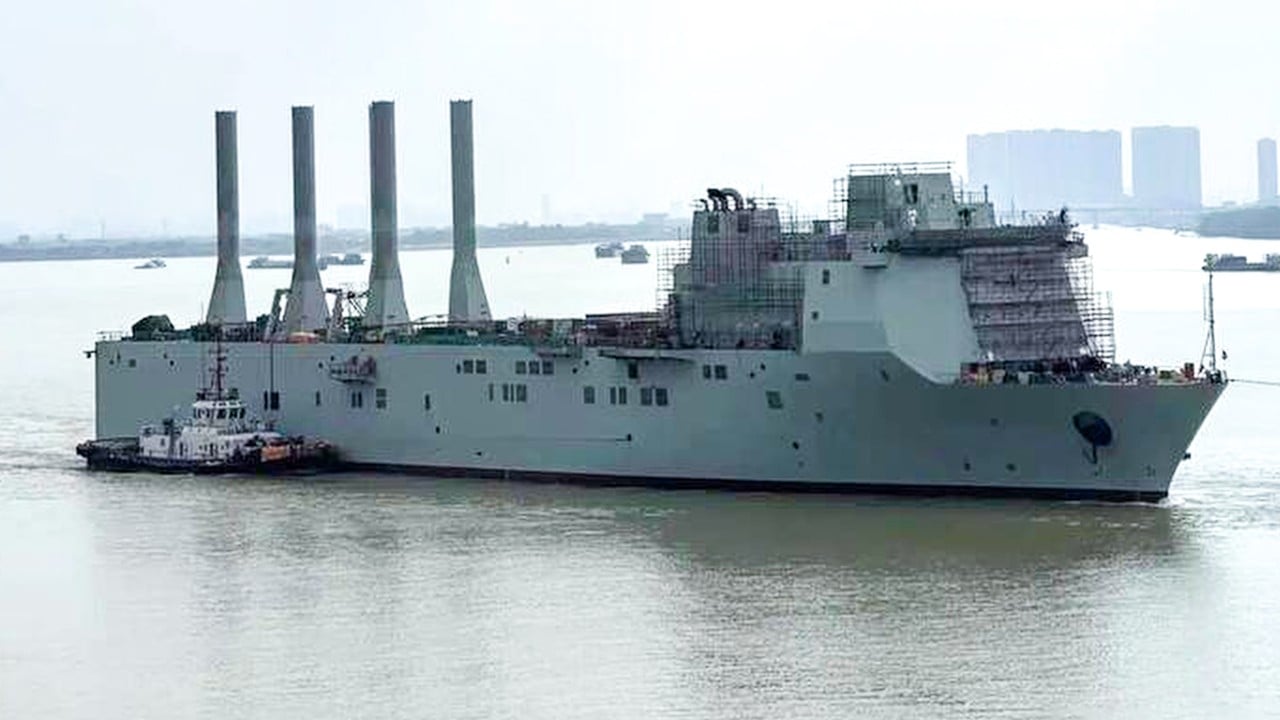
For decades, naval supremacy in the Western Pacific rested on a simple, brutal equation: massive hulls, deep pockets, and thick steel armor. Aircraft carriers and nuclear attack submarines set the tempo of modern maritime strategy. But dockyards in Shanghai are quietly rewriting that arithmetic. Satellite imagery tracking construction at the Hudong-Zhonghua shipyard has laid bare a specialized class of vessel that defies traditional fleet taxonomy. It is neither a standard amphibious landing platform nor a conventional carrier. Instead, it is an industrial-scale mothership engineered to deploy and service extraordinarily large uncrewed underwater vehicles, known as XLUUVs.
This is not a theoretical sketch on a defense contractor's napkin. The People's Liberation Army Navy is actively turning maritime autonomy from a futuristic concept into an immediate operational reality. By marrying large uncrewed submersibles with dedicated surface tender vessels—alongside parallel breakthroughs like electromagnetic catapult trials for aerial drones aboard ships like the Type 076—Beijing is constructing a layered naval architecture designed to bypass traditional Western power projection entirely.
To understand why this shift matters, one must look past the sleek lines of the hulls and examine the geography of the First Island Chain. The waters stretching from Japan down through Taiwan and the Philippines form a natural barrier. For generations, Washington and its regional allies relied on predictable chokepoints—such as the Miyako Strait and the Bashi Channel—to monitor hostile surface and subsurface movements. Acoustic sensors, SOSUS arrays, and dedicated attack submarine patrols created an environment where slipping past the net required immense stealth and high risk.
Extra-large uncrewed underwater vehicles change that math completely. Operating without human crews, these massive autonomous subs can loiter near critical chokepoints indefinitely, mapping ocean floors, tracking adversary movements, and potentially tampering with or neutralizing seabed sensor networks. Yet, uncrewed systems have a fundamental Achilles' heel: transit range and communication bandwidth. An XLUUV traveling thousands of miles under its own battery power burns through energy reserves long before it reaches a contested patrol zone.
Enter the mothership. By utilizing a heavy surface vessel equipped with specialized well-decks, lowering cradles, and vertical jack-up arms, the People's Liberation Army Navy can transport these multi-tonne underwater drones across vast oceanic expanses. Once the tender arrives in a designated operational sector, it can deploy its robotic payload closer to the theater of interest, recover them for maintenance, and relay encrypted commands via satellite links.
The strategic implications for submarine warfare are profound. For years, the United States Navy maintained a decisive qualitative edge in acoustic quieting and sonar technology. American Virginia-class and older Los Angeles-class attack submarines could operate with relative impunity in the Western Pacific, confident in their ability to remain undetected by surface fleets.
However, when an adversary saturates an operating area with scores of autonomous nodes, the ocean becomes structurally more transparent. The protection afforded by vast expanses of deep water begins to erode when uncrewed systems are distributed widely enough to map acoustic profiles from multiple vectors simultaneously. If a mothership can park outside immediate contested zones and seed an area with persistent robotic scouts, the burden of detection shifts dramatically onto the defending force.
Skeptics often point out that administrative size and industrial output do not automatically translate into combat effectiveness. Operating autonomous fleets at sea involves immense engineering hurdles. Saltwater corrosion, biofouling, secure underwater communication bottlenecks, and the sheer computational complexity of managing uncrewed swarms present formidable engineering barriers. Furthermore, a mothership is inherently a high-value, high-signature target. Unlike the quiet drones it carries, a multi-tonne tender can be tracked from space, intercepted by allied reconnaissance, and held at risk by long-range anti-ship missiles.
Yet dismissing these developments as mere parade-ground novelties is a dangerous miscalculation. Western naval planners are grappling with similar capabilities, funding projects like the United States Orca program and Australia's Ghost Shark. The crucial difference lies in the industrial scale of deployment. While Western navies prototype individual systems through protracted procurement cycles, Chinese state-backed shipyards are constructing dedicated infrastructure designed to field these platforms en masse.
The competition for maritime dominance in the twenty-first century will not be decided solely by who builds the biggest aircraft carrier or fields the most nuclear reactors. It will be determined by resilience, adaptability, and the ability to project force below the surface without exposing human sailors to immediate annihilation. As these specialized tenders complete their builder's trials and integrate into active formations, the traditional geometry of Pacific deterrence is quietly dissolving beneath the waves.


