The Iranian rial plunged past the threshold of 2.02 million against the United States dollar on open informal markets, marking a historic nadir for a currency battered by nearly six months of active military conflict, structural isolation, and tightening naval blockades. This freefall coincides with Washington signaling an impending package of severe financial restrictions that United States Treasury Secretary Scott Bessent has characterized as an economic D-Day.
To understand why this specific currency milestone matters, one must look past the noisy headlines of political rhetoric and examine the mechanics of liquidity inside Tehran. The official exchange rate maintained by the Central Bank of Iran sits artificially anchored near 1.5 million rials to the dollar. Yet, that figure is an administrative fiction. Ordinary citizens, importers, and merchants transact within an open market where the real purchasing power of the national currency has evaporated. The gap between official rates and reality measures the true extent of state exhaustion. Meanwhile, you can find other developments here: Why India is Expanding Its Diplomatic Footprint Across Vietnam Laos and Palau.
The Mechanics of the Squeeze
For decades, the standard playbook for managing Iranian economic distress relied on a web of informal regional re-export hubs, primarily located in the United Arab Emirates. Iranian firms utilized these neighboring conduits to launder trade revenue, acquire hard currency, and bypass direct prohibitions.
Recent diplomatic pressure has effectively short-circuited that bypass. The United Arab Emirates announced a total suspension of financial transactions and trade with Iran, a decision arriving on the heels of direct high-level discussions between Washington and Emirati leadership. When a primary financial oxygen line is pinched off overnight, the free-market value of the currency stops being a reflection of market sentiment and becomes an indicator of structural suffocation. To see the complete picture, check out the excellent report by NPR.
Central Bank Governor Abdolnaser Hemmati acknowledged that crude oil exports have virtually halted. Without oil receipts flowing into state coffers, the Central Bank loses the hard currency reserves required to defend its currency or finance critical food and medicine imports.
The Geopolitical Standoff in the Strait
Despite the catastrophic decline of the rial, economic devastation has not immediately translated into the strategic capitulation sought by the White House. Tehran retains a high-stakes counterweight located in the geography of the Persian Gulf.
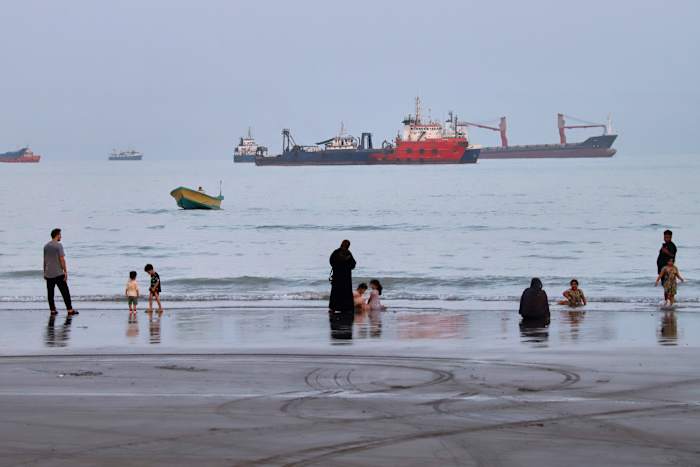
The Strait of Hormuz remains a central pivot of global energy vulnerability. Prior to the outbreak of hostilities in late February, approximately one-fifth of globally traded petroleum traversed this narrow waterway. Current Iranian military positioning and maritime disruptions have brought regular commercial shipping through the corridor to a crawl.
Diplomatic channels are actively grinding against this maritime choke point. Reports indicate that Tehran and Muscat are drafting a joint management framework for the strait, proposing an architecture where inbound traffic utilizes an Iranian-controlled lane while outbound vessels clear through Omani waters. Such a maneuver aims to institutionalize Tehran's toll-gate strategy over global energy transport, directly defying American efforts to enforce total maritime isolation.
Secondary Sanctions and the Risk of Regional Escalation
The upcoming sanctions package promises to expand horizontally by targeting secondary jurisdictions. By penalizing third-party nations and independent corporations that maintain commercial ties with Tehran, the United States Treasury intends to force a stark binary choice upon the international community.
This strategy faces severe diplomatic friction, particularly from major Asian economies that view Western enforcement mechanisms with deep skepticism. Beijing has openly dismissed the efficacy of unilateral American financial pressure, pushing instead for alternative clearing architectures through multilateral bodies like the Shanghai Cooperation Organisation and the BRICS bloc.
Inside Iran, the political establishment has responded to the pressure with explicit retaliation threats. Mohsen Rezaei, secretary of Iran's Supreme National Security Council, stated publicly that any foreign compliance with new American economic restrictions will be treated as a direct act of war.
As the rial trades at historic lows and basic household staples face staggering inflationary spikes—with staple items like rice up significantly and beef prices more than doubling since the conflict began—the domestic burden on the population grows heavier by the day. Yet, the governing apparatus continues to lean into its remaining asymmetric leverage points, ensuring that the financial war inside currency exchanges remains inextricably linked to the physical struggle over the Persian Gulf.