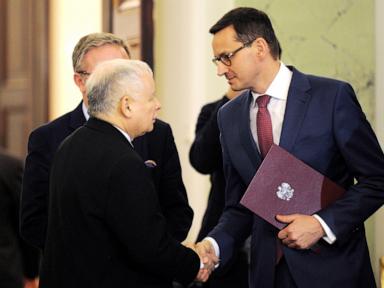
Poland's largest opposition force, the Law and Justice party (PiS), is undergoing a profound structural fracture that threatens to redraw the country's entire political map ahead of the 2027 parliamentary elections. The core driver of this crisis is a bitter internal war over ideological direction and personal survival, pitting party patriarch Jarosław Kaczyński and hardline loyalists against a moderate faction led by former Prime Minister Mateusz Morawiecki. Rather than a simple administrative disagreement, this split exposes a deep operational dilemma facing modern conservative populism: how to balance radical base mobilization with the broad electoral coalitions required to govern. Prime Minister Donald Tusk’s ruling coalition is watching closely, calculating how this right-wing civil war might permanently degrade its primary rival's electoral capacity.
The Mechanics of a Slow-Motion Collapse
To understand why a party that held absolute power for eight years is tearing itself apart, one must examine the mechanics of control at the party's headquarters on Nowogrodzka Street. For decades, Kaczyński maintained ironclad discipline through a combination of ideological purity and patronage distribution. Every factional dispute was mediated by his personal authority.
That authority is no longer absolute.
The 2023 electoral loss, which stripped PiS of its parliamentary majority despite winning a plurality of the vote, triggered an immediate autopsy. Two incompatible diagnostic conclusions emerged from that defeat.
- The Hardline Thesis: Proponents argue that PiS lost because it compromised too much with Brussels and drifted away from its core nationalist-conservative identity. This camp advocates doubling down on identity politics, agrarian protectionism, and aggressive confrontation with the European Union.
- The Technocratic Thesis: Figures aligned with Morawiecki contend that the party exhausted its ceiling by alienating urban professionals and moderate suburbanites. They argue for a pivot toward a wider center-right posture capable of attracting independent voters who recoil from cultural extremism.
When Kaczyński signaled his backing for hardline figures like Przemysław Czarnek to position the party for upcoming electoral battles, the internal friction turned kinetic.
Ideological Purity Versus Electoral Arithmetic
Political parties are coalitions of convenience disguised as brotherhoods. When they are winning, internal contradictions remain buried beneath ministerial cars and budgetary spoils. When they are relegated to the benches of opposition, those contradictions transform into fault lines.
The struggle within PiS highlights a recurring historical pattern among European populist movements. If a party shifts too far to the right to block insurgent nationalists on its flank, it surrenders the vital center. If it moderates to capture the center, it demobilizes the core ideological shock troops who knock on doors and man polling stations.
Morawiecki’s camp attempted to build independent power structures, such as the "Rozwój Plus" initiative, signaling to economic elites and moderate conservatives that an alternative vehicle existed within the broader right-wing ecosystem. In response, party traditionalists viewed these moves not as strategic hedging, but as treason. Expulsions followed, and dozens of parliamentarians cut formal ties with the historic apparatus.
This is not merely a domestic drama for Warsaw insiders. A fractured opposition alters the security and economic posture of Central Europe.
The Broader European Ripple Effect
Poland occupies a linchpin position within the European Union's eastern flank. During the years of PiS governance, Warsaw frequently clashed with Berlin and Brussels over judicial reforms, media laws, and EU budgetary conditionality. A unified nationalist opposition served as a constant counterweight to federalist integration trends within the bloc.
With that opposition now splintering into warring camps, its collective leverage diminishes.
Consider the hypothetical trajectory of a fragmented right wing in a parliamentary system. When a dominant party splits, the total vote share does not automatically translate into efficient seat distribution due to electoral thresholds. If radical populist factions and moderate conservative spin-offs run separate candidate lists, vote-splitting can systematically depress their overall representation in the Sejm.
Tusk’s government understands this mathematical reality intimately. The ruling coalition is carefully calibrating its legislative and judicial policies to encourage further alienation between the opposing wings of the conservative movement. Every public spat over candidate selection or ideological positioning hands ammunition to the center-left establishment.
The Cost of Unyielding Hierarchy
Political institutions built around a single charismatic figure inevitably struggle with succession and adaptation. Kaczyński's leadership style, forged in the dissident movements of the Polish People's Republic and refined through decades of opposition, relies on permanent trench warfare.
Yet the electorate changes faster than party apparatuses. Demographics in Poland's mid-sized cities have shifted. Younger generations, while remaining culturally conservative on specific issues, prioritize economic predictability and European stability over ideological crusades. When a party leadership ignores these underlying tectonic shifts in favor of internal purges, it trades long-term viability for short-term ideological comfort.
The structural damage is already visible in legislative coordination. Key parliamentary votes reveal absentee deputies, parallel voting blocs, and public contradictions among former cabinet ministers. A party that cannot project internal harmony finds it extraordinarily difficult to convince an electorate that it is ready to manage the state apparatus again.
The coming months will test whether the institutional muscle memory of decades of conservative organization can overcome the personal animosities now dictating terms on Nowogrodzka Street. Polarization remains high across Polish society, but the monopoly on that polarization is fracturing. The right-wing landscape is undergoing a violent, irreversible mutation, and the consequences will dictate the balance of power in Central Europe for the next decade.
Poland's opposition PiS splits ahead of crucial 2027 elections
This coverage provides a direct look at the recent leadership expulsions and the broader context of the parliamentary fallout within Poland's largest conservative party.
http://googleusercontent.com/youtube_content/1